Building a House
Evaluating PropertyEssential
Site visit guide
A practical checklist to compare residential projects before paying the booking amount
7 minutes read· Last updated 28 Apr 2026
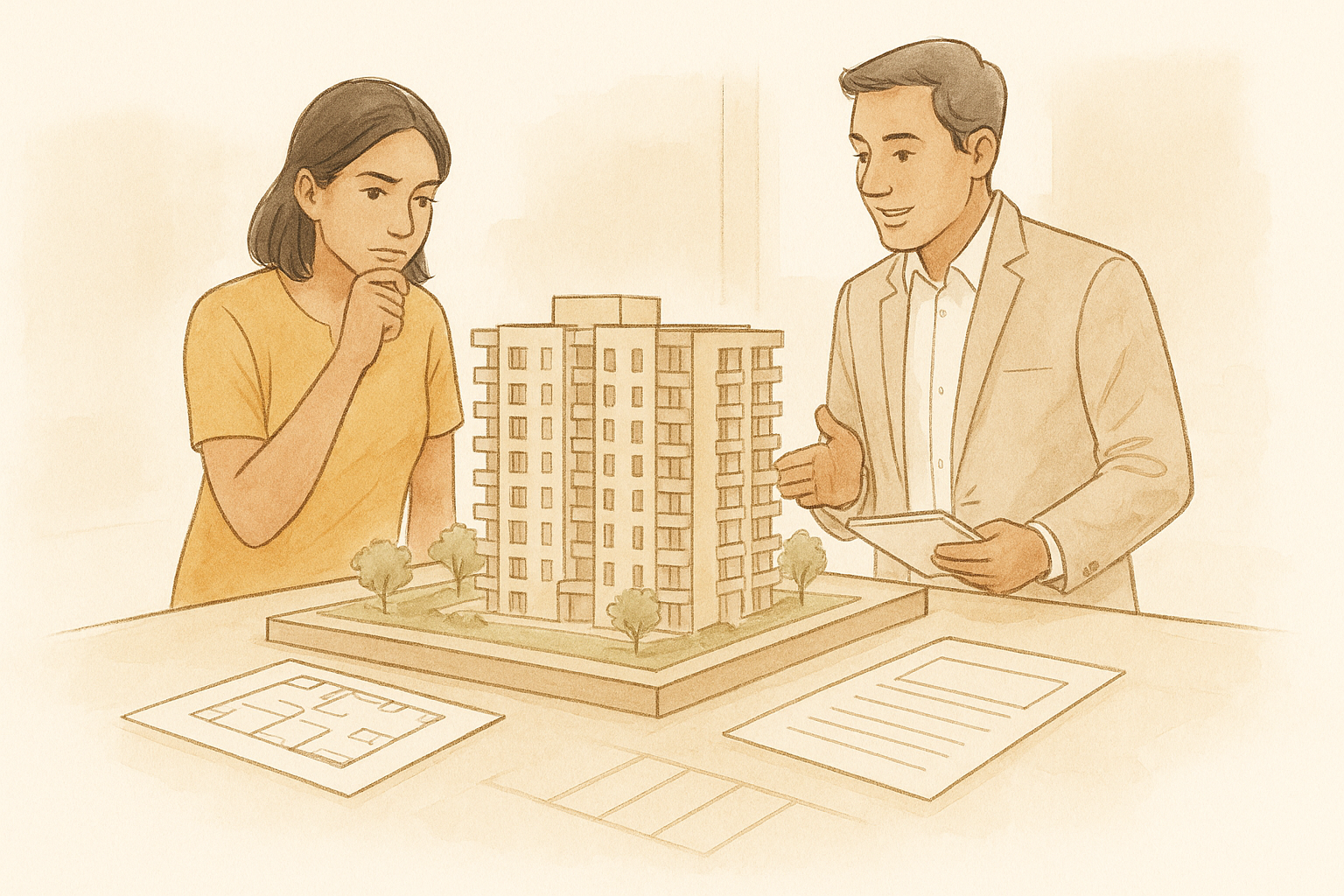
A residential project site visit is not just about seeing the sample flat and listening to the sales pitch. It is your best chance to verify location, layout, builder claims, pricing, payment terms, parking, approvals, and cancellation rules before you commit money.
Many homebuyers in India visit the same project multiple times but still struggle to compare it with another option. The reason is simple: they depend on memory, brochures, and verbal promises. A better approach is to treat every visit like a structured evaluation and capture the same information for every project.
Prepare Before You Reach the Project Site
Go for the site visit with enough time in hand. A rushed visit usually ends with missed questions, unclear pricing, and pressure to pay a token or booking amount. Carry a notepad or use a spreadsheet on your phone so that you can record facts, not impressions.
Before reaching, check the project name, builder name, micro-market, current advertised price, and RERA registration number if available. Also open Google Maps and mark your office, children’s school, nearest metro or railway station, hospital, and main market. This makes the sales discussion more specific.
Use the same format for every project you visit. If you are comparing a 2 BHK in Noida Extension with another in Sector 150, or a flat in Whitefield with one in Sarjapur Road, your notes should make the difference visible.
- Project name and tower visited
- Unit type and carpet area
- Base price and all-inclusive price
- RERA number and promised possession date
- Parking type and cost
- Payment plan and maximum payment timeline
- Offers, freebies, and validity date
Check the Location Beyond the Builder’s Pitch
Location is the first major filter in any apartment buying checklist. Builders often highlight the most attractive landmark: “15 minutes from the airport”, “near expressway”, or “close to upcoming metro”. These points matter only if they improve your daily life or long-term resale value.
Start with social infrastructure. Ask for the names and distances of nearby hospitals, schools, grocery markets, malls, parks, movie theatres, and daily convenience shops. Do not accept only distance in kilometres. In cities like Bengaluru, Mumbai, Pune, Hyderabad, Gurugram, and Chennai, 4 km can mean 10 minutes at one time and 35 minutes at another.
Also check connectivity to your actual workplace or central business district. If you work in Cyber City, BKC, Hinjewadi, Electronic City, Gachibowli, or OMR, calculate peak-hour travel time. Airport proximity is useful, but office commute, school travel, and daily shopping will affect your lifestyle more.
- How much time does it take to reach your office during peak hours?
- Which roads get waterlogged during monsoon?
- Is the approach road fully developed or still temporary?
- Where is the nearest operational metro, railway station, or bus hub?
- Are schools, hospitals, and markets already functional or only proposed?
- What is the neighbourhood profile: premium housing, mixed-use, industrial, village extension, or developing sector?
Neighbourhood quality matters because it shapes future shops, safety, traffic, rental demand, and lifestyle. A project next to warehouses, vacant land, or narrow village roads may still appreciate, but the living experience can be different from the brochure. Visit the area once in the evening and, if possible, once during rain or peak traffic.
Evaluate the Project Layout, Density, Amenities, and Builder Track Record
At the project level, do not get distracted only by the clubhouse, swimming pool, gym, and landscaped images. In the same price category, most large gated communities offer similar amenities. What matters more is whether those amenities are usable for the number of residents and whether the project layout supports comfortable living.
Ask about project density: how many apartments are planned per acre. Lower density usually means more open space, less crowding, and better movement, but it can also mean higher maintenance per household. Also ask how many units are on each floor. More flats per floor may create crowded corridors, longer lift waiting time, and less privacy.
Car-free zones are useful for families with children and senior citizens. Also check whether amenities are only in one central clubhouse or whether each tower has basic facilities nearby. In very large projects, a single central amenity area can become inconvenient for residents living in far-end towers.
- How many acres is the total project?
- How many total apartments are planned?
- How many units are there per floor?
- How many lifts serve each tower and how many flats share those lifts?
- Are internal roads car-free in any zone?
- Are all amenities delivered in phase one or spread across later phases?
- What will be the maintenance model after handover?
Builder credentials are equally important. Ask how many projects the builder has delivered and how many are currently under construction. Later, cross-check this online through the builder’s website, RERA portal, Google reviews, resident forums, consumer complaint platforms, and news search. Search for delay complaints, legal cases, quality issues, and maintenance disputes.
Verify RERA Details, Approvals, and Parking Clearly
Every registered real estate project in India should have RERA details available on the state RERA website. Ask the relationship manager for the RERA registration number and check it yourself. Look at the approved plans, registered carpet area, project completion date, promoter details, and whether the phase you are considering is the same one being sold.
Compare what the sales team says with what is available on RERA. If the RM says possession is expected in December 2027 but RERA shows a later date, clarify why. For homebuyers, the RERA date is important because it is the legally declared timeline, not the optimistic sales estimate.
Parking must be discussed in detail. Many buyers assume parking is included, but some projects charge separately or provide limited options. Ask whether the parking is open, covered, stilt, basement, mechanical, podium, or in a separate parking tower. Also confirm whether it is allotted, exclusive, bundled, or available at additional cost.
- Is one car parking included in the price?
- What is the exact parking type?
- Is the parking slot size suitable for SUVs?
- What is the height clearance in basement or mechanical parking?
- Can a second parking slot be purchased later?
- Is visitor parking available?
- Will the parking allotment be mentioned in writing?
Parking size is not a small detail. In many Indian cities, larger cars such as SUVs and MPVs are common. If the slot is too short, narrow, or has low height clearance, daily use becomes frustrating. Mechanical parking may save space, but some buyers dislike waiting time and maintenance dependence.
Study the Unit Layout and Sample Flat Carefully
The sample flat is designed to create desire, not to show every limitation. It may be made for the largest unit size, have better lighting, thinner furniture, no grills, no bulky storage, and premium interiors that are not part of standard delivery. Always compare the sample flat with the actual unit layout you are considering.
The first decision point is the layout. Check room sizes, passage waste, kitchen placement, balcony usability, bathroom ventilation, and furniture movement. If the layout does not work for your family, do not continue only because the project looks attractive. A poor layout is difficult to fix after possession.
Also understand the difference between carpet area, balcony area, utility area, and niches. Under RERA, certain wall niches can be counted in carpet area, so confirm how the builder has calculated the usable space. A wardrobe niche may look useful, but it can also change how the bedroom functions.
- Is the sample flat the same size as your shortlisted unit?
- What is the exact carpet area as per RERA?
- Are balconies, utilities, and niches shown separately?
- Is there cross ventilation through windows or balcony openings?
- Will sunlight be blocked by another tower?
- What is the distance between facing towers?
- Are there fixed RCC walls that cannot be modified?
- Are internal walls brick, block, gypsum, or RCC?
- Is there extra storage space such as overhead storage or utility shelves?
- Does the unit direction suit your vastu preference, if relevant?
Cross ventilation and natural light are often more important than glossy finishes. Ideally, the flat should have openings in different directions or at least enough airflow through windows and balcony. Ask whether the selected unit faces another tower, podium, open land, road, garden, or service area.
Finishes also matter, but do not get lost in technical terms unless you understand them. Ask what will actually be delivered: flooring, bathroom fittings, kitchen platform, windows, wall finish, electrical points, doors, and paint. Then compare this with the brochure and agreement specifications.
Compare Price, Offers, and All-Inclusive Cost
Builders usually start the price discussion with the base per sq ft rate. This can be misleading because the final amount includes many additional charges. For a proper residential project site visit checklist India buyers should always compare the all-inclusive price, not only the base rate.
Ask for a complete cost sheet. It should show base price, floor rise, preferred location charges, clubhouse charges, parking charges, maintenance deposit, advance maintenance, corpus fund, legal charges, electricity and water connection charges, GST if applicable, stamp duty, registration, possession charges, and any other development charges.
Preferred location charges can change the final cost significantly. A garden-facing unit, higher floor, corner unit, pool-facing flat, or better tower may carry extra charges. A project with a lower base rate can become more expensive than a competing project once these charges are added.
- What is the base per sq ft rate?
- What was the launch base price?
- What are the PLC charges for this exact unit?
- What are the floor rise charges?
- What is the total parking cost?
- What are club, maintenance, legal, and possession charges?
- What is the final all-inclusive cost excluding registration?
- What will be the stamp duty and registration cost in that state?
- What is the monthly maintenance per sq ft?
- Are GST and other taxes included or extra?
Offers also need careful evaluation. Builders may offer modular kitchen, wardrobes, air conditioners, gold vouchers, registration waivers, or limited-period discounts. Convert every offer into a practical market value. If a modular kitchen is “worth ₹5 lakh” according to the builder, check what a similar kitchen would cost outside.
Monthly maintenance is a long-term cost. A difference of ₹1 or ₹2 per sq ft per month may look small, but over 10 years it becomes significant. For a 1,200 sq ft apartment, even ₹2 extra per sq ft means ₹2,400 per month and ₹2.88 lakh over 10 years, before future increases.
Understand Payment Plans, Loan Approval, and Booking Safeguards
Payment plans can change the real cost of the property. Common options include construction-linked plans, down payment plans, 20:80 plans, 25:25:25:25 plans, and subvention-style offers. A “buy now, pay later” plan may sound attractive, but it can involve higher pricing, pre-EMI interest, or strict conditions.
Ask when the maximum payment is due and when possession is expected. In many construction-linked plans, 70% to 80% of payment may be demanded by structure completion. After that, interiors, services, approvals, and handover may still take one to two years. During this period, you may be paying heavy pre-EMI interest to the bank without receiving possession.
Loan approval should be verified independently. Builders often say the project is approved by leading banks, but you should ask for the bank APF number or project approval reference. If you are serious about booking, call the bank or your loan manager and confirm whether the project and phase are approved for home loans.
- Take the RERA number and verify the project on the state RERA portal
- Ask for the complete cost sheet with all charges
- Get the payment plan in writing
- Confirm bank APF number with the lender
- Ask for the cancellation policy before paying booking amount
- Get all offers and freebies written on email
- Mark the sales manager or senior team in important email confirmations
- Do not pay token money only because an offer is “ending today”
Cancellation policy is critical. Ask how long you can cancel, what amount will be deducted, whether GST or administrative charges will be refunded, and when the refund will be processed. Once booking money is paid, disputes over cancellation and refund can become stressful.
Finally, put everything in writing. If the RM promises a discount, free ACs, modular kitchen, parking inclusion, maintenance waiver, or flexible payment date, ask for an email. If they avoid writing it, send your own summary email and copy the senior sales person. This creates a record and reduces the risk of later denial.