Building a House
Evaluating PropertyEssential
Builder Verification Guide
A practical India-focused checklist to reduce risk before buying a flat or apartment
7 minutes read· Last updated 28 Apr 2026
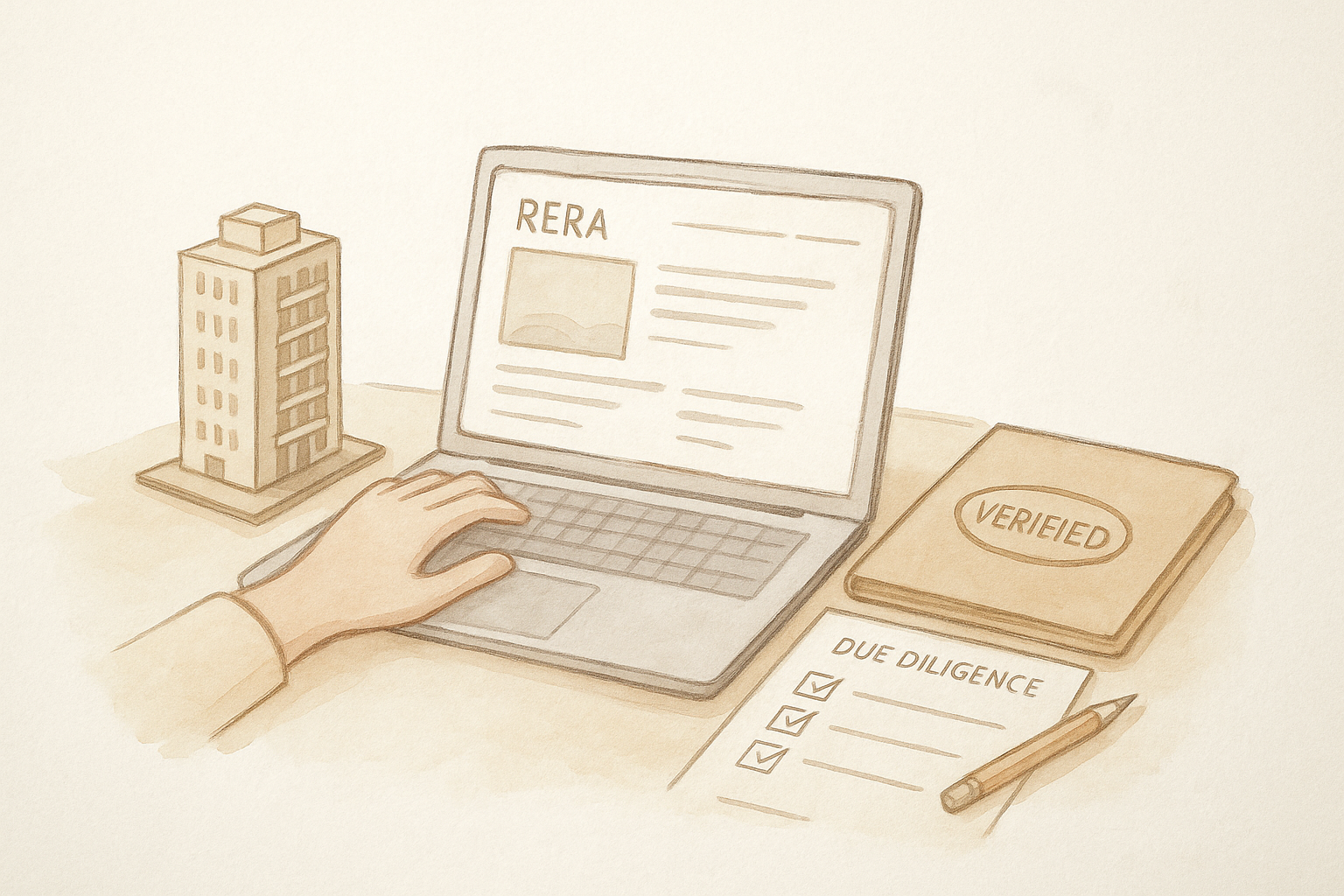
Buying a home in India is not only about carpet area, location, amenities, and price. The builder’s credibility can decide whether you get possession on time, whether the promised clubhouse is actually built, whether maintenance is manageable, and whether your registration happens without last-minute surprises.
Many buyers stop their due diligence once they see a RERA registration number. RERA is important, but it is not a full safety guarantee. A project can be RERA registered and still face delays, quality issues, funding problems, complaints, or disputes with authorities. Before paying a booking amount, you need a structured way to verify the builder.
This guide explains how to check a builder’s background in India using public information, site visits, RERA data, buyer feedback, legal checks, and financial signals.
Why RERA Approval Is Important but Not Enough
RERA was created to bring transparency and accountability to the real estate sector. It helps buyers access basic project details, approved plans, completion timelines, promoter information, quarterly updates, and complaint mechanisms. In states like Maharashtra, Uttar Pradesh, Haryana, Karnataka, Telangana, and Gujarat, RERA portals are often the first place buyers should check.
However, RERA registration does not mean the project is risk-free. It mainly confirms that the project has been registered with the regulator and that certain disclosures have been filed. It does not automatically guarantee construction quality, ethical sales practices, smooth maintenance, or zero delay.
If a dispute arises, RERA can help, but the process may take time. Orders, hearings, appeals, and enforcement can stretch longer than a buyer expects. That is why builder verification should happen before you commit money, not after the project gets stuck.
A safer approach is to treat RERA as the starting point of due diligence, not the final certificate of trust. Your goal is to understand whether the builder has the capacity, intent, and track record to complete the project as promised.
Check the Builder’s Identity, Founders, and Group Background
A credible real estate company usually explains its history clearly. Its website, brochures, annual reports, and media profiles often mention the founders, leadership team, years in business, completed projects, awards, partnerships, and major milestones. Good companies usually want buyers to know their journey.
If a builder shares very little about its promoters, directors, or group companies, treat it as a signal for deeper research. Search the names of founders and directors on LinkedIn, MCA records, news articles, company websites, and industry reports. Look for their past experience, earlier ventures, failed businesses, and association with other real estate entities.
Also check whether real estate is the company’s core business or an expansion vertical. Some Indian groups entered real estate from strong parent businesses, such as consumer goods, infrastructure, engineering, or finance. For such groups, brand reputation may be a serious asset. Others are pure real estate developers with decades of project delivery experience. Both models can work, but you must understand the builder’s main business DNA.
Use this quick identity checklist before shortlisting a project:
- Builder website clearly mentions promoters, directors, and leadership team
- Company history and completed projects are visible
- Group companies are traceable and active
- Founders or directors have a clean public profile
- Brand has a consistent presence across cities or micro-markets
- Contact details, registered office, and corporate information match public records
If you find multiple companies with similar names, frequent name changes, unclear ownership, or disconnected project entities, slow down. Many projects are built through special purpose vehicles, which is common in real estate, but the parentage and responsibility should still be clear.
Evaluate Project Track Record and Delivery Capacity
A builder’s past performance is one of the strongest indicators of future risk. Start by checking how many projects the company has delivered, how many are under construction, how many are newly launched, and how many are planned on future land banks. This shows whether the builder is growing responsibly or stretching itself too thin.
The ratio between delivered and under-construction projects matters. For example, if a new builder has delivered only one small project but has launched four large under-construction townships, the risk is higher. On the other hand, a company with several completed projects across Mumbai, Pune, Bengaluru, NCR, Hyderabad, or Chennai may have stronger systems, vendor networks, and execution experience.
Also check the age of the company in real estate. A builder with 15–25 years of delivery history has passed through multiple market cycles, including demonetisation, GST implementation, NBFC liquidity stress, COVID-19, and interest rate fluctuations. Survival through difficult cycles is not a guarantee, but it adds useful context.
When evaluating delivery capacity, ask these questions:
- How many projects has the builder completed in the last 10 years?
- Were earlier projects delivered close to the promised date?
- How many current projects are in early construction stages?
- Is the builder launching aggressively in multiple cities at once?
- Does the builder own the land, or is it a joint development project?
- Are contractors, architects, and construction partners reputed?
- Does the builder have enough sales momentum in the current project?
A project typically takes around four years to complete, depending on size, approvals, towers, basements, and local conditions. A five-year timeline may still be reasonable for large developments. But if multiple older projects took seven, eight, or ten years, investigate why.
Search Legal Cases, RERA Orders, and Buyer Complaints
Legal cases do not automatically mean a builder is bad. Large developers often have some disputes because of the scale of their operations. The real question is the type of case, frequency of complaints, seriousness of allegations, and whether the same issue keeps repeating.
Start with RERA complaint orders on the state RERA portal. Then search consumer commission cases, NCLT insolvency matters, High Court orders, local development authority disputes, and news reports. Also check whether the company or promoter names appear in matters related to land dues, tax issues, money laundering, delayed refunds, or unpaid contractors.
Legal issues usually fall into three broad categories:
- Financial disputes, such as unpaid landowners, lender defaults, tax issues, or insolvency proceedings.
- Authority-related disputes, such as unpaid external development charges, licence conditions, occupation certificate problems, or layout approval conflicts.
- Buyer disputes, such as possession delay, refund denial, wrong commitments, area mismatch, or maintenance issues.
Financial disputes can be particularly risky because they may affect cash flow and construction progress. Authority-related disputes can delay occupation certificate, completion certificate, registry, utility connections, and handover. Buyer disputes reveal how the developer behaves after receiving money.
Buyer complaints also need pattern analysis. Do not panic because of one angry review. Instead, look for repeated complaints across different projects. Common red flags include poor construction quality, seepage, non-functional lifts, delayed clubhouse, high maintenance charges, unfulfilled sales promises, refund harassment, and sudden layout changes.
Check complaints from multiple sources, including Google reviews, resident welfare association posts, social media groups, RERA orders, property forums, and local broker feedback. Give more weight to detailed complaints with dates, project names, photos, documents, or order copies.
Read Marketing, Discounts, and Financial Signals Carefully
A builder’s marketing style can reveal pressure points. Strong brands may offer limited festive schemes, bank subvention plans, or small launch benefits. But unusually heavy discounts, guaranteed returns, no-EMI promises, free cars, gold offers, or urgent “today only” pricing should be examined carefully.
Developers usually give aggressive offers for two reasons. Either they are not confident about demand for the product, or they need fast cash flow. In both cases, the buyer must ask why the project needs such strong incentives. In hot micro-markets like Whitefield, Wakad, Dwarka Expressway, Thane, Noida Extension, or Gachibowli, good inventory usually does not need extreme discounting unless there is a hidden concern.
Financial checks can help, especially for larger purchases. If the company is listed, read annual reports, investor presentations, debt levels, sales bookings, cash flow, and project pipeline. For private limited companies, MCA filings and paid company-data platforms may provide balance sheets and director information. However, financial statements can be difficult to interpret without accounting knowledge.
Focus on practical financial indicators that affect buyers. Is construction moving steadily? Are vendors active on site? Are banks funding the project? Are reputed lenders approving home loans after legal and technical checks? Are sales strong enough to support cash flow? These signals matter more to a homebuyer than complex accounting ratios.
You can also ask the sales team for the project’s bank approvals. If major banks or housing finance companies have approved the project, it means they have done some legal and technical review. Still, bank approval is not a full guarantee. Banks protect their lending risk; they do not verify every promise made to buyers.
Verify RERA Details, Approvals, and Project Commitments
Once you have the project name and RERA number, visit the relevant state RERA website and search the project directly. Do not rely only on screenshots shared by the broker. Check whether the project name, promoter name, address, phase, land area, sanctioned buildings, and completion date match what is being sold to you.
Pay close attention to the RERA completion date. Sales teams often mention an internal target date that is earlier than the RERA date. For planning your finances, rent, school admissions, and moving timeline, consider the RERA completion date as the more reliable reference. If possession comes earlier, that is a bonus.
Also compare the master plan shown in brochures with the plan uploaded on RERA. Check the number of towers, floors, amenities, open spaces, parking structure, phase boundaries, and common facilities. In large townships, the amenity you are excited about may belong to a later phase, not your immediate phase.
Before paying, verify these project documents wherever applicable:
- RERA registration number and project page
- Land title or development agreement summary
- Sanctioned building plan
- Commencement certificate or building permit
- Environmental clearance for large projects
- Fire approval where applicable
- Draft agreement for sale
- Carpet area as per RERA, not just super built-up area
- Payment schedule linked to construction milestones
- Possession date, grace period, delay compensation, and cancellation terms
The agreement for sale is especially important. Many disputes arise because buyers rely on verbal promises, sample flat features, or brochure claims that are not written into the agreement. If the sales team promises modular kitchen, premium fittings, reserved parking, club access, or maintenance benefits, ask where it is written.
Visit Delivered Projects and Reduce Your Buying Risk
The most practical builder verification method is visiting completed projects. Choose two or three older projects by the same developer, preferably in the same city or region. A builder may perform differently across markets, but local delivery history is still valuable.
Speak to residents, tenants, facility managers, and nearby brokers. Ask about construction quality, seepage, lift performance, basement leakage, parking allocation, maintenance charges, society handover, water supply, power backup, security, and whether promised amenities were delivered. Residents are often more honest than sales teams because they live with the outcome every day.
During your visit, observe the condition of common areas. Look at lobby maintenance, cracks, exterior paint, landscaping, clubhouse usage, STP functioning, waste management, and basement ventilation. A project that looks tired within a few years may indicate weak materials, poor maintenance planning, or unrealistic promises made during launch.
If you want to reduce risk further, prefer a ready-to-move home where possible. It removes the biggest uncertainty: possession delay. You can inspect the actual flat, check the society, confirm occupancy certificate, understand maintenance cost, and speak to existing residents before paying.
If you must buy under construction, choose a builder with either a strong real estate delivery record or a parent brand that is highly reputation-conscious. Large Indian names such as DLF, Lodha, Prestige, Sobha, Godrej Properties, Tata Realty, Shapoorji Pallonji, Birla Estates, and similar established groups may still have complaints, but their scale and brand visibility can reduce certain risks compared with unknown developers.
No method is foolproof. Even reputed builders can face litigation, funding stress, approval delays, contractor issues, or buyer complaints. The purpose of due diligence is not to find a perfect builder; it is to avoid obvious red flags and make a more informed decision.