Building a House
VastuEssential
Water Tank Placement as per Vastu
A practical guide to placing underground, overhead, and ground-level water tanks without creating avoidable layout defects.
11 min read· Last updated 12 Apr 2026
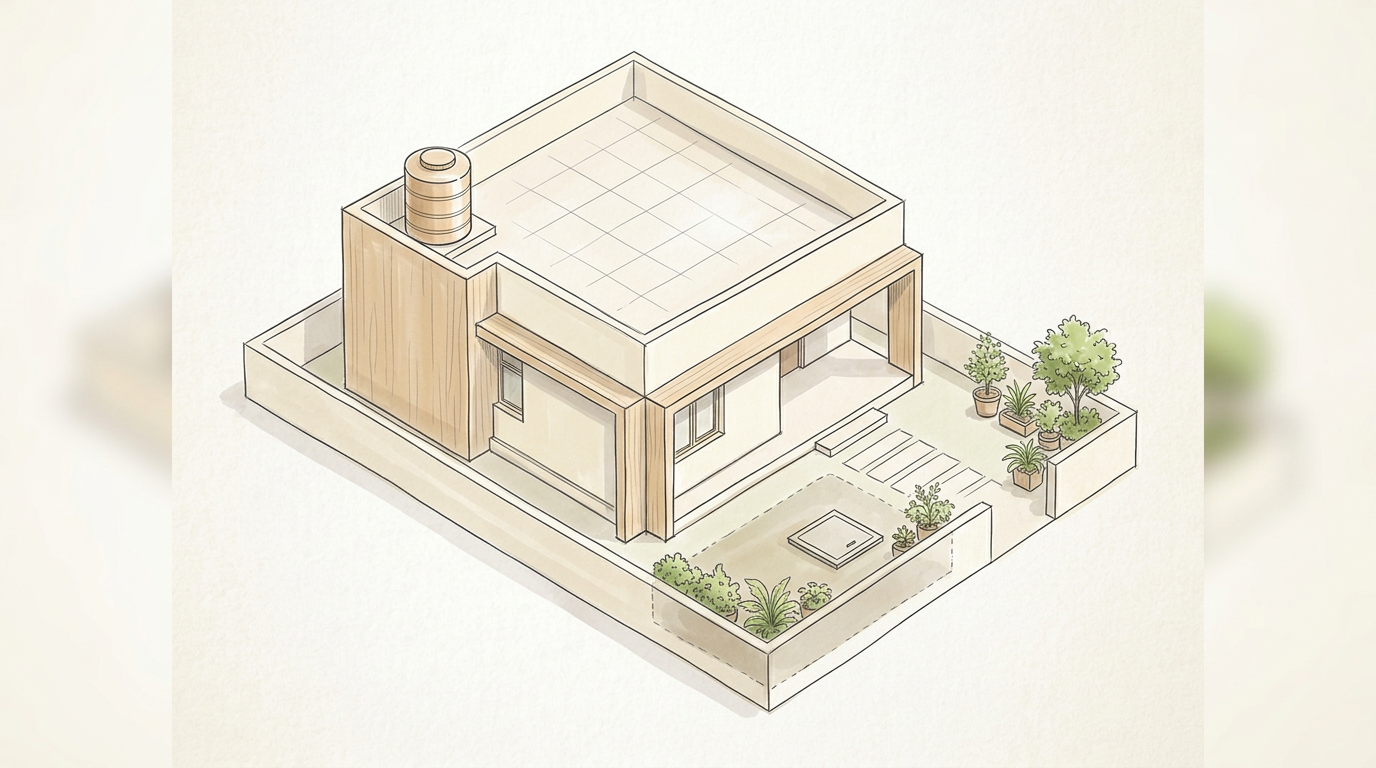
Water storage is one of the most practical parts of home planning, but it is also one of the easiest places to make a Vastu mistake. Many homeowners know that water is linked with the northeast, then assume every type of water tank should go there. That shortcut creates problems because Vastu does not treat all water tanks the same way.
The key difference is simple. An underground tank is a water cavity below ground level, while an overhead or ground-level tank creates visible weight and heaviness in the direction where it is placed. That is why the recommended direction changes depending on the tank type, even though all of them are used to store water.
For Indian homes, this matters most during construction, redevelopment, or plot planning. Whether you are finalising a bungalow in Ahmedabad, checking a duplex layout in Lucknow, or reviewing a builder floor plan in Gurugram, tank placement should be checked before plumbing and civil work are locked.
Why different water tanks follow different Vastu rules
One of the biggest misconceptions is that the Northeast works for every water storage system because it is associated with the water element. In Vastu, that logic applies best to an underground water tank, especially when it is placed in the lighter, open part of the site. It does not automatically apply to overhead or ground-level tanks.
An overhead or ground-level water tank adds weight to a direction. Vastu generally prefers the Northeast to remain open, light, and unobstructed. So even though it is linked with water, placing a heavy tank there can disturb the balance of that zone. This is why many homes end up with mixed advice until the tank type is clearly separated first.
The practical lesson is straightforward: before judging any tank position, first identify whether it is underground, at ground level, or overhead. In Indian construction sites, these three are often discussed together by plumbers and contractors, but from a Vastu perspective they need separate decisions.
Best direction for an underground water tank
For an underground water tank, the recommended placement is in the North of Northeast or East of Northeast. These sub-zones are treated as the better positions because they align with the lighter water-related side of the property without disturbing the central or diagonal energy line. In practical terms, this is why many Vastu-based site plans keep the underground tank in the front-side northeast portion of the plot, but not exactly at a random corner.
Traditional guidance also says the underground tank should remain outside the built house area, on the plot rather than within the main enclosed structure. It should not be attached tightly to the compound wall, and some clearance is preferred. This matters in compact plots in cities like Jaipur, Indore, and Hyderabad, where owners often push tanks right against the boundary to save space.
There is also a commonly repeated caution about the NE-SW axis. The underground tank should not fall directly on that line. If you are working with an architect, ask for the plot to be marked into directional bands before excavation starts. That is much safer than adjusting after RCC work and pipeline routing are already complete.
Best direction for overhead and ground-level tanks
For overhead and ground-level water tanks, the preferred direction shifts to the West. West of Southwest is also treated as acceptable in many traditional explanations. The reason is not that these zones are associated with water in the same way as the northeast, but that they can handle the heaviness created by a tank better than the lighter north and east sides.
This distinction is important in modern homes where the tank may sit on the terrace slab or on a raised platform at site level. Once a tank is elevated or built above ground, it no longer behaves like a light underground water source. It becomes a load-bearing mass. That is why placing it in the Northeast is usually discouraged even though many people assume it should be ideal there.
For terrace planning in cities like Pune, Bengaluru, and Noida, this usually means coordinating the tank position with the staircase headroom, solar system, and service shaft without forcing the tank into the northeast corner. A Vastu-friendly placement should also still make engineering sense for pipe runs, maintenance access, and slab load management.
Common placement mistakes that create Vastu defects
The most common mistake is putting the wrong tank in the wrong direction because of convenience. An underground water tank in the Southwest is considered especially weak and is often linked with financial instability. In the Southeast, it is associated with stress affecting women’s health, relationships, and in some interpretations, difficulties related to conception. In the Northwest, it is linked with family disharmony, legal trouble, or police-related issues.
For overhead and ground-level tanks, the mistakes are different. If these tanks sit in the North, Northeast, or East, they create unwanted heaviness in zones that are ideally lighter. In the Southeast, they are associated with fire-related imbalance, tension in married life, and conception-related difficulties. In the South or Southwest, they are often linked with instability. A tank in the Brahmasthan, whether overhead or ground-level, is treated as a major defect because the centre is not supposed to carry this kind of obstruction.
Some mistakes are practical as well as symbolic. An overhead tank directly above a bedroom is generally avoided because the weight above the room is believed to create stress, poor sleep, and health discomfort. An overhead tank above the kitchen is also discouraged because it places water over the fire zone. Even people who do not follow Vastu strictly often prefer to avoid these placements for comfort and maintenance reasons.
Remedies if the water tank is already in the wrong place
The strongest recommendation for both categories is the same: if shifting is possible, relocation is the best solution. For an underground tank, moving it to North of Northeast or East of Northeast is treated as the proper correction. For an overhead or ground-level tank, moving it to the West or West of Southwest is considered the best fix. If the tank is in the Northeast or in the Brahmasthan, relocation becomes even more important.
If shifting is not immediately possible, the remedies are treated as partial support rather than full correction. For an underground tank, one traditional remedy is to install a copper or silver wire in a crescent shape around the tank from inside the ground. For overhead and ground-level tanks placed wrongly in other directions, one suggested approach is to create extra heaviness in the Southwest using heavy furniture, construction mass, or trees so that the balance of the property improves to some extent.
These measures should be seen honestly. They may reduce the impact, but they are not equal to correct planning. If you are renovating an old independent house in Nagpur or rebuilding a family home in Surat, it is better to plan a structural correction when civil work is already open rather than depend forever on temporary remedies.
Practical installation tips for Indian homes
Beyond direction, water tank condition also matters. An overhead or ground-level tank should be properly covered, should not leak, and should be cleaned regularly. Vastu guidance also prefers such tanks to be kept on a slab about 1.5 to 2 feet above ground level rather than placed carelessly on the surface. If possible, some traditional guidance suggests avoiding plastic tanks, though in practice many Indian homes use them because of cost and availability.
These small details matter during approvals and handover too. In plotted developments and villas, the builder may provide a standard terrace location without fully checking bedroom and kitchen positions below. In independent construction, local contractors may prioritise plumbing convenience over directional planning. In both cases, the owner should verify the final tank spot on the drawing and again on site before installation.
Use this quick checklist when reviewing your layout:
- Identify whether the tank is
underground,ground-level, oroverhead. - Keep the underground tank in
North of NortheastorEast of Northeast. - Keep overhead and ground-level tanks in the
WestorWest of Southwest. - Avoid placing any tank in the
Brahmasthan. - Avoid an overhead tank directly above the bedroom or kitchen.
- Keep some distance between an underground tank and the compound wall.
- Make sure the tank is covered, clean, and free from leakage.
When you review a property in cities like Chennai, Bhopal, or Kochi, ask for both the architectural plan and the plumbing layout if possible. Water tank mistakes are often invisible in marketing brochures because the tank sits on the terrace, underground, or outside the main room layout. A quick directional check at this stage can prevent an expensive correction later.