Building a House
VastuEssential
Locker & Wealth Vastu
Place your locker or cash box correctly to support better savings, stability, and financial discipline at home.
10 min read· Last updated 12 Apr 2026
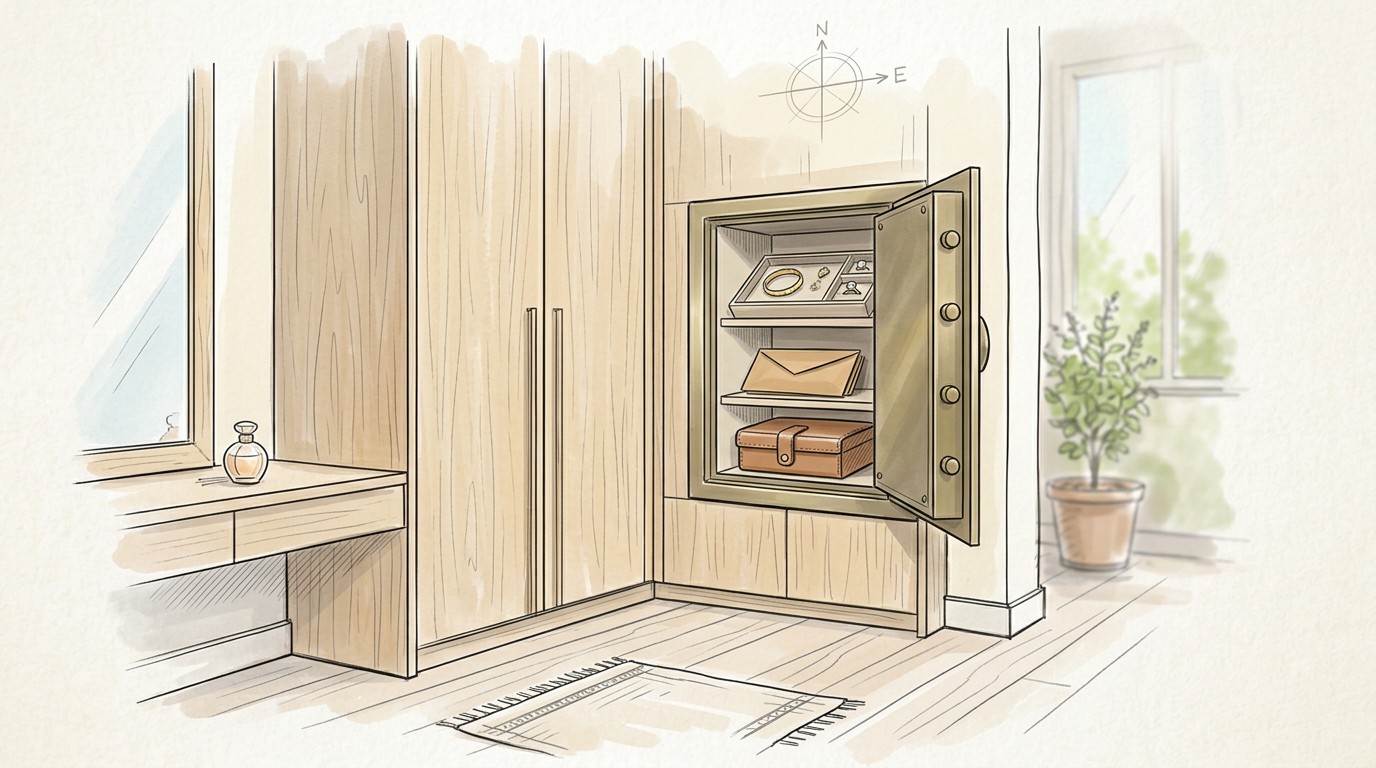
In many Indian homes, a locker is more than a storage unit. It may hold cash, jewellery, emergency funds, property papers, or business-related documents that a family depends on. That is why locker and wealth Vastu is not only about ritual placement. It is also about stability, order, privacy, and how financial items are kept in the home.
Even in the era of UPI, online banking, and digital investing, families still keep some cash or valuables at home for practical reasons. In cities like Mumbai, Jaipur, Surat, or Coimbatore, it is common to maintain a home safe for jewellery, gold, small emergency cash, or key documents. Vastu guidance for a locker focuses on where it should be placed, which way it should open, and what conditions around it should be avoided.
Why locker placement matters in Vastu
The basic Vastu idea behind locker placement is stability. Money and valuables are expected to remain secure, organised, and protected from unnecessary outflow. A poorly placed locker is seen as a sign of unstable savings, frequent unplanned spending, or money that does not stay with the family for long.
This is why the locker is usually recommended in a heavier, more settled part of the home rather than in a light, open, active, or highly exposed area. In practical design terms, this also makes sense. A safe placed in a quiet, enclosed, and structurally stable room is easier to secure than one placed in a circulation zone or directly in front of daily-use spaces.
For Indian homes, the question often comes up during bedroom planning, wardrobe design, or when choosing the best wall for a steel almirah or built-in locker. This is especially relevant in apartments, villas, and independent homes where storage is integrated into the master bedroom or dressing area rather than kept in a separate strong room.
Best direction for a locker or cash box
The most preferred direction for a locker, tijori, or cash box in Vastu is the Southwest. This zone is associated with stability, which is why it is seen as supportive for preserving wealth rather than allowing it to slip away. If the locker is placed in the southwest, it should still be positioned in a proper enclosed setting and not casually pushed into an exposed or cluttered corner.
Other acceptable directions are South and West. These directions are generally treated as heavier and more closed zones in Vastu, which suits the nature of a locker. A safe or cash box is not something that should sit in a highly open, light, or transitional area. That is why these directions are usually preferred over north-east-facing open corners or central zones.
In real homes, this often means placing the locker in the southwest part of the master bedroom, dressing room, or a dedicated storage wall. In a duplex home in Ahmedabad or an apartment in Pune, it may simply mean choosing the south or west wall for the built-in safe rather than placing it randomly wherever the carpenter finds spare space.
- First preference:
Southwest - Secondary options:
SouthorWest - Keep the locker in a closed and stable area, not in an open movement zone
- Treat its location as part of room planning, not just furniture placement
Which way should the locker open
The opening direction is considered just as important as the placement direction. The locker or cash box should ideally open toward North or East. In some cases, Northeast is also treated as acceptable when the overall placement allows it. The idea is that the opening should face a direction associated with positive inflow rather than closure or blockage.
What should be avoided is a locker that opens toward Southeast, South, Southwest, West, or Northwest. According to Vastu, such an arrangement can restrict the inflow of money, increase unnecessary spending, or reduce savings discipline. In practical terms, these rules encourage homeowners to think carefully about both the body of the locker and the swing direction of the door, not just the room in which it sits.
This becomes particularly important in modular wardrobes and custom-built safes. Many Indian homes place the locker on the correct wall but forget to check which way the shutter opens. If the carpenter installs it without directional planning, the family may end up with a locker that is technically in a good room but functionally facing the wrong side.
What to do if southwest placement is not possible
Sometimes the ideal southwest location is not available. There may be an entrance, attached toilet, living area, or other fixed layout condition in the south-facing part of the home. In such cases, North can be used as a practical alternative. The north is traditionally associated with Kubera, the deity linked to wealth, so it is treated as an acceptable backup zone when the preferred southern heavy areas cannot be used well.
Even when the locker is kept in the north, the opening direction still matters. It should preferably open toward North, Northeast, or East. This is not a license to place the locker anywhere in the northern side of the house without planning. It still needs to be in a stable, clean, and enclosed spot rather than directly in front of active, wet, or chaotic areas.
This flexibility is useful in apartments where the southwest may be occupied by a bathroom shaft or fixed furniture wall. For example, in a compact apartment in Bengaluru or Thane, families often use the north side of a wardrobe lobby or a secure bedroom wall as the best possible option. The goal is to choose the most stable alternative, not just any available shelf.
Daily upkeep rules that support wealth Vastu
Locker and wealth Vastu is not only about direction. The condition of the locker matters too. It should be clean, organised, and free from clutter. Cash, jewellery, and important papers should not be pushed together carelessly. A disorderly locker is seen as a sign of financial confusion, while a neat locker reflects better control over money and possessions.
It is also recommended to keep cash and documents separately rather than stacking everything on top of each other. If possible, place a red cloth inside the locker before keeping cash or valuables. Some families also keep a silver Lakshmi coin inside the locker and draw a swastik symbol with kumkum on the inner or outer surface as an auspicious practice. These are cultural additions, but the larger principle behind them is respect, order, and positive association with stored wealth.
Another important rule is that the locker should never remain completely empty. Even if you do not store much cash at home, keep at least one coin or something symbolic inside it. The locker should also be stable. If it shakes, tilts, or stands unevenly, it should be supported and fixed properly. In Indian homes where steel almirahs are often shifted during renovation, this simple issue is surprisingly common.
- Keep the locker clean and clutter-free
- Separate cash, jewellery, and documents properly
- Use a red cloth inside if practical
- Keep at least one coin or some value inside; do not leave it fully empty
- Make sure the locker stands steady and does not wobble
- Review locker placement again after renovation or furniture shifting
Placement mistakes to avoid around the locker
There are a few location mistakes that should be avoided even if the main direction seems correct. The locker should not face a Bathroom, Toilet, or Kitchen directly. These spaces are treated as unsuitable in front of a cash box because they symbolically and practically disturb the sense of purity, order, and security expected around stored wealth.
The locker should also not be placed in Brahmasthan, the central part of the house, or directly under a beam. The center should remain lighter and less burdened, while a beam overhead creates a feeling of pressure and heaviness. In Vastu, both are linked with financial stress or persistent pressure in money matters. In interior design terms, these locations also tend to feel visually awkward and less secure.
Colour and visual tone matter as well. Dark black lockers are usually avoided, while lighter shades such as white, cream, pale yellow, or other soft tones are considered better. In many Indian homes, the safest upgrade is not buying a new locker but simply correcting its surroundings: remove clutter, shift documents out, stop keeping it under a beam, and make sure it is not aligned with an unsuitable space.
How to apply these rules in modern Indian homes
In a modern apartment or villa, locker placement often depends on wardrobe design, bedroom planning, and privacy. The safest way to apply Vastu is to work with the existing layout rather than force an impractical solution. If the southwest is available, use it. If it is not, test south, west, or north carefully while ensuring the locker opens toward a better direction and does not face unsuitable spaces.
Families buying ready-to-move homes from local builders should not assume the wardrobe niche is automatically the best locker spot. Check the direction of the room, the wall position, the opening direction of the locker door, whether a bathroom is directly opposite, and whether the unit falls under a beam. These details matter much more than decorative finishes or panel design.
For business owners who keep a cash box at home or in a small office, the same principles still apply: use a stable, closed, clutter-free area; avoid the center; keep the opening toward a better direction; and do not let the locker become a dumping place for bills, loose papers, expired cheques, and random valuables. Wealth Vastu works best when direction and discipline support each other.