Building a House
VastuEssential
Main Door Direction as per Vastu
A practical guide to choosing the right entrance zone and improving an existing main door.
10 min read· Last updated 12 Apr 2026
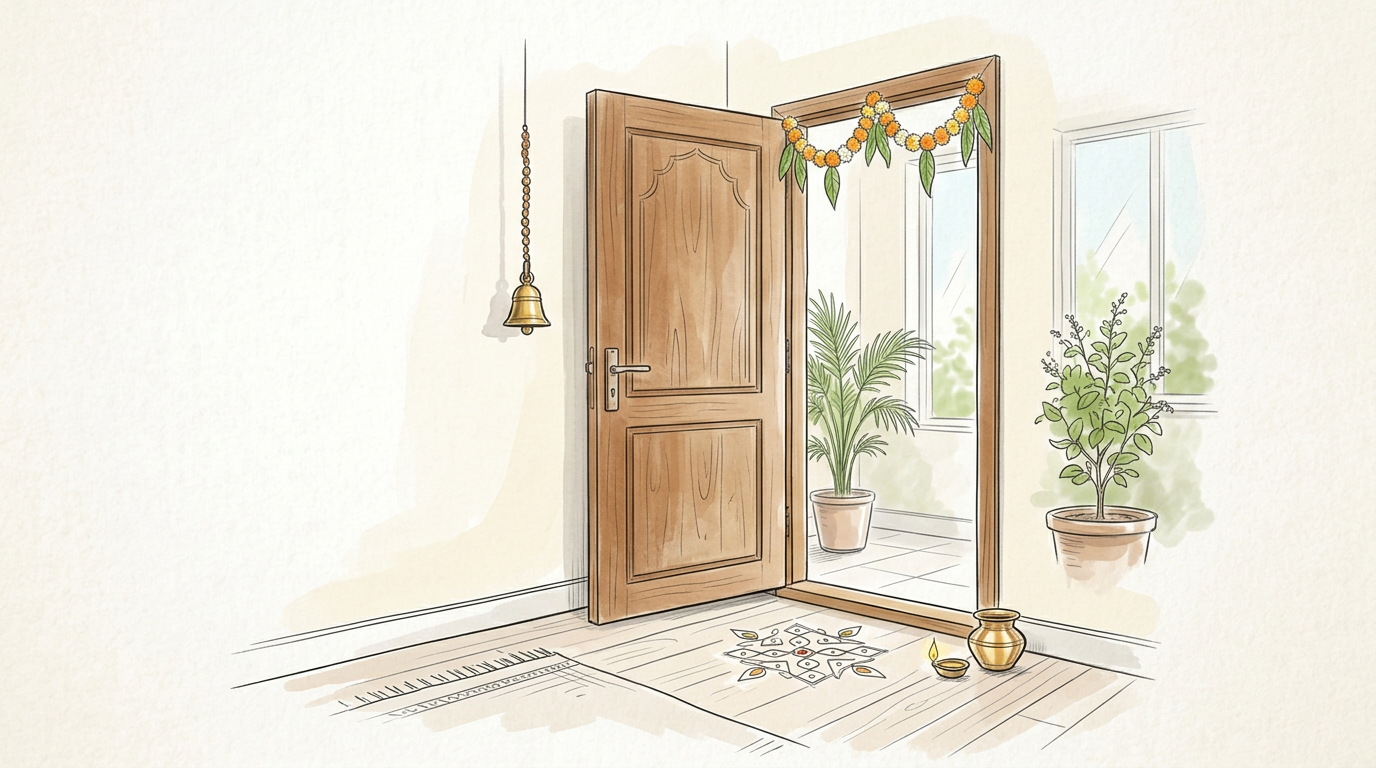
The main door is one of the most discussed parts of a home in Vastu because it is treated as the primary point of movement, interaction, and energy flow. In practical terms, it is also the first part of the house that shapes daily experience, from light and ventilation to privacy, clutter, and circulation.
For Indian homeowners, this becomes especially important at the planning and buying stage. Whether you are comparing apartments in Pune, checking a builder floor in Gurugram, or finalizing a bungalow plan in Ahmedabad, the entrance direction can influence not just Vastu comfort but also how the front zone of the home functions every day.
In new construction, correcting the entrance on paper is usually easy. In completed homes, the choice is often about managing the existing direction intelligently through layout, cleanliness, lighting, and traditional remedies. That is why understanding the exact main door zone is more useful than relying on broad beliefs or builder marketing terms.
Why the main door direction matters
Vastu gives special importance to the entrance because every family member, guest, worker, and visitor enters through this point. The logic is simple: the main door is not only a physical opening, but also the most active threshold of the house. That is why its direction, openness, weight, and surroundings are all given attention.
This is also why two homes with similar layouts can feel very different at the entrance. A well-placed main door in a lighter and more supportive zone usually feels more open and usable, while an entrance in a stressed zone may coincide with clutter, instability, or functional discomfort. In modern housing, this matters even more because lifts, staircases, electric panels, and neighbouring doors often sit very close to the entry.
How to identify the correct entrance zone
Before judging whether an entrance is good or weak, the direction must be read correctly. In Vastu, broad labels like east-facing or west-facing are not enough. The exact position of the door matters because each side is divided into smaller zones or padhas, and some of these are more supportive than others.
The practical method is to first mark all eight directions on the plan, then locate where the main door falls on that side. For example, southeast sits between east and south, southwest between south and west, and northwest between north and west. This is important because a door in the positive part of a side can be treated differently from a door in the exact corner or central negative band. In Vastu-based evaluation, a few degrees of shift can change the reading from supportive to mixed.
- Mark north, south, east, and west correctly on the layout.
- Divide the outer perimeter into the relevant directional zones.
- Check whether the door sits in a pure direction or in a sub-zone.
- Do not rely only on the road side or building brochure description.
- For flats, assess the apartment entrance itself, not just the tower entrance.
In apartment projects across cities like Bengaluru, Noida, and Hyderabad, buyers often hear phrases such as northeast-facing or south-facing without checking the actual door location on the wall. That shortcut causes confusion. A slightly shifted door can fall into a more favourable or less favourable padha, so exact placement matters more than marketing labels.
Best main door directions as per Vastu
Vastu broadly treats five entrance positions as positive and widely usable for homes, offices, shops, and other properties. These are north, northeast, east, south of southeast, and west of northwest. Among them, north, northeast, and east are usually the easiest to understand because the entire north-to-east zone is generally treated as more supportive for entry.
The two special positions need more care. South of southeast is not the same as a full southeast entrance, and west of northwest is not the same as a full northwest entrance. These are narrower beneficial bands within otherwise mixed zones. That is why two homes on the same side of the road can still have very different Vastu readings depending on where the main door is actually placed.
North: commonly preferred for homes seeking a lighter and more open front zone.Northeast: considered one of the strongest entrance areas in traditional Vastu.East: widely accepted for residential use and daily movement.South of Southeast: a specific positive band, not the entire southeast side.West of Northwest: a specific positive band, not the entire northwest side.
For Indian homes, these positive zones are often easier to work with when the architect also keeps the entrance clean, well-lit, and visually open. A good directional position alone is not enough if the door opens into darkness, faces heavy obstruction, or is surrounded by clutter, shoe piles, and storage. Direction and design must work together. In plotted homes, this can influence the siting of the gate, porch, and foyer. In apartments, it can affect how the entry lobby is used and how much visual congestion appears the moment the door opens.
Which directions are less favourable and why
The full southeast, northwest, south, southwest, west, and most of the south-to-west zone are handled more cautiously in Vastu. Among these, southeast, northwest, and southwest are especially discussed because each has a distinct character. Southeast is linked with the fire element and is traditionally better suited to the kitchen. Northwest is linked with air and movement, so it is often associated with instability. Southwest is linked with earth, weight, and stability, which is why it is usually preferred for the master bedroom rather than the entrance.
A southeast entrance is often described as bringing inflow of money but also fast and unnecessary spending, leaving little saving. Traditional explanations also connect this zone with fire-related imbalance, which is why some households associate it with recurring stress or health issues. A northwest entrance is associated with movement, fluctuating thinking, weak coordination, jealousy, frequent expenses, and in some cases legal friction. A southwest entrance is treated as the most serious among the three because this zone is expected to stay heavy, closed, and stable. When it opens up as a main door, the balancing role of the southwest gets weakened.
One traditional observation about southwest entrances is a repeating cycle of income behaviour: initial growth, then a period of stability, followed by decline. Whether one treats that literally or symbolically, the practical lesson is the same. If you are evaluating a southwest-entry home, look carefully at long-term stability, not only short-term improvement. This is especially relevant when buying resale property in cities like Indore, Surat, or Nagpur, where owners may sell after a few years of mixed financial experience.
Main door design rules that strengthen the entrance
Even when the direction is acceptable, the door itself should follow sound design principles. A main door is usually preferred in solid wood, in a regular rectangular shape, and larger than the other doors in the house. Double shutters are traditionally considered better than a narrow single leaf, and the door should open inward. If there is an outer safety door, its hinge side should match the hinge side of the main door so the movement feels aligned rather than conflicting.
The threshold also matters. A proper chaukhat or raised threshold is traditionally preferred, and wood is often considered better than purely decorative stone because it is treated as a more natural boundary material. The entrance should be well lit, clean, and free from dust-heavy decor. Glass main doors, sliding doors, self-closing doors, excessive carving, and dark or neglected front zones are usually avoided in Vastu-based planning. If you use a toran, keep it fresh and clean. Dusty artificial torans and dried flower torans are usually seen as blocking the freshness of the entry.
- Use a solid, crack-free main door with a clean rectangular form.
- Keep it larger and visually stronger than the internal doors.
- Ensure the door opens inward and the entrance stays bright.
- Avoid mirrors or heavy furniture exactly facing the main door.
- Avoid septic tanks in front of the entrance and, in duplex homes, avoid a toilet directly above it.
These rules are practical even beyond Vastu. In many builder apartments, the biggest problem is not only direction but what sits opposite the door: a lift lobby, another flat's entrance, a garbage point, or a dark service niche. In independent houses, the problem may be a blank wall immediately inside, a cluttered shoe area, or a heavy cabinet blocking movement. Correcting these issues usually improves both usability and the perceived quality of the entry. Where homes have two entrances, the door in the more positive zone should be treated and used as the primary entrance wherever possible.
Practical remedies for existing homes
Not every homeowner can change the entrance direction, especially in apartments, row houses, and completed villas. In such cases, Vastu usually recommends remedies to reduce the impact of defects rather than claiming a full correction. This distinction matters. Remedies are supportive measures, not substitutes for good planning, structural fixes, or common-sense maintenance.
For north, northeast, east, and even northwest entrances that need support because of external obstructions such as a lift, staircase, electric pole, garbage point, busy market road, hospital zone, bus depot, railway area, or graveyard nearby, a common traditional remedy is to place Riddhi Ganesh above the main door from the outside along with Panchmukhi Hanuman in a protective standing form. From the inside, a swastik and pyramid are commonly used. For southeast, south, and southwest entrances, the traditional recommendation shifts to Siddhi Ganesh outside with Panchmukhi Hanuman, and a swastik with pyramid inside. In traditional practice, these are usually placed as photo frames or printed tiles rather than statues.
- For an existing entrance, first correct clutter, darkness, dust, and broken hardware.
- Check whether the problem is direction, external obstruction, or both.
- Use traditional remedies only as supportive measures, not miracle fixes.
- Prefer photo frames or printed tiles above the door rather than random decorative objects.
- Keep the entrance area calm, clean, and regularly maintained after applying any remedy.
When to avoid, accept, or work around a direction
If you are still choosing between properties, it is usually better to prefer a home where the main door already falls in a stronger zone. That is easier and cheaper than buying a compromised entrance and depending only on remedies later. This is especially true for self-use residential property, where long-term comfort matters more than short-term excitement or a discount in price.
If the property is otherwise strong and the entrance is not ideal, evaluate the full picture. A northwest or southeast entrance may still be workable if the internal layout is balanced, the front zone is well managed, and the use case fits. Some commercial activities are traditionally considered more suitable in such directions. For example, southeast is often linked with fire-related or energy-intensive businesses such as electrical goods, fuel, hotels, food counters, and beauty services. Northwest is linked with movement-oriented sectors such as telecom, promotion, sprays, and trade goods, while southwest is sometimes considered workable for luxury, commission-based, or heavy-material businesses.
The practical rule is simple: avoid weak entrance directions when you have choice, understand exact sub-zones before making a decision, and do not ignore the basic physical quality of the entry. In Indian urban housing, a directionally good door with poor maintenance can underperform, while a less ideal direction with disciplined upkeep and sensible corrections can feel far more manageable.