Building a House
VastuEssential
Common Vastu Mistakes to Avoid
A practical guide to spotting everyday layout and storage errors before they affect comfort and balance.
10 min read· Last updated 12 Apr 2026
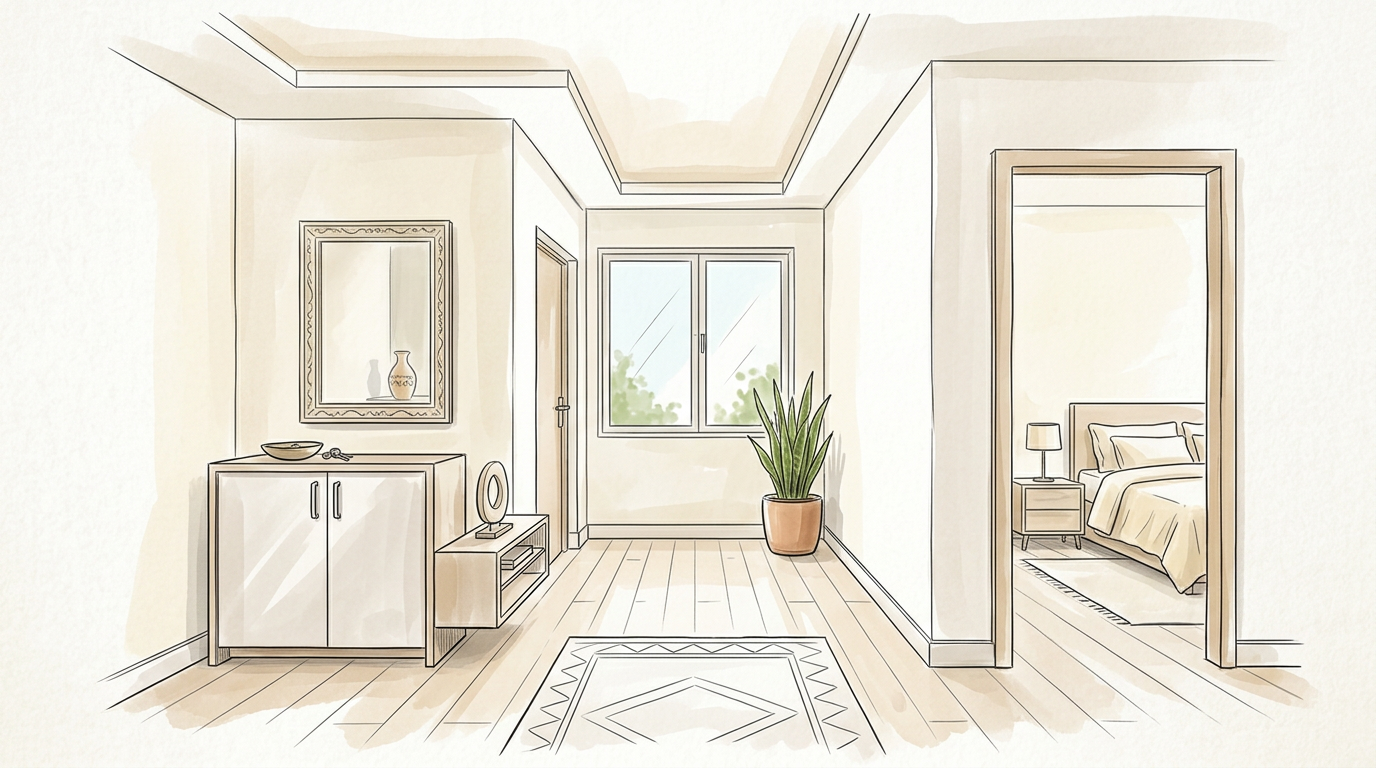
Many Vastu problems do not begin with major construction faults. They usually start with small everyday decisions such as where shoes are kept, how mirrors are placed, whether broken items are left lying around, or whether a bed sits directly below a beam. These details are easy to ignore because they feel minor, but over time they affect how a home looks, functions, and feels.
This matters even more in Indian homes, where compact apartment layouts, builder-fixed plumbing points, and heavy storage habits often push utilities and furniture into the wrong zones. A flat in Noida may have a shoe rack near the entrance because there is no lobby space. A home in Pune may use mirrored wardrobes inside a bedroom. A duplex in Hyderabad may place a bed under a beam because of room size. Common Vastu mistakes are often practical mistakes first, and that is exactly why they should be corrected early.
Remove broken, blocked, and neglected items first
One of the most common Vastu mistakes is keeping broken or non-working items in the house for too long. This includes stopped clocks, cracked mirrors, damaged utensils, broken idols, unusable electronics, and other neglected objects that are neither repaired nor removed. Even from a practical point of view, such items make a home feel heavy, unfinished, and poorly maintained.
Leakages are another major issue that should never be ignored. A dripping tap, leaking pipe, or damp plumbing line should be repaired immediately. In Indian apartments, these are often left pending because the civil repair looks small, but recurring leakage affects walls, cabinets, and maintenance costs. Vastu also treats such unresolved defects as signs of disturbed flow and loss.
Visual clutter has the same effect. Sad, violent, or conflict-heavy paintings should be avoided, especially in shared areas. Very dark colours used heavily across the house can also make interiors feel dull and compressed. In most Indian homes, lighter tones work better because they improve both daylight performance and the overall sense of openness.
Do not block the northeast or pollute the entry zone
The northeast is usually treated as one of the lightest and most sensitive zones of the home. A common mistake is loading this area with the wrong functions such as a dustbin, shoe rack, toilet, or heavy furniture. Even when the floor plan cannot be changed, the northeast should still be kept cleaner, lighter, and less burdened than the heavier south and west sides.
The area around the main door is often mishandled in the same way. In many Indian flats, families pile several pairs of slippers and shoes right outside or just inside the entrance. This may feel normal in daily life, but too much footwear at the door creates visual mess and blocks the entry zone. If your society rules allow it, keep footwear storage controlled and organized rather than scattered around the threshold.
This is especially relevant in cities like Mumbai, Gurugram, and Bengaluru where entrance foyers are often very small. When the entry is already tight, every extra object has more impact. A clean and deliberate entrance makes the home feel better immediately, even before any larger Vastu correction is attempted.
Avoid the most common shoe-rack mistakes
Shoe racks are one of the most misunderstood everyday Vastu items. Since footwear carries dust and dirt from outside, it should not be treated like ordinary storage. A shoe rack is generally better placed away from the north, northeast, east, and the central zone of the home. West and northwest are usually considered more suitable placements for it.
Another common mistake is using an open shoe rack. Open shelves leave footwear exposed and spread visual clutter near the entrance or inside passage areas. A closed rack with shutters is usually a better option because it keeps the storage contained. If it must be kept indoors, it should always be clean, shut, and limited to what is genuinely needed.
Shoe racks should also be kept away from the kitchen, pooja area, and bedroom. If the main door itself falls in the north, northeast, or east and there is no alternative space, keep only daily-use footwear there and store the rest elsewhere. Some households also place camphor in the shoe cabinet to reduce odour and maintain freshness, which is a practical habit regardless of belief.
Correct mirror placement before it creates avoidable problems
Mirrors can improve light and visual depth, but they are also one of the easiest items to place wrongly. In Vastu, north, northeast, and east are generally treated as better directions for mirrors. At the same time, a mirror should not be placed exactly opposite the main door, because the entrance should not feel like it is immediately throwing back what comes in.
Bedrooms need even more care. A mirror should not reflect the bed while a person is sleeping, and it should never be fixed on the ceiling above the bed or directly on the headboard behind it. Mirrored wardrobes are common in urban homes because they save space, but if the sleeping person’s reflection falls into them, the effect can feel disturbing even from a design point of view. If relocation is not possible, the mirror can be covered at night.
Two more mistakes show up often in Indian homes: two mirrors facing each other, and old mirrors that no longer give a clear reflection. Broken, irregularly shaped, or dirty mirrors should also be avoided. A mirror should be clean, simple, and properly placed, not used casually as filler decor or as a remedy without understanding what it reflects.
Keep beds, study zones, and prayer areas away from beams
Beams and columns are structural necessities, but they create one of the most repeated Vastu mistakes in finished homes. Since beams carry load, the area directly below them feels heavier. This is why beds, study tables, work desks, gas stoves, and pooja units should not be placed under a beam if it can be avoided.
The problem is common in Indian apartments where the beam line decides where wardrobes, beds, and false ceilings are placed. A child may end up studying under a beam because that is where the desk fits best. A master bed may sit under a beam because the wardrobe layout leaves no other wall. These arrangements are usually compromises of planning, but they are still worth correcting if possible by shifting furniture.
Columns create a similar issue when they protrude into the room and disturb movement or visual balance. There should not be a beam or column in front of the entrance door, and the center of the house should not carry such heavy interruptions if avoidable. Cracks in beams or columns should never be treated as a Vastu issue alone. They are a structural maintenance priority and should be repaired immediately by qualified professionals.
If a beam cannot be avoided, a false ceiling is often considered the most practical way to reduce its visual and spatial impact. Traditional remedies may also be used by some households, but they are secondary. The first correction should always be layout, concealment, and structural safety.
Watch hidden storage and everyday bedroom clutter
Another subtle Vastu mistake is invisible clutter, especially inside bed storage. In many Indian homes, box beds become dumping spaces for extra utensils, metal objects, old papers, seasonal decor, unused wires, and miscellaneous household stock. The issue is not the storage itself, but the lack of order. When the bed base is crammed with random items, the bedroom starts functioning like a store room.
Keeping bed storage organized is a simple correction with a strong practical benefit. Avoid stuffing it carelessly, and avoid piling unnecessary metal items there. Bedrooms should support rest, not act as overflow storage for the entire house. This is particularly important in compact apartments where every hidden compartment gets overused.
Use this quick review once every few months:
- Remove broken, stopped, or unusable items from the house.
- Repair leaking taps, pipes, and damp spots quickly.
- Keep the northeast lighter than the rest of the house.
- Keep shoe racks closed, clean, and away from pooja, kitchen, and bedroom zones.
- Make sure mirrors do not face the bed or sit directly opposite the main door.
- Shift beds, study tables, or stoves away from beams wherever possible.
- Keep bed storage organized instead of using it as a dumping space.
When these small corrections are made consistently, the house starts feeling cleaner and easier to live in. That is why common Vastu mistakes are worth addressing even in homes where major civil changes are not possible. The goal is not perfection. It is to reduce avoidable disorder and improve the basic quality of daily living.