Building a House
VastuEssential
Bedroom Direction and Layout
A practical guide to placing bedrooms, beds, and furniture for better balance and everyday comfort.
10 min read· Last updated 12 Apr 2026
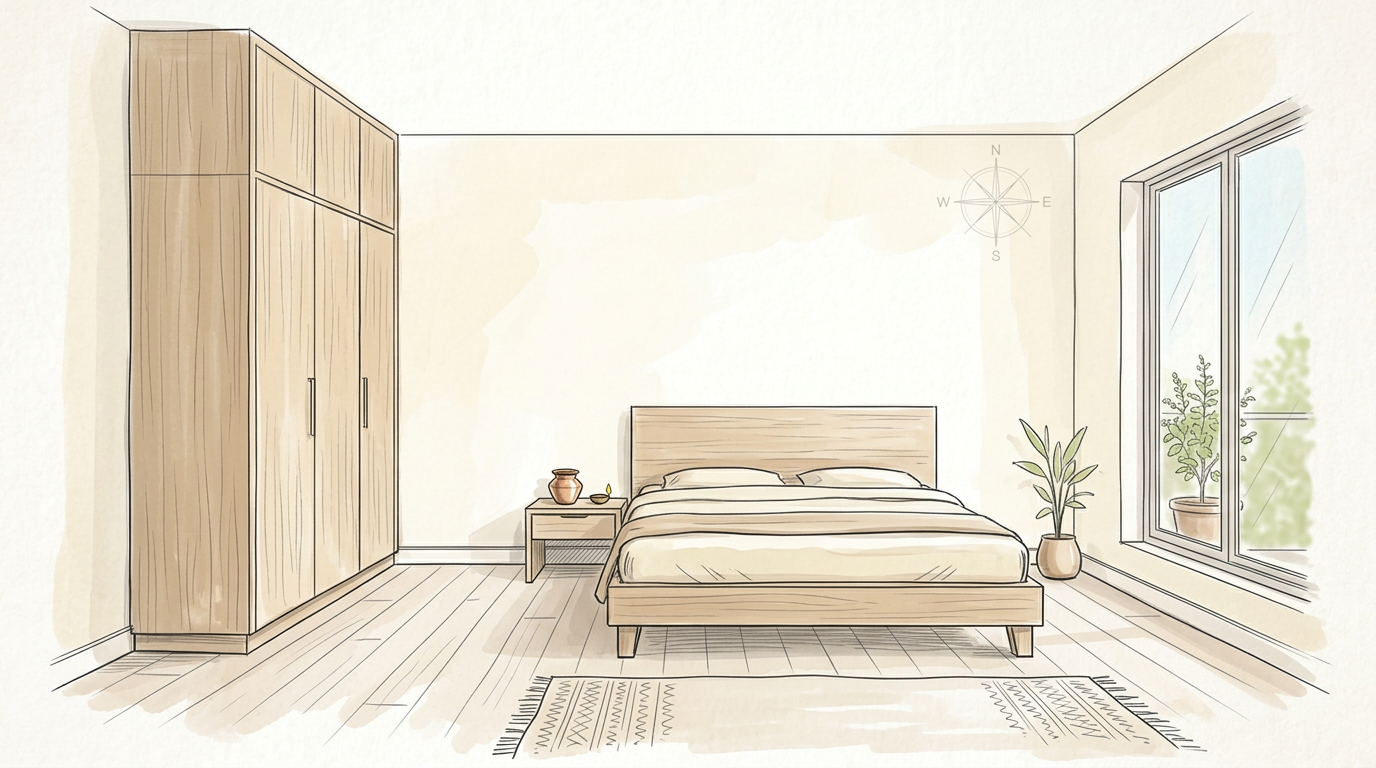
Bedrooms affect rest, privacy, and routine more than almost any other room in the house. In Indian homes, where one layout often has to support parents, children, guests, wardrobes, attached toilets, and compact furniture planning, the position of the bedroom and the way the bed is placed both matter.
Vastu treats the bedroom as a space of stability, recovery, and mental calm. That is why room direction, bed orientation, mirror placement, storage weight, and sleeping position are all connected. If these basics are planned properly at the layout stage, many common issues in flats, villas, and builder floors can be avoided without expensive corrections later.
Choose the right bedroom direction for each family member
The first rule is simple: not every bedroom should be assigned randomly. The room used by the head of the family is generally preferred in the southwest because this zone is associated with stability and groundedness. Even if the southwest bedroom is smaller than another room, it is still treated as the stronger choice for the master bedroom.
Parents or grandparents are better placed in the north, northeast, or east, where the room feels lighter and calmer. Children are generally better in the south, west, northwest, or east. A guest bedroom is usually more suitable in the northwest, which supports short stays and movement rather than long-term control of the household.
- Use the southwest for the master bedroom.
- Use north, northeast, or east for parents and grandparents.
- Use south, west, northwest, or east for children.
- Use northwest for guests.
In practical Indian planning, this matters when a 3BHK apartment has one corner room, one front-facing room, and one compact bedroom near the passage. Instead of choosing rooms only by size or balcony access, assign them by use. A family in Pune or Hyderabad may prefer the largest room for convenience, but if the southwest room is available, that is usually the better master bedroom location in Vastu terms.
Follow the correct head direction while sleeping
Once the bedroom is chosen, the next decision is sleeping direction. The most preferred position is with the head towards the south. East is also considered a good direction, especially for children, students, and people whose daily work depends on focus, reading, or learning. West can be treated as a fallback option when south or east is not practical.
The direction to avoid is north. The traditional explanation is based on magnetic alignment: the human body is treated like a magnet, with the head considered the north pole and the feet the south pole. Because of this, north-facing sleep is believed to create disturbance over time, while south-facing sleep is associated with better rest and steadier health.
- Best option: head towards south.
- Good option: head towards east.
- Acceptable backup: head towards west.
- Avoid: head towards north.
This rule becomes especially useful in modern apartment layouts where attached toilets, wardrobes, and windows limit furniture movement. Even if the room itself is fixed by the builder in cities like Noida, Bengaluru, or Ahmedabad, the bed can often still be rotated so the sleeper’s head remains towards the south or east. That one change can improve the overall bedroom setup without any civil work.
Plan the bed layout to keep the room balanced
The bed should not be pushed thoughtlessly into any available corner. Vastu prefers a placement where the bed has a solid wall behind it, a proper headboard, and open access on three sides as far as possible. The bed should also not fall in the Brahmasthan, which is the central zone of the house, and it should not block the main energy flow of the room by being squeezed tightly into one corner.
The bed should not be placed exactly in front of the entry door, directly in front of the toilet door, or with a window immediately behind the head side. It is also better to avoid placing the bed under a beam, under a heavy loft, or below a false ceiling cut or depression exactly above the sleeping position. These conditions are all treated as sources of pressure and disturbed sleep.
- Keep a solid wall and headboard behind the bed.
- Try to leave movement space on three sides of the bed.
- Avoid placing the bed exactly opposite the main bedroom door.
- Avoid a window directly behind the bed.
- Do not sleep directly under a beam, loft, or heavy overhead cut.
- Keep the toilet door closed if it faces the bed.
For Indian homes with space constraints, this does not mean every bed must float in the exact center of the room. It means the bed should not feel trapped, unstable, or visually pressured. In compact Mumbai or Gurugram flats, even a small clearance on both sides, a stable head-side wall, and correct sleeping direction can create a far better layout than a bed jammed between a wardrobe and window.
Place storage, mirrors, and appliances with care
Within the bedroom, the lighter zones are generally the north, northeast, and east, so windows and open areas work better there. The heavier elements such as beds, wardrobes, dressing units, and bulky storage are usually more suitable in the south, southwest, and west. This creates a practical weight balance that also works well with how Indian bedrooms are normally used.
Mirrors need special attention. The bed should not be reflected in a mirror while you are sleeping. The same rule applies to a television screen if it acts like a reflective surface at night. If the mirror cannot be moved because it is built into a wardrobe shutter, then covering it while sleeping is considered a useful correction. Heavy storage above the bed should also be avoided because it creates visual and physical heaviness.
Bed design also matters. A square or rectangular wooden bed is generally preferred. Irregular bed shapes are avoided. A four-legged bed is treated as the ideal because it allows a cleaner flow below, but in real homes storage beds are common. If storage is unavoidable, keep only light items inside and do not fill the under-bed area with metal scrap, unused electronics, broken décor, or heavy clutter. Clean under-bed storage is more important than maximum storage.
Set up children’s bedrooms for sleep, study, and calm
Children’s bedrooms need a slightly different approach because the room supports rest, study, creativity, and emotional balance all at once. South and west are generally considered strong options for a child’s room, while northwest can work as a second option. Southeast is treated carefully because it is linked to the fire element and may make children more irritable or restless if the room becomes too hot, cluttered, or visually intense.
Inside the room, the child should sleep with the head towards the south or east. The study table should be arranged so that the child faces north, northeast, or east while studying, with a solid wall support behind. Storage and wardrobes are better in the south, southwest, or west. The room should be well ventilated, open, bright, and kept clean rather than overloaded with toys, gadgets, and random furniture.
- Prefer south or west for the child’s room.
- Use northwest as a workable second option.
- Keep the child’s head towards south or east while sleeping.
- Make the child face north, northeast, or east while studying.
- Place wardrobes and heavier storage in south, southwest, or west.
Green is considered a supportive colour in children’s rooms because it is associated with calmness and fresh thinking. In an east-facing room in Chennai or a west-facing room in Jaipur, this can be introduced through curtains, bed linen, or plants rather than repainting the entire room. Avoid dull lighting, TV dependence inside the room, studying or sleeping under a beam, and the habit of eating on the bed or study table, because all of these reduce discipline and room clarity.
Correct common bedroom defects before they become bigger problems
One of the most common issues in Indian homes is that the master bedroom ends up in the wrong direction because the flat is already built or the room allocation was done for convenience. A master bedroom in the northeast is seen as unstable because that zone is meant to remain lighter. In the southeast, the fire influence is said to increase irritation and conflict. In the northwest, decision-making may become inconsistent because the air element creates movement rather than steadiness.
If a southwest bedroom exists anywhere in the home, the head of the family should ideally shift there. If there is no formal bedroom in the southwest but another usable room is available there, sleeping in that room is considered the strongest remedy. When this shift feels difficult, it can be done gradually over a few weeks instead of changing overnight. If southwest is unavailable due to a cut, toilet, or other planning defect, then south or west can be used as the next best option, with the bed placed to strengthen the southwest side of that room.
In real projects, this often appears in duplexes, plotted homes, and resale flats where room usage changes over time. A family may keep the southwest room for guests because it is larger or has a better wardrobe, while the couple uses an east or northeast room for convenience. Before spending on redesign, first check whether the room assignment itself is wrong. In Vastu-based planning, the biggest gains usually come from correcting the sleeping room and bed direction before trying advanced remedies.