Building a House
Construction StagesEssential
Grill & Windows Installation Guide
Install MS or SS window grills at the right stage so plaster, granite, frames, and glass all align cleanly.
10 min read· Last updated 12 Apr 2026
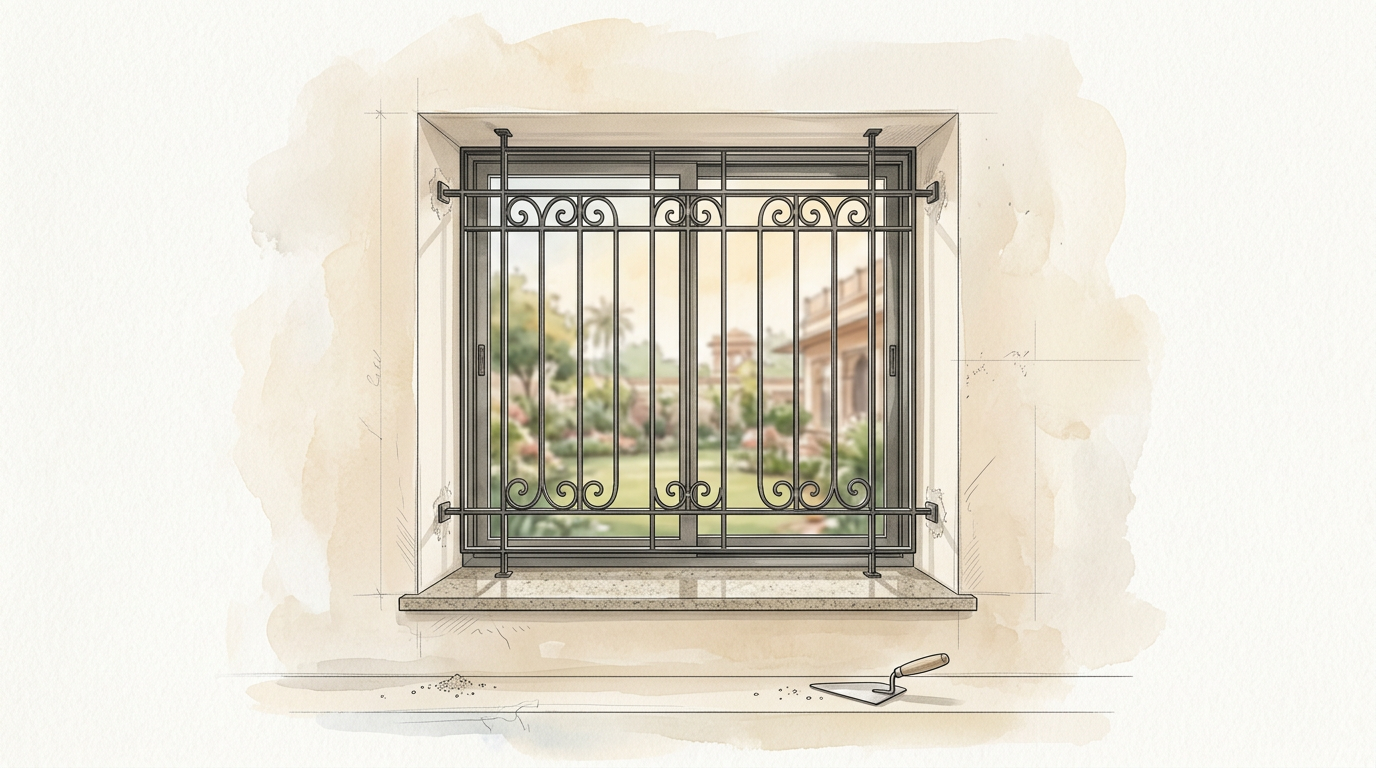
Why Window Grill Timing Matters More Than Most Homeowners Expect
Window grill work looks simple from outside, but the timing affects finishing quality, wall damage, frame alignment, and even the final appearance of the house. In Indian home construction, many owners first install the window frame and then start wondering whether the grill should come before plaster, after plaster, after granite, or only at the final finishing stage. If that decision is delayed, the site team may drill into finished surfaces, spoil the sill edge, or leave the grill sitting awkwardly ahead of or behind the frame.
This is especially common in plotted houses where masonry, plaster, frame fitting, granite sill work, and paint all happen in overlapping phases. A grill that is fixed too early may get damaged during plaster or paint. A grill that is fixed too late may force drilling into granite, break tile edges, or create a poor-looking joint around the window. The correct timing depends on one important thing first: what type of window system you are building.
In practical terms, grill timing usually changes based on whether the house has a wooden frame, an MS frame, or an aluminum and glass window setup. A basic independent house in Lucknow or Patna may still use a conventional wooden window frame with an MS grill. A newer villa in Hyderabad or Pune may use aluminum sliding windows with an SS grill. Both are valid, but the execution sequence is not the same.
- Finalize grill timing only after the window frame type is confirmed.
- Treat grill fixing as part of finishing coordination, not only as a fabrication task.
- Check how plaster, granite sill, paint, and glass window work will interact with the grill.
- Avoid a last-minute decision because that usually increases drilling damage and alignment issues.
- Match the grill type to the window system and the look you want outside the house.
How to Choose Between MS Grill and SS Grill
In most residential projects, the first choice is between MS grill and SS grill. MS, or mild steel, is still very common in independent house construction because it is practical, strong, easy to fabricate locally, and works well with traditional wooden or standard masonry-window detailing. It is often selected when the owner wants a sturdy grill design, can manage primer and paint properly, and prefers a more conventional exterior look.
SS, or stainless steel, is more common where the house uses aluminum and glass windows, a cleaner modern facade, or a lower-maintenance finish. In many urban projects across Bengaluru, Ahmedabad, and Gurugram, homeowners prefer SS grills because they sit better visually with sliding glass systems and usually need less frequent repainting than MS. That does not mean SS is always better. It simply means the grill choice should suit the window type, the elevation style, and the maintenance expectation.
The visual coordination matters just as much as the material. If the house has a wooden window frame, a heavy SS grill may sometimes look disconnected from the overall design. If the house has sleek aluminum windows and polished granite sills, a painted MS grill may look bulkier than intended unless the detailing is handled very carefully. Good finishing decisions come from seeing the grill as part of the window composition, not as a separate metal item to be added later.
- Use MS grill when you want a traditional, strong, locally fabricated option.
- Use SS grill when the house has a modern aluminum and glass window system.
- Match the grill finish to the window frame finish and elevation style.
- Decide the grill material before granite, plaster, and glass detailing are finalized.
- Think about repainting, rust risk, and long-term appearance before approving fabrication.
Tip:
When to Install MS Grill on a Wooden or Traditional Window Frame
For a wooden or traditional frame-based window, the practical site rule is usually simple: fix the frame first, then install the grill in a way that sits correctly over that frame line. The grill should not sit awkwardly forward, and it should not fall too deep behind the visual face of the frame. The goal is a clean, centered relationship between the frame and the grill so the window looks deliberate from both inside and outside.
In many conventional house projects, an MS grill for a wooden frame can be installed toward the later finishing stage instead of at the earliest stage. This is because the frame defines the reference line first, and the grill can be matched to that reference after the main masonry and surface work become clearer. The transcript context strongly suggests that for wooden-frame windows, the MS grill can be kept for the later stage, which is often safer when the site still has active plastering, chipping, and finishing movement.
This later timing also helps prevent one common problem: damage to the grill during other works. If you install the MS grill too early, masons may lean ladders on it, plaster splashes may stick to it, and painters may later have to correct too many surfaces around it. In self-built houses in Jaipur, Ranchi, and outer Delhi NCR, keeping the MS grill toward the finishing end often gives a cleaner final result, provided the fixing points are planned properly in advance.
- Install the window frame first and use it as the reference for grill alignment.
- Keep the MS grill centered with the frame face instead of pushing it too far in or out.
- Prefer later-stage fixing for wooden-frame windows when other wet works are still active.
- Confirm holdfast or anchor locations before the wall finish closes completely.
- Paint and protect the MS grill properly because late installation still needs corrosion control.
When SS Grill Works Better With Aluminum and Glass Windows
SS grill timing is usually more sensitive when the window system uses aluminum and glass. In these setups, the grill often needs better coordination with sill level, plaster finish, and the final alignment of the aluminum frame. If the grill is treated as an afterthought and added only after granite or detailed finish work is complete, drilling and patching can spoil the clean modern look that aluminum windows are meant to create.
That is why SS grill setups are often planned earlier than the typical late-stage MS grill on wooden frames. On many sites, the grill fixing logic is resolved before final plaster or before the sill and window finishing become difficult to disturb. The exact sequence varies by fabricator and site condition, but the practical principle stays the same: if the grill is part of an aluminum and glass composition, do not postpone the decision until after every polished surface is complete.
The mention of granite in the source context is important here. Once a granite sill is fully installed and polished, careless drilling for grill fixing can chip the edge or leave visible marks. In apartments and villas in Mumbai, Hyderabad, and Pune, this is a common avoidable defect. If the owner knows the window will use glass plus grill, the fixing method should be settled early so the finished sill and frame are not compromised later.
- Coordinate SS grill work early when the house uses aluminum and glass windows.
- Avoid a sequence where finished granite or polished sill work must be drilled casually afterward.
- Keep the grill line consistent with the aluminum window frame and opening proportion.
- Confirm whether the grill sits outside, inside, or in the frame zone before plaster and sill closing.
- Use SS grills where the final look demands a cleaner and more modern window composition.
Warning:
Correct Grill Position, Alignment, and Fixing Details
Good grill installation is not only about timing. Positioning matters just as much. The grill should relate properly to the frame line and the wall thickness so the window does not look visually broken. A common site mistake is fixing the grill without checking whether it should sit flush with the frame face, slightly outside the opening, or integrated into the window system. The result is a grill that appears either too buried inside the reveal or too far out from the facade.
The site should first check the frame face, plaster thickness, sill level, and opening squareness. If the frame is not truly aligned, the grill will only make the defect more visible. For this reason, the grill should be checked with level and line before permanent fixing. In homes across Indore, Surat, and Chennai outskirts, many small finishing defects around windows are not caused by poor fabrication, but by fixing the grill to an opening that was never checked properly after frame installation.
Hardware and fixing quality also matter. Whether the grill is welded to a frame system, bolted, or mechanically anchored, the fixing points should be consistent and rust-safe. For MS grills, primer and paint protection are essential, especially near welds and cut edges. For SS grills, the real risk is not rust in the same way, but scratched surfaces, loose fixing, or poor edge finishing that weakens the premium look the owner paid for.
- Check frame line, plaster face, and sill level before fixing the grill permanently.
- Make sure the grill position suits the window type instead of using one standard placement everywhere.
- Keep the grill aligned visually with the frame, not randomly inside the wall depth.
- Protect welds, cuts, and fixing points properly in MS grill installations.
- Inspect SS surfaces for scratches, loose anchors, and poor finishing before sign-off.
Common Grill Installation Mistakes and a Final Site Checklist
Most grill mistakes are coordination mistakes, not fabrication mistakes. The common failures are installing too early and damaging the grill during plaster, installing too late and drilling into finished granite, choosing SS for the wrong window language, fixing MS grills without corrosion protection, and ignoring the visual relationship between the grill and the frame. Another frequent issue is leaving the decision entirely to the fabricator when the carpenter, mason, granite team, and painter all affect the final outcome.
Homeowners should also avoid assuming that all windows need the same grill approach. A front-elevation window, a utility window, a stair window, and a kitchen opening may not all need identical detailing. The grill design can remain consistent, but the fixing sequence may change depending on whether the opening has wooden frame detailing, aluminum sliding shutters, or later glass work. This is why a short room-by-room review before fabrication saves so much rework.
Use this checklist before approving grill installation:
- The window frame type is confirmed as wooden, MS, or aluminum/glass.
- The grill material is finalized as MS or SS before late finishing starts.
- The grill position is checked against the frame face, not guessed on site.
- Granite sill and plaster edges are protected from careless drilling.
- MS grills are primed and painted properly at weld and cut locations.
- SS grills are checked for surface finish, rigidity, and anchor quality.
- The fixing sequence has been coordinated with the carpenter, mason, and fabricator.
- The final window look is reviewed from both inside and outside before handover.
- Do not finalize fabrication without confirming the exact fixing line on site.
- For wooden frames, late-stage MS grill fixing is often the safer finishing choice.
- For aluminum and glass systems, settle SS grill fixing earlier to protect the clean detail.
- Review one sample window fully before repeating the same detail across the house.
- Inspect the finished grill in daylight because alignment errors show clearly then.