Building a House
Construction StagesEssential
Concrete Pouring: Key Precautions
Plan materials, labour, supervision, and site readiness properly so slab concrete pouring stays safe, continuous, and structurally sound.
10 min read· Last updated 12 Apr 2026
Why Concrete Pouring Needs Full Pre-Planning
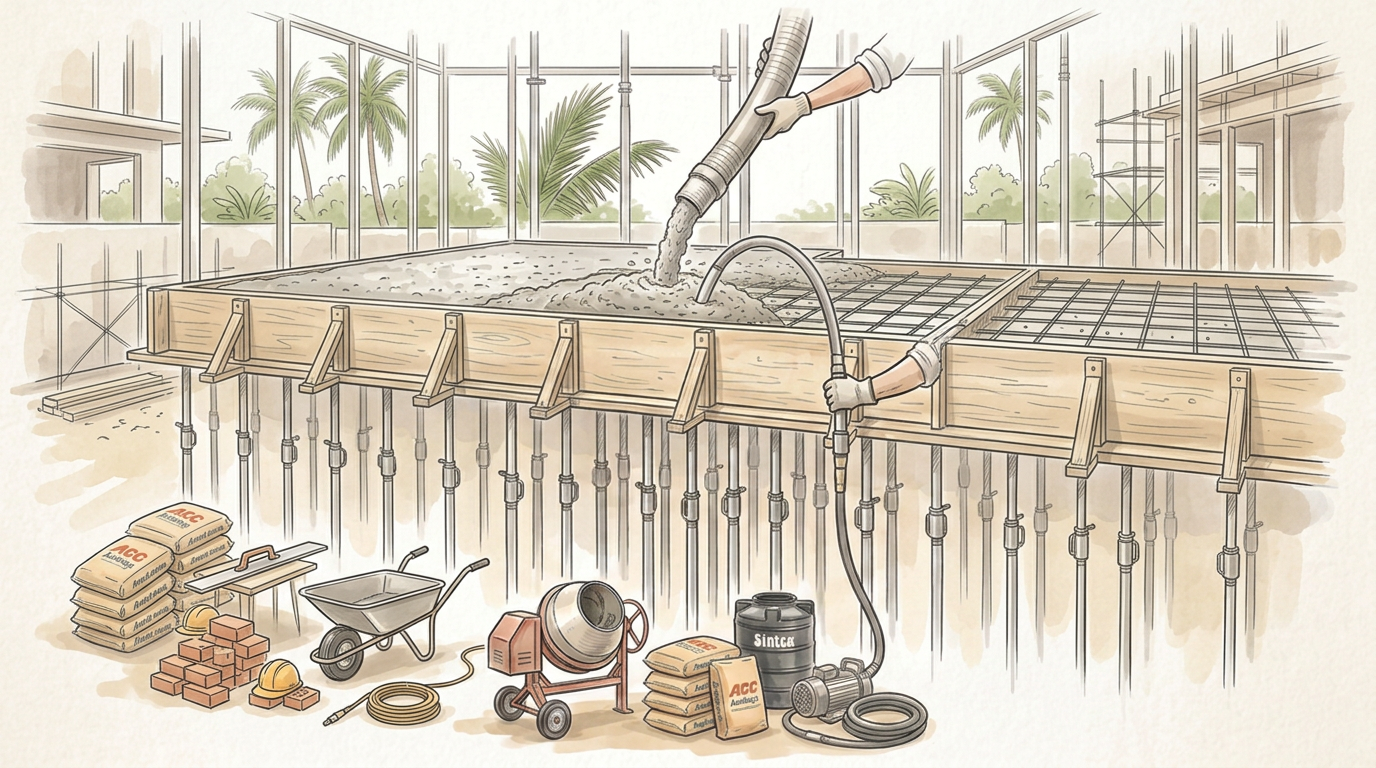
Concrete pouring for a slab or beam is one of the most time-sensitive stages in house construction. Once mixing starts and labour begins lifting or pumping concrete, the site cannot run on assumptions. If cement runs short, sand finishes midway, the mixer stops, or water supply fails, the slab pour gets interrupted and the quality of the entire structural member can suffer. In Indian self-construction projects, this usually happens not because the work is difficult, but because the planning before casting was casual.
For a homeowner, the first job is to treat slab concreting as a planned operation, not as a normal daily activity on site. The volume of concrete should be calculated in advance for slab areas, beams, and any extra thick zones. From that quantity, the contractor or engineer should estimate cement, sand, aggregate, water, labour, vibration time, and the expected duration of the pour. In cities like Lucknow, Pune, Indore, and Hyderabad, even a few hours of delay can raise labour charges and create cold-joint risk if the pour is not continuous.
- Calculate total concrete volume before finalizing the casting date.
- Convert that volume into cement, sand, and aggregate requirement in advance.
- Include a safety margin for wastage, beam depth variations, and small site errors.
- Treat slab concreting as a one-day operation that cannot depend on last-minute buying.
- Ask your engineer or contractor to explain the full pour sequence before work starts.
Check Materials, Contractor Scope, and Machine Readiness
Many owners focus only on concrete quantity and forget the execution system behind it. On residential sites, the labour contractor often quotes slab casting by square foot or by work package, but the exact scope can vary. Some contractors bring their own mixer machine, ropes, pans, vibrators, and labour team, while others expect the owner to arrange diesel, water line extensions, or backup tools. If this is not clarified before the pour, confusion starts exactly when concrete must move quickly.
Material availability must also be physically verified, not just discussed on phone. Cement bags should already be stacked on site, aggregate should be clean and sufficient, sand should be measured properly, and the mixer machine should be checked for fuel or oil. A frequent site problem is that the machine stops mid-pour because diesel ends or the mixer develops a fault. On plotted house projects in Jaipur, Patna, and outer Bengaluru, this kind of “small” issue often disrupts the entire casting cycle and forces workers to wait while concrete setting has already begun.
- Confirm whether the contractor is supplying labour only or labour plus machine and tools.
- Verify cement, sand, and aggregate stock physically a day before casting.
- Check the mixer machine, diesel, oil, belts, and operator availability in advance.
- Keep backup arrangements for fuel and minor machine repair items nearby.
- Lock the contractor rate and scope clearly so there is no argument during the pour.
Warning:
Ensure Water, Electricity, and Backup Utilities Are Ready
Concrete needs uninterrupted water not only for mixing, but also for cleaning, vibration support, finishing, and post-pour curing preparation. If your house has a borewell and pump, that helps, but you still need to confirm that the pump, pipe connection, and storage capacity are working properly. If there is no permanent water source, tanker supply or stored water drums should be arranged well in advance. A slab pour should never pause because the site ran out of usable water.
Electricity is equally important because mixer machines, needle vibrators, pumps, and temporary lighting may depend on it. In many Indian construction sites, especially in developing colonies or peri-urban areas, power cuts are common. That is why backup planning matters. If power is unreliable, keep a generator or alternate power arrangement ready. In monsoon season or in areas with unstable supply such as new layouts near Gurugram, Bhubaneswar, or tier-2 city outskirts, this check is not optional.
- Confirm water source, pump, pipe route, and storage before the pour starts.
- Keep enough water on site so mixing does not stop during a power issue.
- Check temporary electrical wiring for mixer, vibrator, and pump equipment.
- Arrange generator backup where power supply is uncertain.
- Ask the team who will handle water filling and power switching during the cast.
Tip:
Inspect Shuttering, Staging, Cover Blocks, and Reinforcement Before Pouring
Before the first concrete batch is placed, the slab support system must be rechecked carefully. Staging and shuttering may look fine when empty, but wet concrete adds heavy load quickly. If the base below staging is weak, if the shuttering has loose joints, or if the beam bottoms are not supported properly, the system can settle or leak during casting. That is why staging quality, shutter tightness, and alignment should be verified again on the actual casting day.
Reinforcement details also need attention before concrete covers them permanently. Cover blocks must be in place at the slab bottom, beam sides, and other required locations so steel remains at the correct distance from the shuttering. If cover blocks are missing or displaced, the effective cover reduces and steel may become exposed later. Many residential sites in Ahmedabad, Nagpur, and Coimbatore ignore this because the team is rushing to start pouring, but this is exactly when the owner or site engineer should slow the work down for one final structural check.
Use this pre-pour checklist before approving slab concrete:
- Staging is vertical, firm, and bearing on a stable surface.
- Shuttering joints are tight and there are no obvious leakage gaps.
- Beam bottoms and slab areas are level and properly supported.
- Cover blocks are placed correctly below slab steel and at beam sides.
- Reinforcement spacing, laps, and bar positions are already approved.
- Openings for electrical conduits, sleeves, or plumbing points are checked.
- No loose debris, wood pieces, or binding waste remain inside the formwork.
- Recheck staging and shuttering on the same day as the pour, not only earlier.
- Confirm cover blocks before concrete placement starts because later correction is impossible.
- Look for leakage points under beams, slab edges, and patched shuttering zones.
- Ensure all embedded services are placed before concrete covers the slab.
- Stop the cast if any major support or cover issue is still unresolved.
Manage Labour, Supervision, and Concrete Vibration During the Pour
Good concrete is not only about the mix ratio. It also depends on how the site team handles placement, compaction, and supervision minute by minute. Labour count should match slab size, carrying distance, and speed of work. If the team is too small, workers get tired, batching becomes inconsistent, and the pour slows down. If the site is large or access is difficult, labour planning becomes even more important. On many house projects, owners discover too late that the team is under-manned for the slab area being cast.
Supervision must stay active throughout the operation. At least one responsible person should monitor batching, one should watch reinforcement cover and concrete spread on top, and one or two workers should remain below the slab to check for leakage, loose shuttering, or any staging distress. Needle vibrators are critical for compaction, especially in beam zones and congested reinforcement. Since vibrators often fail in the middle of work, keeping two or more working units is far safer than relying on one machine.
- Match labour count to slab area, lifting method, and total pour duration.
- Keep dedicated supervision for top-side work and bottom-side shutter observation.
- Place at least one worker below the slab to detect leakage or support movement early.
- Keep backup concrete vibrators ready because failure during compaction is common.
- Do not allow random labour decisions to replace engineer or supervisor control.
Control Mix Quality, Sequence, and Emergency Response on Casting Day
One of the most common slab casting mistakes is leaving concrete proportioning entirely to labour judgment. If cement, sand, ballast, and water are added casually, batch quality changes from one mixer load to the next. That leads to inconsistent strength, poor compaction, honeycombing, and uneven finish. Residential owners often assume labour “knows the mix,” but the safer approach is to define the batch proportion clearly before work begins and keep checking it throughout the pour.
The casting sequence should also be planned. The pour should move systematically across the slab so there is no random piling of concrete in one place, no excessive delay between zones, and no confusion at beam intersections. If leakage begins below, if shuttering shifts, or if staging shows distress, the supervisor must stop the pour immediately and correct the issue before continuing. Quick reaction matters. A small leak caught early may only need tightening, while a neglected one can widen into a dangerous formwork failure.
- Fix the concrete mix proportion clearly before the first batch is made.
- Monitor every few batches so labour does not change cement or water quantity casually.
- Pour in a planned sequence instead of dumping concrete at random locations.
- Stop immediately if shuttering opens, concrete leaks heavily, or support movement is noticed.
- Keep the engineer or experienced supervisor available until the entire slab is compacted and levelled.
Final Site Discipline After Placement and Before Initial Set
Once concrete has been placed and vibrated, the work is not finished. The slab surface should be levelled properly, roughness or finish requirement should be decided, and edge zones should be checked again. Some owners want a rough top surface for the next construction layer, while others want a more controlled finish depending on whether the slab will later receive screed, waterproofing, or flooring treatment. This decision should be made in advance so the labour team does not improvise after the concrete has already started setting.
After placement, the site should remain disciplined for the next few hours. Avoid unnecessary walking on fresh concrete, keep tools organized, and prepare for early curing arrangements. If any area looks weak, segregated, or under-compacted, it is easier to address immediately than after initial set. Across self-built homes in Chennai, Bhopal, and Noida, the difference between a sound slab and a problematic slab often comes down to whether the owner maintained control during the last hour of casting instead of leaving the site too early.
- Decide the required top finish before the pour, not after levelling starts.
- Restrict unnecessary movement on the slab once final compaction is done.
- Recheck beam edges, slab corners, and service opening zones before initial set.
- Prepare curing arrangements immediately after finishing is complete.
- Stay on site until the slab is stable, levelled, and all major risks are closed.