Building a House
Buying LandEssential
Plot Orientation and Basic Planning
Choose a plot that works for light, access, drainage, approvals, and future home planning.
9 min read· Last updated 12 Apr 2026
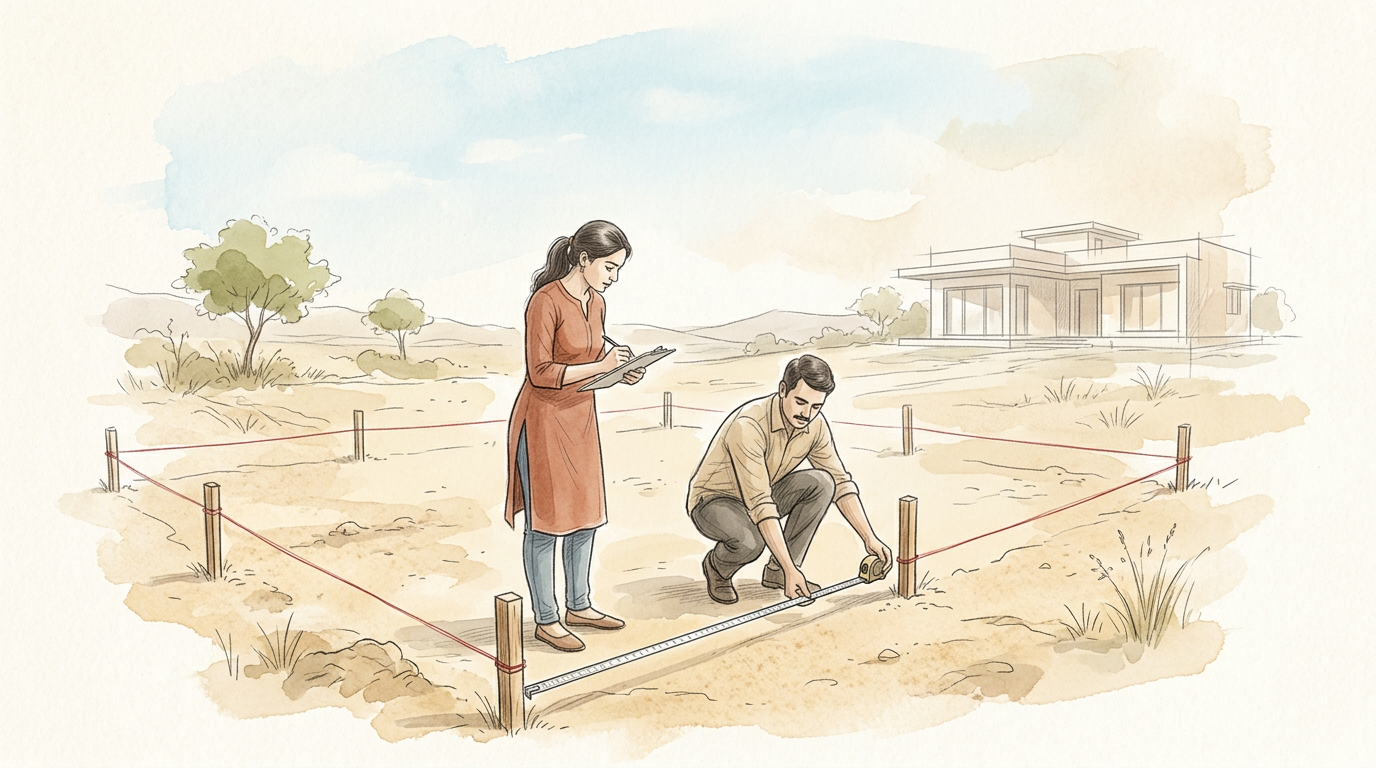
Buying a plot is not just about price, area, or location. The orientation of the site, the road position, the shape of the land, and the way you will eventually plan the house all affect comfort, resale value, and construction efficiency. Many buyers in India focus only on whether a plot is north facing or east facing, but that is only one part of the decision.
A good residential plot should support practical planning from day one. It should allow proper entry, natural light, drainage, parking, setbacks, and a sensible room layout. If these basics are ignored, even a plot in a strong location can become difficult to design or expensive to build.
Why Plot Orientation Matters
Plot orientation decides how your home will relate to the road, the sun path, prevailing breeze, privacy, and front open space. In most Indian cities, north and east facing plots are popular because they are easier to plan for softer daylight and more comfortable front-side use. They also tend to be easier to market later because buyers are already familiar with these preferences.
That said, a south-facing or west-facing plot is not automatically a bad plot. A well-planned plot in these directions can still work very well if the entry, shading, room placement, and ventilation are handled correctly. In hot cities such as Ahmedabad, Jaipur, or Nagpur, this becomes especially important because afternoon heat gain can affect the front elevation and interior comfort.
What matters most is whether the plot allows a practical and balanced house plan. If the frontage is usable, the access point is sensible, and the building can respond well to light and heat, the plot can still be a strong choice even if it is not the most preferred facing in the market.
How to Assess Facing, Entry, and Road Position
Before finalising a plot, confirm the actual facing on site instead of relying only on the broker's description. A plot is generally described by the direction you face when standing inside the plot and looking toward the road. Use a compass app, but cross-check with a site plan because irregular roads, curved layouts, and corner plots can create confusion.
The entry position matters almost as much as the facing itself. For example, an east-facing plot with a practical entry near the north-east side may be easier to plan than an east-facing plot where the only workable gate falls awkwardly near a service corner. Similarly, on north-facing plots, the exact gate and driveway location can influence parking, stair placement, and the flow of the ground floor.
For a first-time home builder, these are the most important road-side checks:
- Confirm whether the plot has one road, two roads, or a corner-road advantage.
- Check whether the road width is enough for car access, material movement, and future traffic growth.
- See if the driveway or gate can be placed without blocking parking, septic lines, or staircase planning.
- Verify whether the local layout rules force a mirrored house pattern, fixed setback line, or restricted gate position.
Plot Shape, Proportion, and Buildable Area
A regular plot is always easier to use than an irregular one. Square and rectangular plots usually allow cleaner room planning, better structural grids, and less wasted space. They are also easier for parking layout, staircase placement, and future expansion. Odd corners, sharp cuts, or tapered rear portions can reduce usable carpet area even when the total plot size looks attractive on paper.
In practical terms, do not judge a plot only by its total square footage. What matters is the buildable portion after setbacks, access movement, utility zones, and structural planning. A 1,500 sq ft rectangular plot may perform better than a larger but distorted plot where the corners are cut or the frontage is too narrow for a proper house entry and car park.
Some shapes also create planning trade-offs:
- Broad-front plots are usually more flexible for frontage design, parking, and natural light.
- Very narrow-front plots often force long passages and reduce layout efficiency.
- Tapered plots can create unusable corners and awkward room sizes.
- Corner cuts or extensions may affect compound wall alignment and service planning.
Buyers who follow Vastu preferences usually prefer cleaner shapes and avoid major missing corners. Even if you are not selecting a plot primarily on Vastu, regular geometry still makes sense from a design, cost, and resale perspective.
Slope, Soil, and Drainage Cannot Be Ignored
A plot should not trap water. Even a slight natural slope can make a big difference to drainage, foundation planning, and long-term maintenance. During the monsoon, a poorly graded plot can create waterlogging, dampness, and boundary wall problems. This is especially common in low-lying plots on the edge of expanding layouts around Bengaluru, Hyderabad, Pune, and tier-2 city extensions.
If possible, observe the direction in which rainwater naturally moves. A plot with manageable drainage is far better than one that sits lower than the road or receives runoff from neighboring sites. If the road level is already high and the plot is low, you may spend later on filling, retaining, and plinth correction. That affects both budget and timeline.
Do not skip ground reality checks:
- Ask whether the plot was previously filled land, pond area, or agricultural low patch.
- Check if the soil looks recently dumped or uneven across the site.
- Ask nearby owners if the area floods during heavy rain.
- If the budget is significant, get a basic soil and bearing-capacity opinion before construction planning.
In older practice, buyers also paid attention to the nature and past use of the land. Even today, it is sensible to ask what stood there earlier. Land that previously hosted a workshop, chemical activity, waste dumping, or a structure with unresolved debris issues may need extra caution before residential use.
Look Beyond the Plot: Surroundings Matter
A plot can look fine in isolation and still become a poor choice because of its surroundings. Start with the road approach. A site at the dead end of a narrow internal road, or one that directly receives road momentum at a T-junction, can create safety, privacy, and planning issues. Corner visibility may sound attractive, but it must be balanced with traffic movement and boundary design.
Also look at what sits around the plot. If your plot is small but flanked by much taller buildings, you may lose daylight, privacy, and airflow. If a large structure sits immediately opposite the site, the front setback may feel compressed and less usable. This is common in redeveloping city neighborhoods where vacant plots remain between already-built houses.
Use this shortlist before paying token money:
- No obvious waterlogging marks on the road or site edge
- Road access is wide enough for car entry and construction vehicles
- No severe squeeze from adjacent tall buildings
- No dead-end pressure or unsafe traffic movement at the site front
- Power poles, drains, transformers, or manholes do not block the likely gate
- The surrounding area feels residentially compatible for the next 5 to 10 years
Basic Planning Questions to Ask Before Finalising
Even before you hire an architect for detailed design, you should mentally test whether the plot can support your future house. Think about parking, staircase position, septic or sewer line planning, underground water tank placement, overhead tank routing, and whether the first floor can be added later without disturbing the entire house. These questions reveal whether the plot is truly usable for your family.
In India, plot planning is also tied to local regulations. Municipal or development authority rules may control front setbacks, side margins, permissible built-up area, height, and corner plot treatment. A plot that looks generous can become restrictive once these rules are applied. This is why buyers should always check the approved layout, road reservation, and local building norms before assuming what can be built.
Ask these practical planning questions early:
- Can one car and one two-wheeler be parked comfortably without blocking the main entry?
- Is there enough width for a proper staircase if a rental floor or future first floor is planned?
- Will the setbacks still leave workable room sizes after approval norms are applied?
- Is there clear access for water line, sewer connection, rainwater pipe, and utility meter placement?
- If you want a garden, pooja room, home office, or elder-friendly bedroom on the ground floor, can the plot support it?
This step is where many first-time buyers make mistakes. They buy based on direction and price, then discover later that the frontage is too tight, the parking is awkward, or the municipal setback leaves a weak layout. A simple pre-buy sketch by an architect or engineer can save a large amount of redesign cost later.
Balancing Vastu and Final Decision-Making
For many Indian buyers, Vastu is part of the decision-making process, and that is perfectly reasonable. North, east, and north-east oriented openness is often preferred, and regular shapes with sensible entry placement remain popular. These preferences often overlap with practical design concerns such as daylight, ventilation, frontage usability, and easier planning.
The mistake is to use facing as the only filter. A north-facing plot with poor drainage, irregular shape, blocked frontage, or no room for parking is not a smart buy. A well-proportioned south-facing or west-facing plot with proper entry planning, shading, and a workable floor plan may perform better in daily life. Treat Vastu as one layer of evaluation, but pair it with technical checks such as setbacks, road level, soil condition, utility routing, and layout feasibility.
Once you shortlist two or three plots, compare them on function, not emotion. Create a simple scorecard for road width, direction, shape, slope, sunlight, entry position, utility access, and future expansion. If needed, get a quick pre-purchase review from an architect or engineer. A good residential plot in India is one that supports a comfortable house, smooth approvals, manageable construction, and long-term livability.