Building a House
Buying LandEssential
Hidden Costs While Buying Land
A practical cost breakdown so your plot budget does not fail after the token payment.
9 min read· Last updated 12 Apr 2026
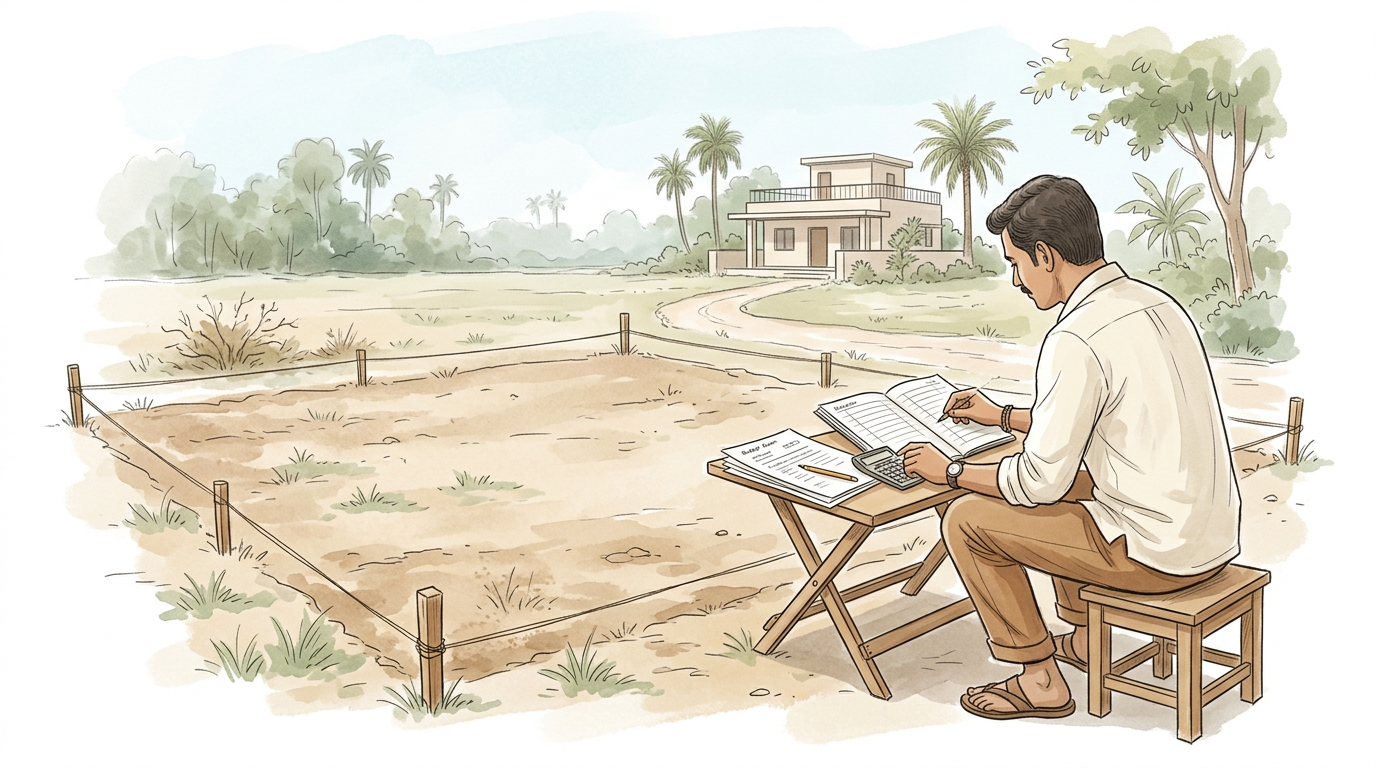
The advertised rate of a plot is rarely the number you finally pay. A layout may be promoted at Rs 3,500 per sq ft, but the final outgo can jump sharply once registration, development charges, legal work, tax compliance, and basic site-preparation costs are added.
That gap matters even more for first-time home builders. If you budget only for the base land price, you may end up delaying registration, borrowing at the last minute, or cutting corners on legal checks and site readiness. The safer approach is to treat the advertised rate as only the starting point.
Why the Advertised Plot Price Is Not the Real Price
The headline price usually reflects only the basic land cost. In a plotted development, this may be calculated on the plot area, while several other charges are added separately for roads, drains, water lines, clubhouse access, or maintenance deposits. In an individual resale plot, the list is different, but the gap still exists because government and legal costs are unavoidable.
A simple example makes this clear. If a 1,200 sq ft plot is advertised at Rs 3,500 per sq ft, the base value is Rs 42 lakh. But once you add stamp duty, registration, legal due diligence, development charges, utility deposits, and post-purchase site work, the total can easily move closer to Rs 48-55 lakh, depending on the city, state, and project structure.
This is why land buyers should always ask for an all-inclusive cost sheet before paying a booking amount. If the seller or developer cannot give a written breakup, treat that as a risk signal rather than a minor sales issue.
Government Charges You Cannot Avoid
The first major addition is stamp duty and registration. These charges vary by state and sometimes by buyer category, gender, municipal limits, and document type, but in practice they often add around 5% to 8% or more to the transaction value. In many states, the duty is calculated on the higher of the agreement value and the circle or guidance value, so a “discounted deal” does not always reduce this cost.
If the total consideration or stamp duty value is Rs 50 lakh or more, buyers should also check whether 1% TDS under Section 194-IA applies. This is commonly missed in property deals. The buyer must deduct it, deposit it through Form 26QB, and issue Form 16B to the seller. Agricultural land is generally outside this rule, but buyers should confirm classification before assuming exemption.
Government-side expenses may also include mutation, khata transfer, property tax updates, survey-related fees, and local cess or transfer charges in some jurisdictions. These may look small individually, but together they can materially change the registration-day cash requirement.
Developer and Project Charges in Plotted Layouts
When you buy in a gated layout or plotted township, the developer often adds charges that do not appear in the ad copy. These may include internal development charges for roads, storm-water drains, sewer lines, water pipelines, street lighting, electrical cabling, security systems, landscaping, and common-area finishing. Some projects quote a single development amount, while others split it into several heads.
Preferential location charges are another common add-on. A corner plot, park-facing plot, wider-road plot, east-facing plot, or plot near the entrance or clubhouse may be sold at a premium. In some cities, these premiums are modest; in high-demand micro-markets, they can materially increase the rate per square foot.
Clubhouse membership, corpus fund, advance maintenance, transformer or electrification charges, and water connection charges may also be collected upfront. In a plotted development, these charges are not always unreasonable, but they should be specific, documented, and linked to actual facilities rather than vague “future infrastructure” promises.
Legal and Compliance Costs Buyers Often Ignore
Many buyers spend weeks negotiating price and almost no time budgeting for legal verification. That is backwards. A competent property lawyer should check title flow, parent documents, encumbrance certificate, mutation records, approved layout plan, conversion status, access road rights, and whether the land falls under acquisition, litigation, or restricted-use categories. This cost is small compared with the damage caused by a defective title.
For land, compliance is especially important because not every plot is immediately ready for home construction. The buyer may need to verify non-agricultural conversion, land-use permissions, zoning rules, setback requirements, road width compliance, and whether the plot is in an approved layout under the relevant local authority. A cheap plot with an unclear approval trail can become an expensive legal problem.
Other overlooked items include demarcation and survey charges, khata transfer assistance, old property tax arrears, document drafting fees, notarisation, and bank or authority certification costs. If the seller says “everything is clear,” ask for the exact documents, not verbal comfort.
Costs That Start After You Buy the Land
Many buyers think the spending stops once registration is complete. In reality, the next wave begins before construction even starts. A vacant plot may need site clearing, debris removal, filling, levelling, temporary fencing, boundary wall work, gate installation, and soil testing. If the plot sits lower than road level or has poor drainage, the correction cost can be significant.
Utilities are another common surprise. Water, electricity, sewage, and storm-water connections may involve application fees, deposits, line-extension costs, and contractor charges. In peripheral areas, municipal water may not be available immediately, which means additional spending on tanker dependence, borewell work, storage tanks, or septic arrangements until full services arrive.
If you are buying in a society, recurring maintenance starts earlier than most people expect. Even before construction, you may be asked to contribute toward security, common lighting, road upkeep, waste removal, and clubhouse operations. These ongoing costs should be treated as part of land ownership, not as an afterthought.
Financing, Tax, and Transaction Costs That Distort the Budget
If you are buying land through a loan, the lender will add its own layer of costs. These may include processing fees, legal and technical valuation charges, mortgage creation charges, insurance bundling, and documentation expenses. Land loans also usually have stricter eligibility rules, shorter tenures, and higher EMI pressure than home loans, which affects the practical affordability of the purchase.
Brokerage is another cost buyers forget to budget for. In resale deals, brokers may charge a percentage of transaction value or a fixed fee. Even when the seller claims “no brokerage,” indirect transaction handling charges sometimes appear through document support, local liaison, or market-introduction fees. These should be discussed upfront, not on the day of token payment.
There is also an opportunity-cost angle. If a project demands multiple upfront charges before registration or if possession of infrastructure is delayed, your money stays locked without making the plot build-ready. That is why the real question is not only “What is the land price?” but also “How much cash must I deploy before I can legally register and practically start building?”
A Practical Checklist Before You Finalise the Deal
Before you commit, ask the seller or developer for one sheet that combines base price, government charges, developer charges, legal costs, and post-purchase readiness costs. If they provide only a promotional leaflet and avoid a full breakup, slow down. Good land deals survive scrutiny.
Use this quick checklist before paying the booking amount:
- Ask for the total payable amount, not just the per-square-foot rate.
- Confirm stamp duty, registration, mutation, and khata-transfer costs for your state.
- Check whether
1% TDSapplies and who will handleForm 26QBcompliance. - Verify layout approval, conversion status, title chain, and encumbrance certificate.
- Get every development charge, PLC, clubhouse fee, and maintenance deposit in writing.
- Confirm whether GST is applicable to any part of the transaction.
- Budget separately for legal review, survey, site levelling, utility connections, and boundary work.
Once you have the cost sheet, compare at least two or three options on the same basis. Do not compare one project’s basic rate with another project’s near all-inclusive rate. The better comparison is the final cost per usable plot plus the time and money required to make it construction-ready.
Here is a simple way to think about the total:
- Start with the basic land value.
- Add all government charges payable at registration.
- Add layout or developer charges, if any.
- Add legal, survey, and compliance expenses.
- Add site-readiness and utility costs before construction.
- Add financing and transaction costs if you are borrowing or using a broker.