Building a House
Pricing & NegotiationEssential
Stamp Duty & Registration
A practical India-focused guide to costs, calculation, documents, payment options, and legal ways to reduce stamp duty.
7 minutes read· Last updated 28 Apr 2026
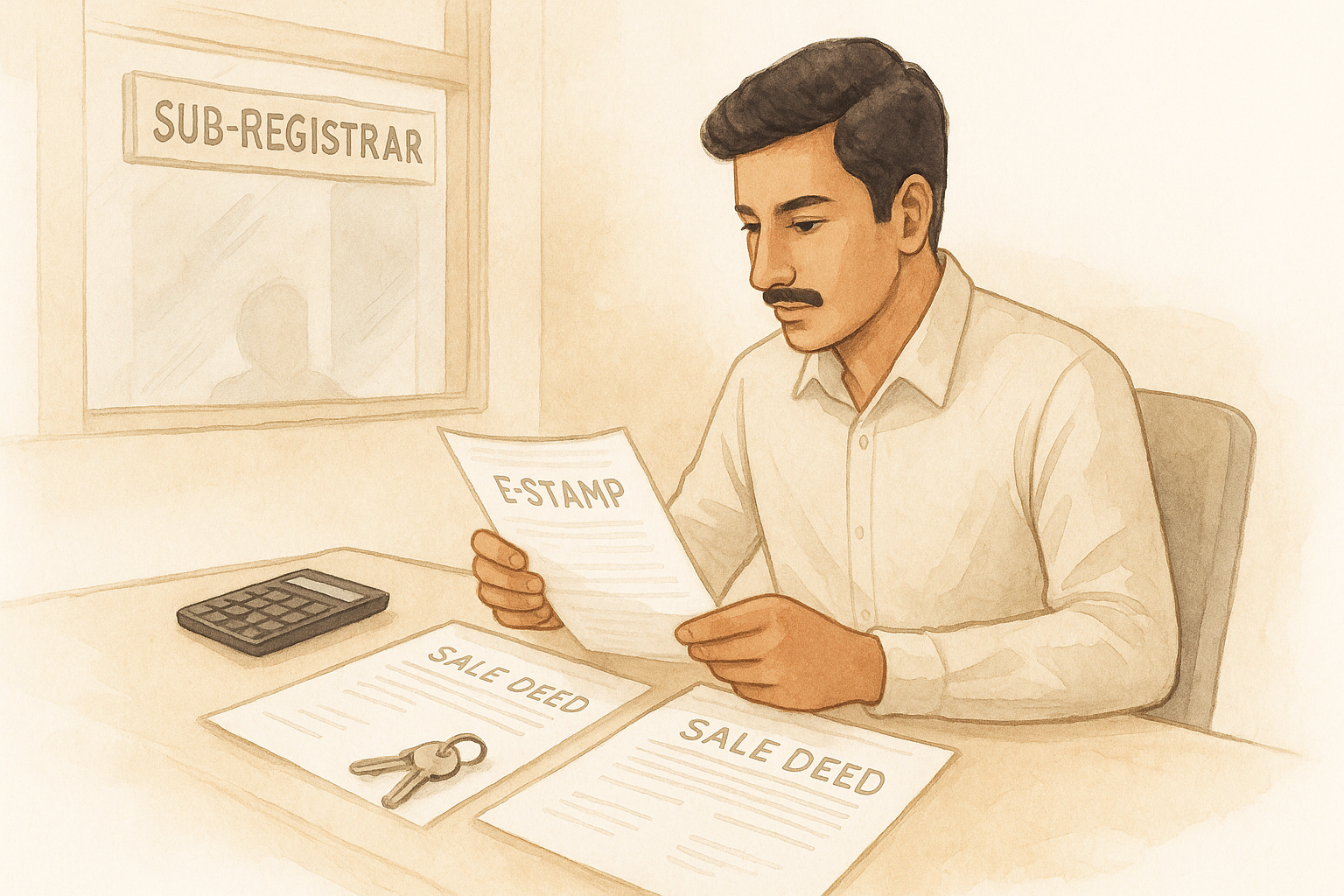
Buying a property in India is not complete when the seller accepts your payment or hands over the keys. The legal transfer usually becomes strong only when the correct deed is executed, stamp duty is paid, and the document is registered with the sub-registrar.
Stamp duty and registration charges can feel heavy because they often run into lakhs of rupees. But they are not optional costs. They are government charges that make your property document legally usable, protect ownership records, and help you prove title if a dispute arises later.
What Is Stamp Duty and Why Registration Matters
Stamp duty is a state government tax paid on certain legal documents, especially documents that transfer property or property rights. In a normal property purchase, the main document is the sale deed. Once the sale deed is signed, stamped, and registered, it becomes formal evidence of ownership transfer.
Registration is equally important because it records the transaction with the government. If your original sale deed is lost, a registered document can usually be retrieved as a certified copy from the registration records. If the document is not registered where registration is compulsory, proving ownership can become difficult in court, during resale, or while applying for a home loan.
The Indian Stamp Act, 1899 provides the broad legal framework, but stamp duty rates are decided mainly by state governments. That is why Delhi, Maharashtra, Rajasthan, Karnataka, Tamil Nadu, Haryana, Uttar Pradesh, and other states may have different rates, rebates, and document-wise rules.
Documents on Which Stamp Duty Is Paid
Stamp duty is not limited to sale deeds. It applies whenever ownership, possession, or a property-related right is transferred or recorded through a legal document. The exact duty depends on the type of document and the state where the property is located.
Common property documents that may attract stamp duty and registration include:
- Sale deed, when ownership is transferred from seller to buyer for consideration.
- Gift deed, when property is transferred without sale consideration, often between relatives.
- Exchange deed, when two parties exchange properties.
- Partition deed, when joint or ancestral property is divided among co-owners.
- Lease deed, especially when the lease period is more than 12 months.
- Mortgage deed, when property is offered as security for a loan.
- Power of attorney, especially where rights relating to property are given to another person.
For rental arrangements, many people use an 11-month rent agreement because registration may not be compulsory in many states for leases below 12 months. However, longer lease deeds generally need registration. Commercial leases, warehouse leases, and long-term office agreements should be reviewed carefully because stamp duty can vary based on rent, deposit, tenure, and escalation clauses.
How Stamp Duty Is Calculated: Circle Rate vs Market Value
Stamp duty is usually calculated on the higher of two values: the government-notified value or the actual transaction value. The government value is called by different names in different states. In Delhi and many North Indian states, people commonly call it the circle rate. In Rajasthan, it is often called DLC rate. In Maharashtra, it is known as the Ready Reckoner Rate. In Karnataka, it is the guidance value, and in Tamil Nadu, it is the guideline value.
The circle rate is the minimum value notified by the government for registration in a particular area. For example, if a flat in Gurugram is sold for ₹1.20 crore but the circle-rate value is ₹1 crore, stamp duty is likely to be calculated on ₹1.20 crore because the transaction value is higher. If the market is slow and the same property is sold for ₹80 lakh while the circle-rate value is ₹1 crore, duty may still be calculated on ₹1 crore.
This rule prevents under-reporting of property prices. It also means buyers should calculate duty before finalising the deal. A property may look affordable at the negotiated price, but the stamp duty may be based on a higher government valuation.
Tip:
Typical Stamp Duty and Registration Charges in India
Stamp duty in India commonly ranges from around 3% to 8% of the property value, though some states and document types may be outside this range. Registration charges are often around 1%, but this also depends on the state and may be subject to caps or separate local rules.
Several factors can influence the final amount:
- State and city, because stamp duty is a state subject.
- Gender of the buyer, as many states offer lower rates for women.
- Property type, such as residential, commercial, industrial, agricultural, or institutional.
- Location, because urban properties may attract different rates from rural properties.
- Ownership structure, such as single owner, joint owners, or co-ownership with a woman.
- Document type, because sale deed, gift deed, lease deed, and partition deed are treated differently.
For example, Delhi has historically offered lower stamp duty for female buyers compared to male buyers. If a male buyer pays 6% and a female buyer pays 4%, a property valued at ₹1 crore can create a difference of ₹2 lakh in stamp duty. Joint ownership rates may be different again.
In states like Maharashtra, Karnataka, Rajasthan, and Uttar Pradesh, rates may also change depending on municipal limits, property use, and state notifications. Always check the latest state registration department website or consult a local property lawyer before execution.
Legal Ways to Reduce Stamp Duty
You cannot legally avoid stamp duty where it is mandatory. But you can structure the transaction correctly and use available rebates. The aim should be lawful optimisation, not evasion.
A practical approach includes:
- Buy in a woman’s name where suitable. Many states give stamp duty concessions to female buyers. This can be useful for a family home in Delhi, Noida, Jaipur, Bengaluru, Pune, or other cities where such concessions apply.
- Use the correct government value. If the transaction value is higher, duty is usually payable on that higher value. But do not unnecessarily declare a value above the required basis without understanding the impact.
- Challenge excessive valuation where legally allowed. In some states, if the notified value is clearly higher than the actual market value, the buyer may seek review or reference under the applicable stamp law provisions, often handled through the collector or valuation authority.
- Use a gift deed for eligible family transfers. If a husband transfers property to wife, parents to children, or siblings in states where concessional duty is available for blood relatives, a gift deed may cost much less than a sale deed.
- Use a partition deed for joint or ancestral property. Where family members are dividing inherited or joint property, a partition deed or family settlement may attract lower duty than treating it like a normal sale.
Gift deeds and partition deeds must be drafted carefully. A gift deed should clearly show voluntary transfer without sale consideration. A partition deed should show genuine division of joint rights and should not be used as a disguised sale. State-specific rules matter, because concessional duty for relatives is not identical across India.
How to Pay Stamp Duty and Complete Registration
Stamp duty can be paid in different ways depending on the state. Many states now prefer online payment and e-stamping because it reduces fake stamp paper risk and creates a digital trail. However, traditional methods may still be available in some places.
Common payment methods include:
- E-stamping through authorised platforms or state portals, where you generate an e-stamp certificate after payment.
- Non-judicial stamp paper purchased from an authorised stamp vendor.
- Franking through authorised banks or agencies, where the document is marked after payment of duty.
- Online challan payment through the state registration or treasury portal.
After stamp duty is paid, the document must be executed and registered within the legally permitted time. Under the Registration Act, 1908, many compulsorily registrable documents should be presented for registration within four months from the date of execution. Delays can lead to penalties or refusal, depending on the facts and state process.
At the sub-registrar office, the parties usually provide identity proof, PAN, photographs, property details, previous title documents, payment proof, and witnesses. Biometric verification and photographs are common in many states. For home-loan properties, the bank may also check the registered deed before final loan disbursement or mortgage creation.
Use this checklist before registration day:
- Latest circle rate or guidance value checked
- Correct deed type selected: sale, gift, lease, partition, mortgage, or exchange
- Buyer and seller names match PAN, Aadhaar, and title records
- Stamp duty and registration charges calculated state-wise
- E-stamp, challan, or franking receipt verified
- Property description, boundaries, flat number, floor, and area checked
- Witnesses and original ID documents arranged
- Previous title chain and encumbrance status reviewed
Common Mistakes Buyers Should Avoid
The biggest mistake is assuming that stamp duty is calculated only on the negotiated price. If the circle-rate value is higher, the duty may be calculated on that value. This happens in areas where market prices have corrected but government rates have not been updated quickly.
Another mistake is choosing the wrong document type. For example, a family transfer may be documented as a sale deed even though a gift deed could have been legally cheaper. Similarly, inherited property may be sold among family members instead of being divided through a proper partition deed or family settlement where appropriate.
Buyers should also avoid relying only on brokers for duty calculation. Brokers may know local practice, but errors in valuation, property category, or deed structure can be expensive. For high-value properties in Mumbai, Delhi NCR, Bengaluru, Hyderabad, Chennai, Pune, Ahmedabad, Jaipur, or Lucknow, a quick review by a property lawyer or deed writer familiar with local registration rules is worth the cost.