Building a House
Pricing & NegotiationEssential
Hidden Costs in Property Buying
A practical guide to calculate the real cost of buying a home in India before booking.
7 minutes read· Last updated 28 Apr 2026
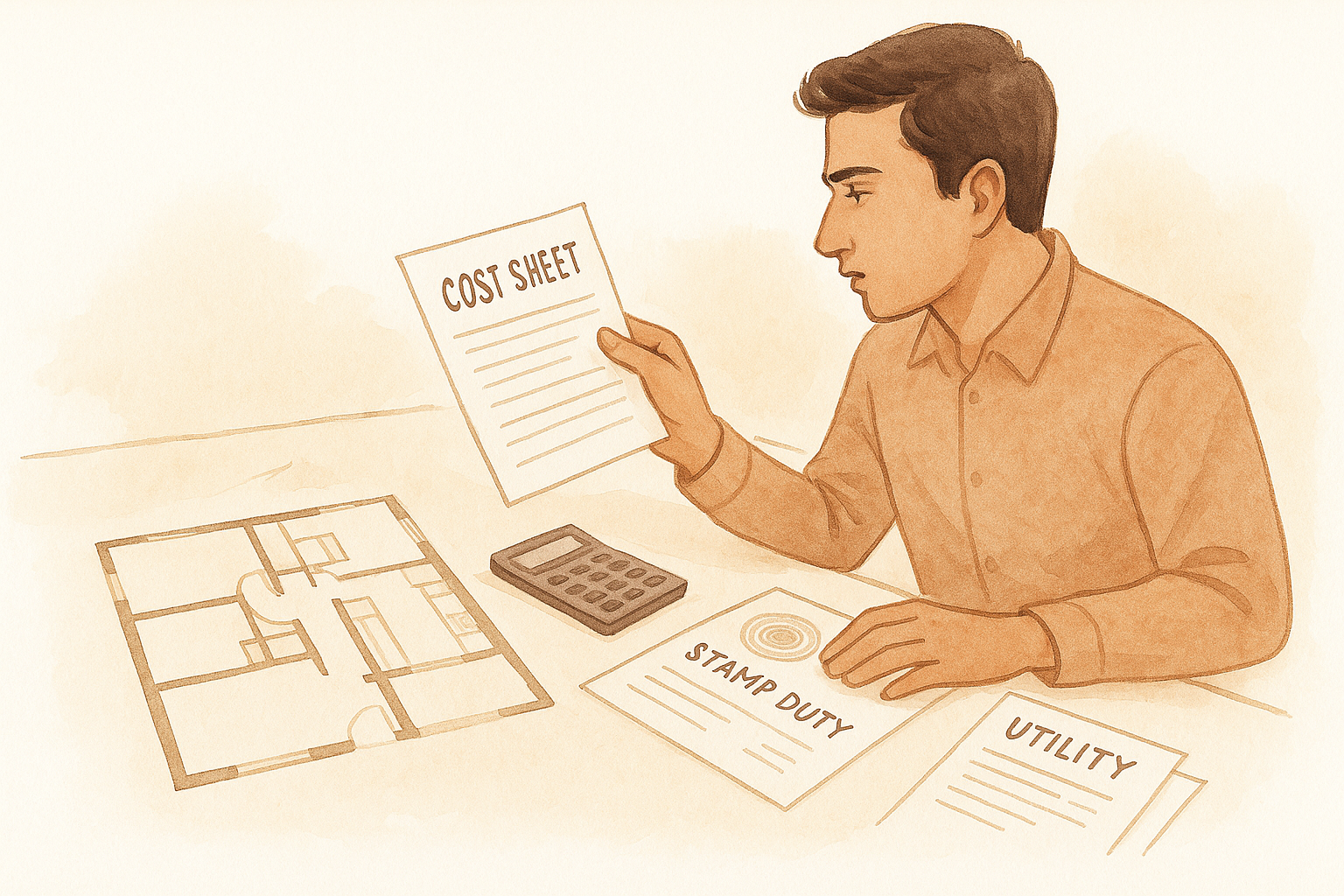
Buying a home in India rarely costs only what the advertisement says. A project brochure may highlight a 3BHK at an attractive “starting price”, but the final amount can rise sharply once floor charges, parking, club membership, GST, stamp duty, registration, maintenance deposits, utility connections and possession-time payments are added.
This is why a flat advertised at ₹1 crore can easily become ₹1.25 crore to ₹1.40 crore before you even include home loan interest. The problem is not always that the builder is charging illegally. The bigger issue is that many buyers read only the headline price and do not decode the full cost sheet.
This guide explains the main cost heads involved in buying a flat or apartment in India, which charges builders usually show, which ones may be hidden in fine print, and how to verify everything before paying the booking amount.
Why the Advertised Property Price Is Not the Final Price
Most builders market the lowest possible number because it looks attractive. This is usually the basic selling price, also called BSP or base price. It may be calculated per sq. ft. on the super built-up area, carpet area or saleable area, depending on how the builder presents the project.
The final home cost is different because multiple charges are added on top of this base price. Some are linked to the apartment, some to the project infrastructure, some to government taxes, and some appear only near possession. In cities like Gurugram, Noida, Mumbai, Pune, Bengaluru and Hyderabad, the gap between advertised price and all-inclusive price can be significant.
A smart buyer should not ask only, “What is the rate per sq. ft.?” The better question is, “What is the total payable amount from booking to possession, including taxes, registration, maintenance, loan charges and all possession-linked payments?”
Sale Consideration: Base Price, PLC and Floor Charges
Sale consideration is the core price of the property paid to the builder or seller. In a new project, it usually includes the basic selling price plus location-based charges. This is the number on which many other calculations, including GST and stamp duty in some cases, may depend.
Preferential Location Charges, commonly called PLC, are added when the apartment has a preferred view or position. For example, a garden-facing, club-facing, pool-facing, corner or park-facing unit may cost more than a regular unit. In premium urban projects, even a better skyline view can attract PLC.
Floor PLC also varies by city and project type. In Delhi NCR, lower floors may command a premium in some societies because buyers prefer easier access. In Mumbai, Bengaluru or Hyderabad high-rises, upper floors often cost more because of better views, ventilation and privacy. Always check whether floor rise charges are already included in the quoted price or added separately.
The sale consideration may include:
- Basic selling price or base price.
- Floor rise charge or floor PLC.
- View PLC such as garden, club, road, lake or city view.
- Corner unit or preferred tower charge.
- Any premium charged for special inventory.
Do not assume that a “starting price” applies to the unit you actually want. The advertised price is often for the least preferred unit, lower specification or limited inventory. Once you choose a better tower, floor or view, the price can move up quickly.
Other Builder Charges: Parking, Club, Infrastructure and Maintenance
After the sale consideration, builders add other charges. These are not always presented in the same format across projects. One builder may include certain items in the base price, while another may show them separately under “other charges”.
Common builder charges include club membership, car parking, power backup, infrastructure charges, fire-fighting charges, common area charges and society formation charges. In some states and projects, infrastructure charges may be labelled as EDC, IDC or development charges. These relate to internal and external development work required to make the project liveable.
Internal development may include water pipelines, sewerage lines, electrical cabling, internal roads, gas pipeline readiness, landscaping and common area facilities. External development may include connecting the project to the main road, municipal water line, drainage system, electricity infrastructure and surrounding access.
Some builders use these charges as marketing tools. For example, an advertisement may say “free club membership” or “free parking”, but the cost may already be adjusted somewhere else in the pricing. What matters is not whether something is called free, but whether the total payable amount is competitive and transparent.
Maintenance-related charges are also important. Builders commonly collect IFMS, which means Interest-Free Maintenance Security. This is a refundable or transferable deposit kept for future major repairs or society-level expenses, depending on the project terms. Many builders also collect 12 months or 24 months of advance maintenance at possession.
Government Taxes: GST, TDS, Stamp Duty and Registration
Government charges are a major part of property buying costs in India. These are not optional and cannot be negotiated with the builder, though the way they are calculated and collected should be clearly understood before booking.
GST applies differently depending on the property stage. If you buy a ready-to-move property with a completion certificate or occupancy certificate, GST is generally not applicable. If you buy an under-construction residential property, GST may apply, commonly 5% for non-affordable housing without input tax credit and 1% for affordable housing, subject to current rules. Certain other charges may attract GST at different rates, often 18%, depending on the nature of the charge.
TDS is another area where many buyers get confused. Under Section 194-IA, if the property value is ₹50 lakh or more, the buyer generally has to deduct 1% TDS from the amount payable to the seller and deposit it with the Income Tax Department. The buyer then provides the TDS certificate to the seller or builder.
This means TDS is usually not an extra cost over and above the property price. It is part of the payment that is routed to the government on behalf of the seller. However, some smaller developers or resale sellers may create confusion by asking for the full amount and expecting the buyer to deposit TDS separately. Clarify this in writing.
Stamp duty and registration charges vary from state to state. Maharashtra, Karnataka, Telangana, Haryana, Uttar Pradesh, Delhi and Tamil Nadu all have different rates, concessions and calculation methods. Stamp duty may range roughly between 4% and 8%, while registration is often around 1% or a fixed amount, depending on the state and property value.
Possession-Time and Hidden Charges Buyers Often Miss
Possession is when many buyers face surprise demands. By this stage, the buyer has already paid most of the amount, the home loan is active, and shifting plans may have started. This makes it difficult to negotiate or delay.
One common possession-time charge is a possession charge or handover charge. It may be 1% to 2% of the sale value or a lump-sum amount. Sometimes it is mentioned in the cost sheet but not added to the total calculation. Buyers see the line item and assume it is included, only to discover later that it is payable separately at handover.
Utility connection charges are another important cost. Do not confuse them with infrastructure development charges. Infrastructure charges may relate to bringing electricity, water, sewage and gas infrastructure into the project. Utility connection charges relate to your individual flat connection, meter installation, name registration and service activation.
Legal and documentation charges can also be split into multiple parts. A builder may charge legal fees for preparing the builder-buyer agreement or sale deed. Later, during registration, you may still need to pay advocate coordination charges, document handling charges, notary charges, scanning charges or court-related facilitation fees.
Home loan costs are often ignored in the property budget. Banks and NBFCs may charge processing fees, legal verification fees, technical valuation fees, MODT charges, franking charges, insurance premiums or administrative fees. For self-employed buyers and business owners, loan processing costs can sometimes be higher because lenders require deeper financial assessment.
Other missed costs may include:
- Meter deposits for electricity, gas or water.
- Move-in charges or refundable shifting deposits.
- Society formation or apartment association charges.
- Corpus fund contribution.
- Interior permission fees or debris removal charges.
- Parking allocation documentation charges.
- Delayed payment interest if loan disbursal is late.
Individually, some of these charges may look small. Together, they can create a sudden burden of several lakhs at possession. This is why buyers should maintain a separate buffer beyond the agreement value.
How to Read a Builder Cost Sheet Before Booking
A builder cost sheet should be treated like a financial document, not a brochure. Read every line item, footnote, asterisk and payment milestone. If something says “payable at actuals” or “to be determined at possession”, ask for the current estimated amount.
Do not rely only on verbal explanations from the sales executive. Sales teams may change, and verbal promises are hard to prove later. If a charge is waived, included or payable later, ask the builder to confirm it by email or include it in the booking form, allotment letter or agreement.
Use this checklist before paying the booking amount:
- Confirm whether the quoted price is based on carpet area, built-up area or super built-up area.
- Check if base price, PLC and floor rise charges are separately shown.
- Verify whether parking, club membership and power backup are included or extra.
- Ask for GST calculation on each charge head.
- Confirm whether TDS will be deducted from builder payment or demanded separately.
- Get stamp duty and registration estimates for your state.
- Ask if IFMS and advance maintenance are refundable, adjustable or transferable.
- Check all possession-time charges and utility connection costs.
- Ask for loan-related charges from your bank before finalising budget.
- Get every clarification in writing by email.
Also compare the cost sheet with the project’s RERA registration details where available. RERA pages often mention carpet area, project status, approvals, completion timelines and promoter details. While RERA may not list every buyer-level charge, it helps you verify whether the project information matches what is being sold.
How to Negotiate and Budget for the Real Home Cost
Once you understand the full cost, you can negotiate better. Builders may not reduce government charges, but they may adjust PLC, club membership, parking, floor rise, payment plan benefits or certain administrative charges. In a slow market or during quarter-end sales targets, developers may offer better flexibility.
Create a total acquisition cost estimate before booking. This should include builder payments, taxes, stamp duty, registration, loan charges, possession charges, interiors, moving costs and a contingency buffer. For a ₹1 crore under-construction flat, keeping an additional 20% to 35% buffer is often safer, depending on the city and project structure.
If you are comparing two projects, do not compare only the basic rate per sq. ft. Compare the final all-inclusive cost for the specific unit you want. A project with a higher base price but fewer add-ons may be better than a project with a low advertised price and many extra charges.
A practical comparison should include:
- Total builder payable amount.
- GST and tax impact.
- Stamp duty and registration.
- Maintenance deposit and advance maintenance.
- Utility and possession charges.
- Home loan processing and insurance costs.
- Expected interior and move-in budget.
The biggest advantage of identifying hidden costs early is control. You can negotiate, arrange funds, choose the right loan amount and avoid last-minute stress. More importantly, you can decide whether the property genuinely fits your budget.