Building a House
Pricing & NegotiationEssential
Home Loan & Builder Payment Plans
Understand common builder payment plans in India before booking an under-construction or ready-to-move home.
7 minutes read· Last updated 28 Apr 2026
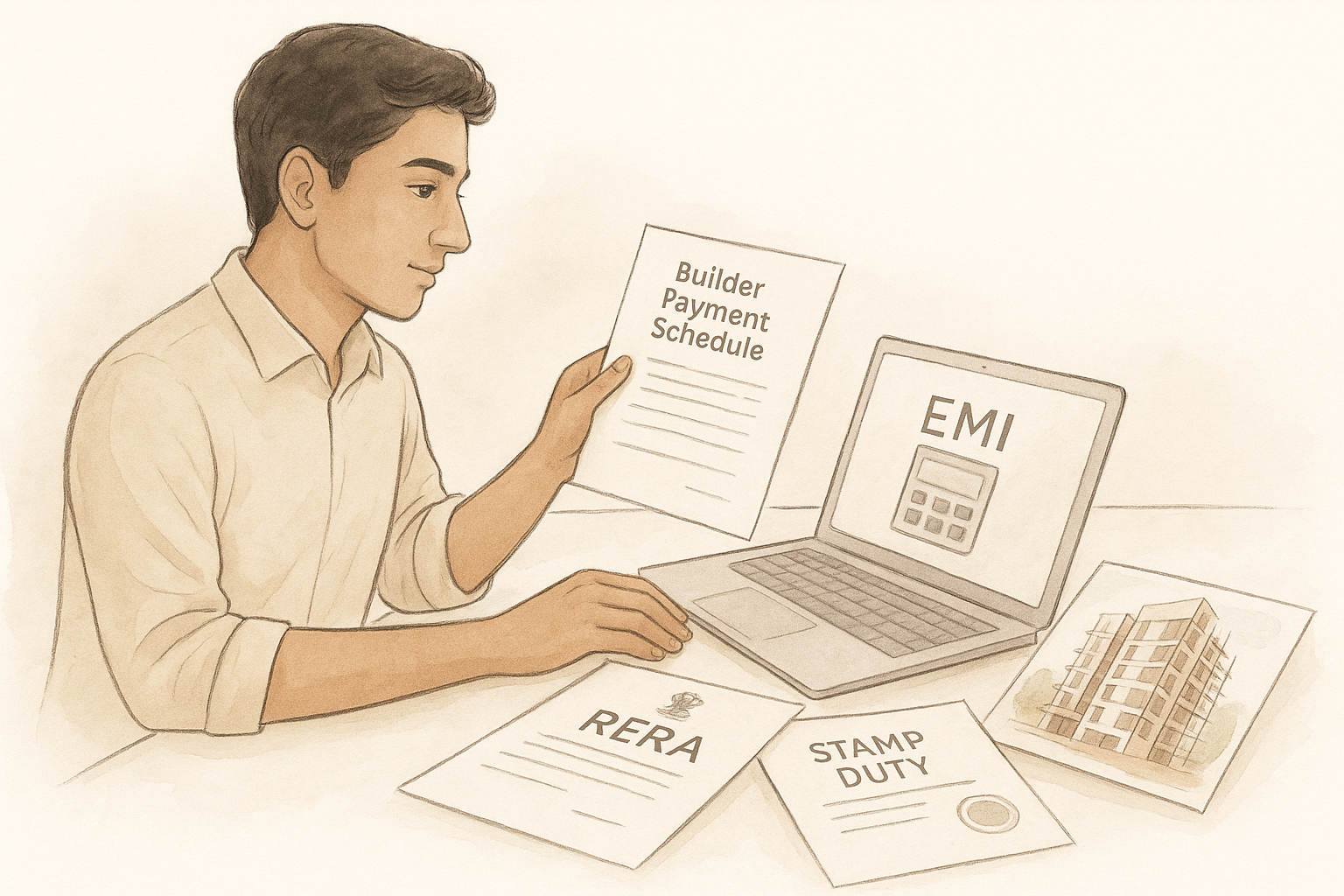
Why Builder Payment Plans Matter for Homebuyers
When you buy a flat in India, the property price is only one part of the decision. The payment plan decides when your money goes out, when your home loan gets disbursed, and how much risk you carry if the project is delayed. This is especially important in under-construction projects in cities like Mumbai, Pune, Bengaluru, Hyderabad, Noida, Gurugram, Chennai, and Ahmedabad, where possession can take two to five years.
A builder may offer a lower price under one plan and more flexibility under another. But the cheapest-looking option is not always the safest. Your choice should depend on your savings, home loan eligibility, current rent, expected possession date, builder track record, and the project’s RERA status.
Most payment plans fall into five broad categories: down payment plan, construction linked plan, flexi payment plan, subvention scheme, and possession linked plan. Each has a different cash-flow pattern, different loan impact, and different level of buyer protection.
Down Payment Plan: Best Price, Higher Delay Risk
In a down payment plan, the buyer pays a large portion of the flat cost at an early stage. Usually, the builder may ask for around 10% at booking and a major balance soon after agreement, bank approval, or a fixed timeline. In many cases, 80% to 90% of the total property cost may be demanded before possession.
The main advantage is pricing. Builders often offer a better discount because they receive money early. If you have strong liquidity or a sanctioned home loan, this plan can reduce the purchase price. It may work for buyers who are purchasing from a financially strong developer with a near-complete project and clear RERA milestones.
The risk is delay. If possession is postponed after you have already paid most of the amount, your bargaining power becomes limited. You may also start paying EMI early if the bank has disbursed a large loan amount. This can create pressure if you are paying rent and EMI together.
Construction Linked Plan and Slab-Based Payments
A construction linked plan, often called CLP, connects your payment schedule to actual construction progress. Typically, you pay around 10% at booking, another amount within a fixed period or at agreement, and the remaining amount in stages as the building reaches milestones such as plinth, podium, slabs, brickwork, plaster, flooring, doors, windows, sanitary fittings, and possession.
This plan is popular for under-construction flats because payments move broadly with progress. If the project moves slowly, your payments also slow down. For home loan buyers, the bank usually disburses money as per the builder’s demand letter and construction stage. During construction, you may pay pre-EMI interest on the disbursed loan amount instead of full EMI, depending on your loan arrangement.
A typical slab-based demand schedule may look like this:
- Around 10% at booking or application stage.
- Additional amount at agreement execution, along with stamp duty and registration.
- Demand at plinth or foundation completion.
- Demand at each slab or group of slabs.
- Demand when superstructure is complete.
- Demand at brickwork, plaster, flooring, doors, windows, and sanitary fittings.
- Final demand at possession, after completion-related formalities.
In some projects, a builder may collect a significant amount by the time the full slab structure is complete. For example, by the time the building reaches full slab completion, the total demand may already be 60% to 70% of the flat cost. The remaining amount may be linked to finishing work and possession. This is why you should not assume CLP is automatically risk-free; you must study the exact demand schedule.
Flexi Payment Plan: A Middle Path Between Price and Safety
A flexi payment plan combines features of the down payment plan and construction linked plan. Usually, the buyer pays 10% at booking and a larger portion, often 30% to 40%, within a short period or at agreement. The remaining 50% to 60% is paid in instalments linked to construction milestones or closer to possession.
This plan reduces the immediate burden compared to a full down payment plan. At the same time, it may give a better price than a pure construction linked or possession linked plan. For salaried buyers with stable income and partial savings, this can be a practical middle option.
The disadvantage is that the discount may be lower than a down payment plan, while the early exposure may still be higher than a construction linked plan. You need to check how much money will be paid before the building reaches meaningful progress. If 40% is payable before major construction, the plan may not be as flexible as it sounds.
Tip:
Subvention Scheme and Possession Linked Plan
In a subvention scheme, the buyer pays a small upfront amount, often 10% to 20%, and the bank disburses the balance to the developer as per a tripartite agreement between buyer, bank, and builder. The builder may promise to pay interest or EMI for a certain period, commonly until possession or for a fixed number of months.
The attraction is simple: the buyer gets time before regular EMI begins. This can be useful if you are living on rent and do not want immediate EMI pressure. However, the loan is still in your name. If the builder fails to service the interest as promised, delays the project, or defaults with the bank, your credit score can be affected. You may also face EMI liability even before possession.
A possession linked plan is safer from a cash-flow perspective. The buyer pays a booking amount at the start and the major balance near possession. If the project is delayed, most of your payment is also delayed. This plan is attractive for buyers who want to reduce construction-stage risk.
However, possession linked plans may come with a higher base price. Builders may offer fewer discounts because they receive less money upfront. Also, if the developer has weak finances, they may not offer a genuine possession linked structure or may add conditions that shift payment earlier. Always read the agreement carefully instead of relying on brochure claims.
Home Loan, EMI, Pre-EMI, TDS, GST and Other Costs
Your builder payment plan directly affects your home loan disbursement. In a ready-to-move property, banks usually disburse the loan in one major tranche after legal and technical checks. In an under-construction property, disbursement happens in stages based on demand letters, construction progress, and the approved loan amount.
If you choose full EMI from the beginning, you start repaying principal and interest immediately on the disbursed amount or full loan, depending on bank policy. If you choose pre-EMI, you pay only interest on the amount disbursed during construction. Pre-EMI reduces monthly burden at first but does not reduce principal, so your overall interest cost may be higher if the project is delayed.
Indian buyers must also plan for statutory and transaction costs. Stamp duty and registration vary by state. Maharashtra, Karnataka, Telangana, Tamil Nadu, Gujarat, Haryana, Uttar Pradesh, and Delhi NCR all have different rates and procedures. GST applies to under-construction residential property, but not generally to completed ready-to-move homes where completion certificate has been issued. TDS under Section 194-IA is applicable when property value exceeds ₹50 lakh, and the buyer must deduct and deposit it as required.
You should also check whether the builder quote includes or excludes parking charges, clubhouse charges, floor rise, preferred location charges, maintenance deposit, legal charges, electricity meter, water connection, corpus fund, and society formation charges. Many buyers calculate only the basic flat cost and later face a large funding gap.
How to Choose the Right Payment Plan
The right builder payment plan depends on your risk comfort and cash position. A buyer with surplus savings may consider a down payment plan only if the project is nearly complete, legally clean, and offered by a reliable developer. A buyer with limited savings and regular salary may prefer construction linked payments because the loan disbursement is spread across construction stages.
A buyer who is already paying high rent should be careful with plans that trigger EMI early. In markets like Mumbai Metropolitan Region, Bengaluru, and Gurugram, rent plus pre-EMI or EMI can become a serious monthly burden. For first-time buyers, predictability is more important than chasing the maximum discount.
Use this checklist before finalising the plan:
- Check the project’s RERA registration and promised possession date.
- Download the payment schedule from the agreement, not just the brochure.
- Confirm whether payments are linked to real construction milestones.
- Ask the bank when EMI or pre-EMI will start.
- Calculate rent plus EMI or pre-EMI for at least 24 to 36 months.
- Verify GST, stamp duty, registration, TDS, and other charges.
- Check the builder’s past delivery record and customer complaints.
- Avoid verbal promises on subvention, discounts, or delayed payment relief.
- Keep an emergency fund after paying booking and agreement amounts.
- Review cancellation, refund, delay compensation, and interest clauses.
If two plans look similar, choose the one that keeps more payment linked to visible progress and possession. A slightly higher price may be worth it if it reduces exposure to delay, loan stress, and uncertainty.