Building a House
Pricing & NegotiationEssential
Risks in Pre-Launch Projects
A practical guide to project stages, RERA checks, marketing tactics, and safer buying decisions in India.
7 min read· Last updated 28 Apr 2026
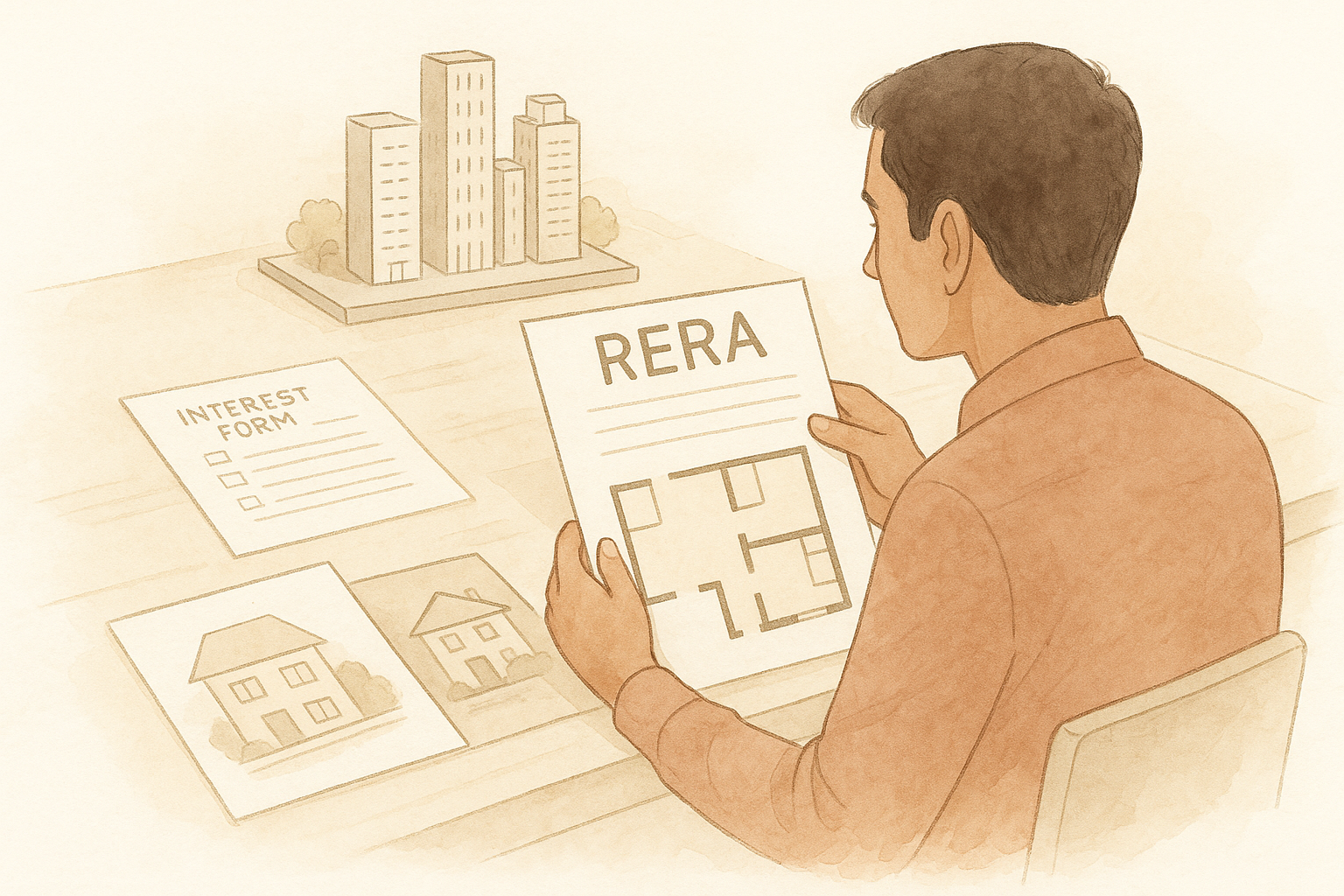
Why Pre-Launch Projects Look So Attractive
A pre-launch property is usually presented as the “first chance” to enter a new residential project before full public marketing begins. Developers and channel partners share limited details such as the land parcel, proposed towers, expected unit mix, tentative sizes, and an approximate price. The promise is simple: buy early and get the lowest price.
This stage feels tempting because Indian homebuyers are repeatedly told that prices will increase after launch. In fast-moving markets such as Gurugram, Noida, Pune, Bengaluru, Hyderabad, Mumbai Metropolitan Region, and Ahmedabad, this fear of missing out can feel real. Sales teams may say that only a few preferred units are available, that the rate will change next week, or that early buyers will get better floors and views.
The attraction is not fake, but it is incomplete. Pre-launch buying can offer pricing advantage and choice, but it also carries higher uncertainty. At this stage, the buyer often has less visibility on final approvals, exact layout, payment terms, possession timeline, amenities, and sometimes even RERA registration status. That is why the decision must be based on verification, not urgency.
Real Estate Project Stages in India: Pre-Launch to Near Possession
Most residential projects move through four broad stages. Understanding these stages helps you compare price, risk, waiting period, and decision comfort. The same project can feel very different at each stage because the available information keeps changing.
- Pre-launch stage: The developer shares basic project information with existing customers, investors, and channel partners. Buyers may be asked for an Expression of Interest, also called EOI. At this point, the lowest price may be offered, but details can be limited.
- Launch stage: The project is formally marketed through newspapers, hoardings, digital campaigns, brokers, and sales offices. Floor plans, payment schedules, price sheets, approvals, and brochures are usually clearer. More end-users enter at this stage.
- Under-construction stage: Construction has started and the project moves through slabs, structure, finishing, and services. Prices may remain stable for long periods, unless the location improves, demand rises, home loan rates change, or infrastructure gets completed.
- Near-possession stage: The building is almost ready, the developer may have applied for Occupancy Certificate or Completion Certificate, and possession can be expected in a few months. Buyers can physically see the product, construction quality, approach road, utilities, and neighbourhood.
The lowest price is usually not the same as the safest price. A pre-launch rate may be lower, but a near-possession home gives far more clarity. A launch-stage home can be a middle path because enough documents are available while some pricing advantage may still remain.
Key Risks in Pre-Launch Projects
The biggest risk in a pre-launch project is incomplete information. A buyer may not know the final master plan, exact carpet area, tower placement, club location, open space, floor rise charges, preferential location charges, parking cost, maintenance deposits, or possession-linked payment structure. If these details change later, the buyer’s expected value can also change.
Another risk is money getting stuck. Many buyers assume that an EOI is harmless because it is refundable. In reality, refund timelines can stretch. If the pre-launch period itself takes one to three months, and cancellation refund takes another one to two months, your money may remain blocked for three to five months. During this time, you may miss another better project, a resale deal, or a ready-to-move opportunity.
There is also the risk of timeline extension. If a project is still waiting for key approvals, the clock to possession may not really start for you. A project that takes four to five years after proper launch can feel much longer if you entered several months before registration, approvals, or formal allotment. For end-users planning school admissions, rental exits, or family relocation, this delay can be costly.
RERA Checks Before Paying Any Token or EOI
RERA has changed the Indian real estate market by forcing greater discipline, disclosure, and accountability. Under RERA, a developer cannot advertise, market, sell, offer for sale, invite people to purchase, or accept booking for a real estate project without registration, if the project falls under RERA registration requirements. This is a crucial protection for homebuyers.
In practice, buyers must still be careful. In some markets, a few developers or sellers may start “soft marketing” after applying for RERA but before receiving the registration number. This is risky. RERA application is not the same as RERA approval. The authority can ask for changes, clarifications, corrections, or additional documents. That can delay launch and may also change project details.
Before paying any amount, verify the RERA number on the official state RERA website. For example, Maharashtra buyers should check MahaRERA, Uttar Pradesh buyers should check UPRERA, Haryana buyers should check HRERA Gurugram or HRERA Panchkula as applicable, and Karnataka buyers should check Karnataka RERA. Match the project name, promoter name, land details, sanctioned plans, completion date, approvals, and uploaded documents.
- Check whether the project has a valid RERA registration number.
- Verify the registration on the official state RERA portal, not only on a brochure.
- Match the promoter name with the entity receiving your payment.
- Read the RERA completion date and compare it with sales promises.
- Ask for sanctioned plans, land title details, and approval status.
- Confirm whether the EOI amount is refundable and within how many days.
- Avoid cash payments and insist on proper receipts.
Marketing Tactics Developers Use at Pre-Launch and Launch
Developers use urgency because homebuying decisions take time. A buyer naturally wants to compare projects, discuss with family, check loans, visit the site, and think about long-term affordability. Sales teams try to shorten this cycle by creating scarcity around price, floor choice, view, and offers.
At pre-launch, the common message is that today’s rate will never come back. At launch, the message changes slightly: “This is the last week of pre-launch pricing.” Developers may also add offers such as a modular kitchen, gold coin, international trip, free club membership, zero floor rise for selected units, or limited-period payment plans. These offers are designed to make delay feel expensive.
The smart way to judge an offer is to calculate the net effective price. A project advertised at ₹12,000 per sq ft with discounts, waived charges, or free fittings may not be very different from a pre-launch quote of ₹11,800 per sq ft once all costs are added. Always compare total cost, including GST, stamp duty, registration, parking, maintenance deposit, floor rise, PLC, legal charges, and corpus fund.
- Ask for the full cost sheet, not only the per sq ft rate.
- Compare carpet area and usable area, not just saleable area.
- Check whether offers are included in the agreement or only promised verbally.
- Ask whether the payment plan is construction-linked, time-linked, or subvention-based.
- Compare two to three competing projects in the same micro-market.
- Take at least one day before paying, even if the sales team says the offer ends today.
In high-demand micro-markets, early pricing gaps can be meaningful. Examples include areas near new metro lines, expressways, IT corridors, airport zones, or large employment hubs. But in average-demand locations, the difference between pre-launch and launch price may be much smaller after discounts. Do not assume that early always means significantly cheaper.
When Each Buying Stage Makes Sense
Buying at pre-launch can make sense for investors or experienced buyers who understand the developer, location, and market cycle. It may also work for end-users who have a long waiting period, stable finances, and strong confidence in the builder’s delivery record. However, this should only be considered after RERA registration and basic document verification.
The launch stage is often more comfortable for regular homebuyers. By then, project details are clearer, the master plan is available, banks may start loan evaluation, and more official documents can be checked. The price may be slightly higher than pre-launch, but the increase is often worth the added clarity, especially for first-time buyers.
Near possession is attractive for end-users because the product is visible. You can inspect tower placement, lobby size, approach road, neighbouring construction, sunlight, ventilation, lifts, parking access, water supply, electricity connection, and nearby social infrastructure. The price may be higher, but the risk is lower because you are buying something you can evaluate physically.
Under-construction projects sit between these stages. Their value depends heavily on construction progress and external factors. If a metro station, ring road, flyover, office district, school belt, or hospital cluster becomes operational nearby, prices may move up. If home loan interest rates rise sharply or the broader market slows, appreciation can pause even if the project is good.
How to Make a Safer Pre-Launch Decision
The first rule is to slow down. Same-day booking is rarely necessary for a lifetime financial decision. If a project is genuinely good, it will still be worth evaluating after you check documents, understand pricing, and compare alternatives. Urgency should not replace due diligence.
Focus on the developer’s capability. Check whether the builder has delivered similar-scale projects before, whether past buyers received possession on time, whether maintenance handover was smooth, and whether promised amenities were actually completed. A branded developer with a strong track record reduces risk, but even branded projects must be verified.
Also evaluate your own situation. If you are buying for self-use and need the home within one or two years, pre-launch may not suit you. If you are comfortable waiting four to five years, can manage rent plus EMI or pre-EMI, and have emergency funds, you may be better placed. The best deal is not the cheapest deal; it is the one that fits your timeline, cash flow, and risk comfort.
- Visit the project location at different times of the day.
- Check road access, public transport, schools, hospitals, markets, and office connectivity.
- Speak to residents in the developer’s older projects if possible.
- Verify whether banks or housing finance companies have approved the project.
- Keep written records of every offer, commitment, receipt, and communication.
- Review the allotment letter and agreement terms before signing.
- Do not rely only on channel partner assurances.
Pre-Launch vs Launch vs Near Possession: What Should You Choose?
There is no single correct answer for every buyer. Pre-launch is about price and choice, launch is about balanced information, under-construction is about progress and market movement, and near possession is about visibility and lower uncertainty. Your decision should depend on your purpose, not only on the builder’s offer.
For investors, pre-launch may be useful if the entry price is genuinely lower, the RERA registration is in place, the micro-market has strong demand, and the exit window is clear. For first-time homebuyers, launch or advanced construction is usually safer. For families planning to move soon, near-possession or ready-to-move property often provides the most practical certainty.
The most important habit is comparison. In Indian real estate, two projects in the same area can have very different legal status, payment plans, carpet efficiency, maintenance cost, and delivery risk. A lower pre-launch rate can become expensive if approvals are delayed, unit allocation is poor, or hidden charges are high. A slightly higher launch or near-possession price can be better if it reduces uncertainty.