Building a House
Legal & FinanceEssential
Flat documents checklist
A practical India-focused sequence to verify resale flat papers before paying token money or registering the sale deed.
7 minutes read· Last updated 28 Apr 2026
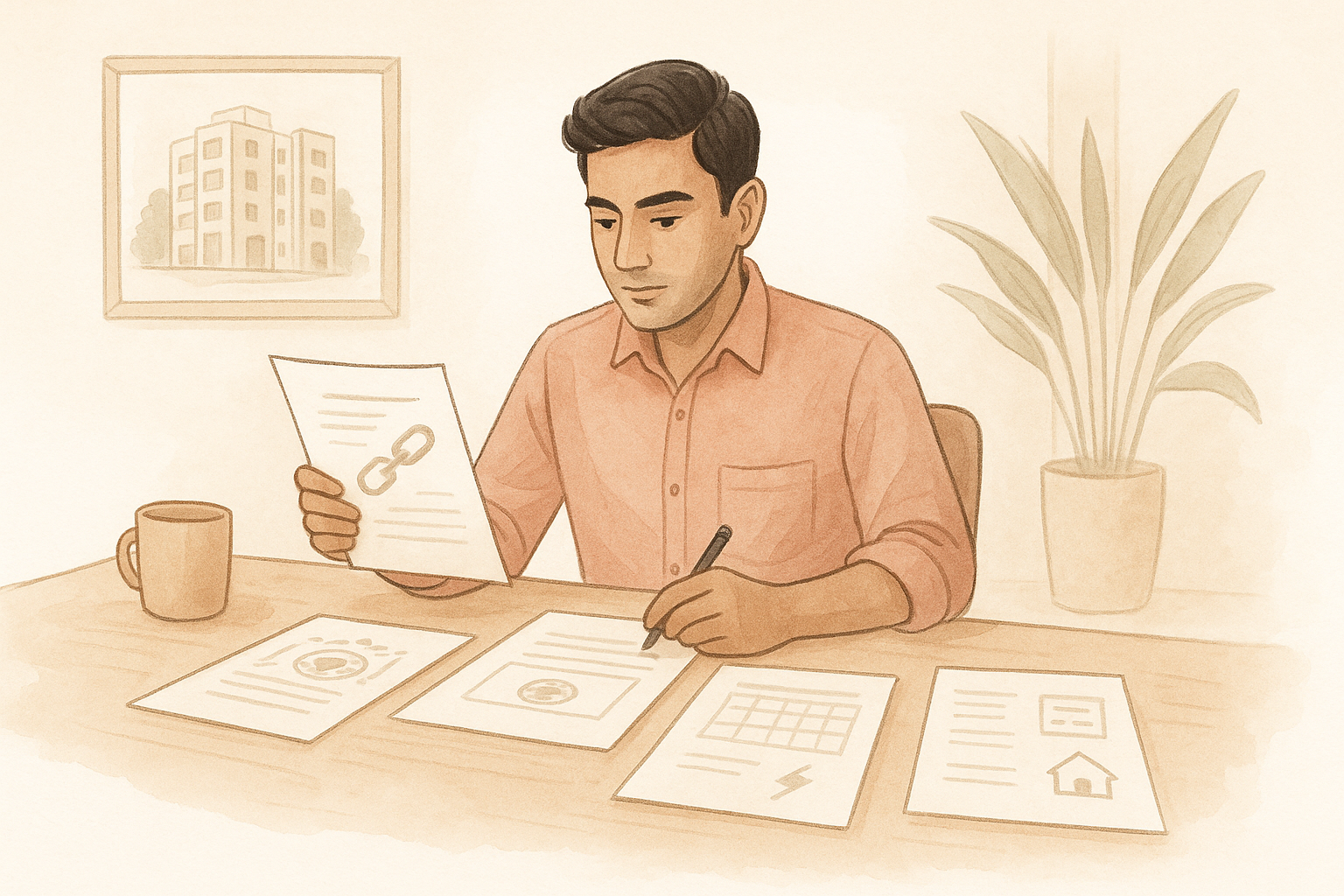
Buying a resale flat in India is not only about location, price and negotiation. The real safety lies in whether the property documents create a clean, complete and legally traceable ownership chain. A flat may look ready to move in, but missing papers, unpaid dues or a disputed title can make resale, loan approval and future possession difficult.
The safest approach is to check documents in the right sequence. Some papers must be verified before paying token money, some before signing the agreement to sale, some just before registration, and some after the sale deed is registered in your name.
Why Document Sequence Matters in a Resale Flat Purchase
Most buyers ask for “all documents” in one go, but sellers often share papers only when the deal becomes serious. This is common in cities like Mumbai, Pune, Bengaluru, Delhi NCR, Hyderabad and Chennai, where resale flats move quickly and brokers push buyers to close fast. Still, you should not pay a token amount without seeing the core ownership papers.
The correct sequence helps you identify gaps early. For example, if the allotment letter is in one name, the possession letter in another, and the sale deed skips an owner in between, the title chain may be incomplete. Even if the current seller is genuine, a missing link can create problems during bank loan processing or future resale.
A clean resale flat file should answer four questions clearly: who first received the flat, how it moved from one owner to another, whether the building is legally usable, and whether all dues are cleared. If any answer is unclear, pause the transaction and get a property lawyer to review the papers.
Documents to Check Before Paying Token Money
Before giving token money, check the documents that prove the flat’s origin and ownership chain. Start with the allotment letter. This is usually issued by the builder, development authority, housing board or cooperative group housing society to the first buyer. It should mention the allotment date, flat number, tower or block number, carpet or built-up area, parking details if applicable, and the first allottee’s name.
Next, verify the possession letter. This confirms that the builder or authority handed over possession of the unit. The allotment number, unit details and owner name should match the allotment letter. If the possession letter is in a different name, ask for the agreement to sell or transfer document between the earlier parties. Every transfer before possession must be supported by paperwork.
You should also review the full chain of registered documents. In a simple case, the first owner received allotment, possession and then executed a conveyance deed or sale deed. In a multiple resale case, there may be one conveyance deed and several sale deeds. Make a written timeline of every transfer, date, seller, buyer, registration number and consideration value.
- Check whether the first allottee’s name matches the first registered document.
- Confirm that every sale deed mentions the previous transaction correctly.
- Verify flat number, floor, tower, area and parking details across all papers.
- Check whether every sale deed is registered and stamped properly.
- Ask for original documents, not only photocopies or scanned files.
Builder, Authority and Building-Level Papers
A resale flat is part of a larger building, so the flat’s legality also depends on building-level approvals. The most important documents are the completion certificate and occupancy certificate, commonly called CC and OC. These are issued by municipal or development authorities after checking whether construction is completed as per sanctioned plans and basic services are in place.
In Mumbai, the Brihanmumbai Municipal Corporation issues occupation-related approvals. In Bengaluru, BBMP or BDA-related approvals may apply depending on the property. In Noida, Greater Noida or Gurugram, development authority and DTCP-related records may be relevant. In Pune, PCMC or PMC approvals may matter. The local authority changes by city, but the principle remains the same: the building should have legal permission for occupation.
Also check the conveyance deed or deed of apartment, depending on the state and project structure. In Maharashtra cooperative housing societies, deemed conveyance may become relevant if the builder has not transferred land and building rights to the society. In authority allotment cases, like Noida or Delhi Development Authority flats, understand whether the property is leasehold or freehold and whether conversion formalities are pending.
- Ask for occupancy certificate or part occupancy certificate if the project was completed in phases.
- Check whether the flat number appears in the approved occupation records.
- Verify whether the society, association or apartment owners’ body has been formed.
- Confirm whether land title or lease documents support the project’s legal existence.
- Check if any redevelopment, structural notice or municipal dispute is pending.
Society Papers, Share Certificate and Maintenance Dues
If the building has a cooperative housing society, the society share certificate is a crucial document. It shows that the flat owner is recognized as a member of the society and holds shares linked to the flat. In many Maharashtra societies, the back side of the share certificate carries endorsements for every ownership transfer.
Check whether the current seller’s name appears correctly on the share certificate. Also check whether the transfer history matches the sale deed chain. If the share certificate still shows an old owner, ask why the transfer was not completed. Sometimes the sale deed is registered, but society transfer is pending; this can delay your own membership after purchase.
Maintenance bills are equally important. They show monthly or quarterly charges such as common area maintenance, water charges, lift maintenance, watchman charges, sinking fund, repair fund and sometimes property tax collected through the society. Before registration, ask for a no-dues certificate from the society or association.
- Latest society maintenance bill is available
- No-dues certificate is issued by the society or association
- Share certificate shows the seller as current member
- Transfer endorsements match the ownership chain
- Parking rights are mentioned in society records or allotment papers
- No dispute or pending complaint is recorded against the flat
- Society transfer charges and membership process are understood
Do not laminate the original share certificate if it contains endorsement pages. Many societies write future transfers, signatures and stamps on the same certificate. Lamination can make endorsements difficult and may create practical issues during verification.
Loan, Encumbrance and Original Document Verification
If the seller has an active home loan, the original property documents will usually be with the bank or housing finance company. In that case, the seller may only show photocopies. This is not automatically a problem, but you must verify the bank’s records before making a major payment.
Ask for two key papers: a list of documents held by the bank and the latest loan account statement. The document list shows which originals are deposited with the lender. The loan statement shows the outstanding balance. If the seller cannot provide these, do not proceed casually.
An encumbrance certificate is also useful. It helps check registered charges, mortgages or transactions recorded against the property during a specific period. In many states, you can apply online through the registration department portal. In other places, a lawyer or search clerk can obtain a title search report from the sub-registrar office.
- Ask the seller for the bank’s document custody letter.
- Review the latest loan outstanding statement.
- Visit the lender with the seller for physical verification of originals where possible.
- Get clarity on whether the loan will be closed or transferred.
- Obtain a bank NOC before or at the time of final payment.
- Take an encumbrance certificate or legal search report for the relevant years.
Banks also conduct legal and technical verification when you take a home loan. If you do not need a large loan, some buyers still take a small loan to get an additional layer of bank due diligence. However, bank approval is not a substitute for your own legal review, because bank checks are designed to protect the lender first.
Final Checks Before Registration of Sale Deed
Just before registration, shift focus from title history to current dues and final permissions. The seller should clear all outstanding society maintenance, property tax, electricity, water, piped gas and other utility dues. If these are not cleared, you may inherit the burden after possession.
Property tax receipts are important because they also show whether municipal records reflect the owner correctly. In some states, the post-sale update is called mutation. In land revenue language, buyers may also hear words like jamabandi or khata transfer, depending on the region. For apartments, the exact process varies, but the goal is the same: public records should eventually reflect your ownership.
For utilities, check the latest paid electricity bill. In Mumbai, this may involve providers like Tata Power, Adani Electricity or BEST in some areas. In Delhi NCR, it could be BSES, Tata Power-DDL, DHBVN or UHBVN. In Bengaluru, BESCOM applies. The name on the bill should ideally be the current seller, or there should be a clear reason why it remains in an earlier owner’s name.
- Get a society no-dues certificate dated close to registration.
- Collect latest paid maintenance receipts.
- Collect latest property tax paid receipt.
- Collect paid electricity, water and gas bills.
- Obtain bank NOC if the property was mortgaged.
- Confirm handover date, keys, parking access cards and meter readings.
- Mention possession and document handover clearly in the sale deed.
The registered sale deed should mention the complete chain of title, consideration amount, payment schedule, flat details, parking rights, existing loan closure if any, possession date and list of documents handed over. Keep copies of demand drafts, bank transfer proofs and TDS challans if applicable.
After Registration: Mutation, Society Transfer and Safe Storage
Many buyers relax after the sale deed is registered, but post-registration work is important. First, submit the registered sale deed to the society, builder, apartment association or authority for transfer of records. This is how your name gets updated in membership, maintenance and internal ownership records.
Next, apply for mutation or equivalent record update with the municipal authority, development authority or revenue department, depending on the property type and city. In Bengaluru, buyers often deal with khata transfer. In Maharashtra, municipal property tax name transfer and society membership transfer are common. In Noida or Greater Noida, authority transfer records may be relevant if the property is authority-linked.
Finally, store documents safely. Keep original sale deed, old chain documents, share certificate, OC copy, tax receipts, NOCs, society transfer papers and utility transfer acknowledgements in one file. Scan everything and maintain a digital backup, but never rely only on scans for future resale.
- Registered sale deed collected from sub-registrar office
- Society membership transferred in your name
- Share certificate endorsed in your name
- Municipal or authority records updated
- Electricity, water and gas accounts transferred
- Property tax name change completed
- Original document file stored safely
If you plan to sell the flat later, this organized file becomes a major advantage. Buyers, banks and lawyers prefer a clean document chain, and it can help you close resale faster without unnecessary price negotiation.