Building a House
Legal & FinanceEssential
Verify Any Property on RERA
Learn how to check project safety, delay risk, approvals, complaints, and compensation before buying an under-construction home in India.
7 minutes read· Last updated 28 Apr 2026
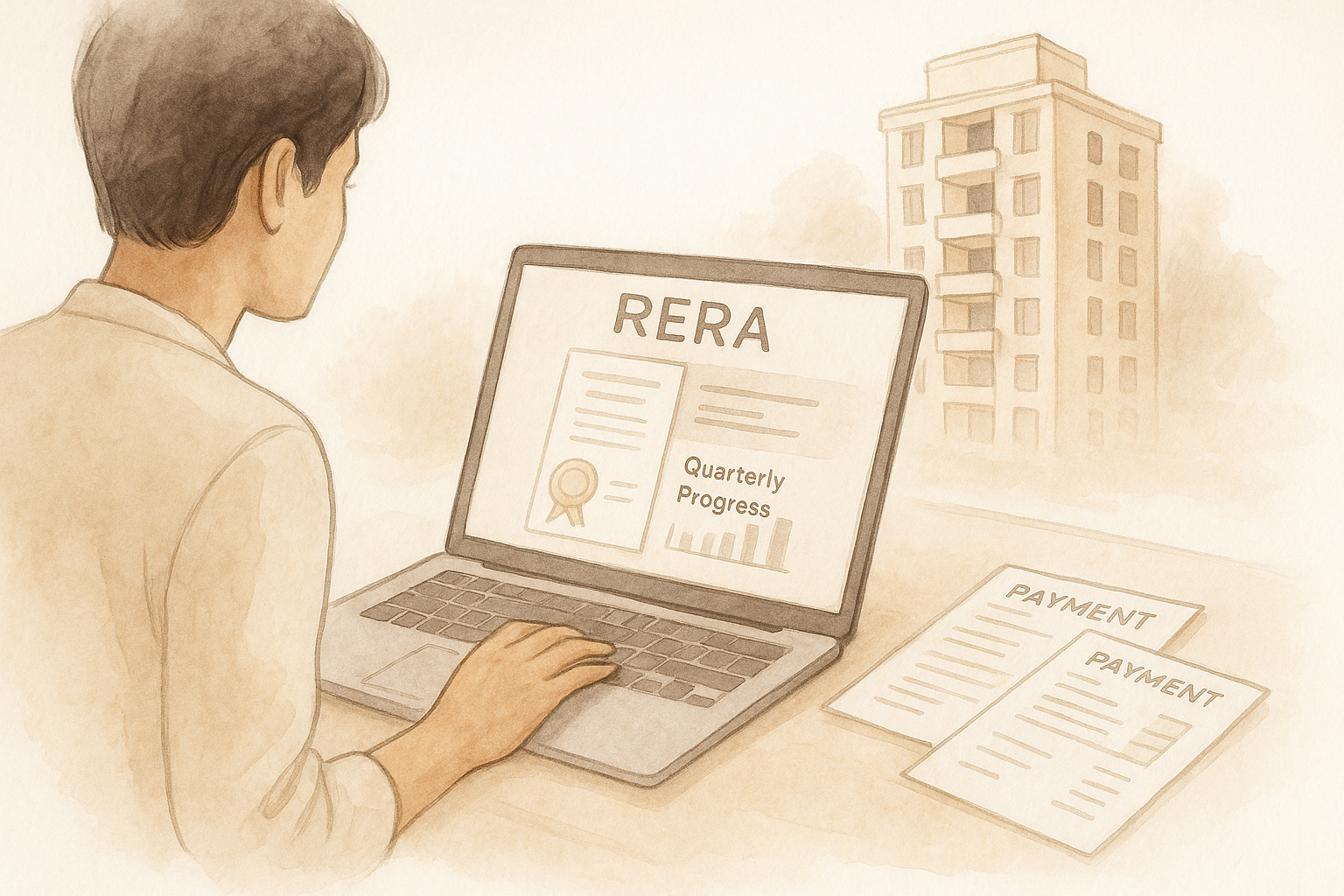
Buying an under-construction home in India usually starts with one reassuring line: “The project is RERA registered.” That is important, but it is not enough. A RERA registration does not automatically mean the project is risk-free, financially healthy, or guaranteed to be delivered on the promised date.
The smarter approach is to use the state RERA website as a due diligence tool. If you know where to look, you can check the approved completion date, extensions, quarterly progress, legal cases, buyer complaints, promoter details, and the builder’s track record before you pay the booking amount.
Why RERA Registration Is Important but Not a 100% Safety Guarantee
RERA has improved transparency in Indian real estate. Developers must register eligible projects, upload approvals, disclose timelines, maintain project-level records, and update progress reports. Buyers can also file complaints online if the builder defaults or delays possession.
However, RERA registration is largely based on documents and disclosures submitted by the developer. If a builder gives incomplete information, submits wrong documents, faces a financial crisis later, or gets stuck in litigation, the project can still be delayed. There have been cases where projects received registration and later faced serious issues due to fake documents, promoter disputes, or cash-flow problems.
This means RERA should be treated as a starting point, not the final green signal. A buyer in Mumbai, Pune, Gurgaon, Noida, Bengaluru, Hyderabad, or Ahmedabad should still verify the project independently and compare what the builder says with what the official RERA records show.
How to Find the Right Project on Your State RERA Website
Every state has its own RERA portal. Maharashtra has MahaRERA, Haryana has HARERA, Uttar Pradesh has UP RERA, Karnataka has Karnataka RERA, and so on. The layout differs, but the core information is broadly similar.
In some states, you can see a full list of registered projects and filter by district, promoter, or project name. In others, you need to search using the RERA registration number, project name, or developer name. For example, if you are checking a Gurgaon project, HARERA may show a list-based project page. If you are checking a Pune or Mumbai project, MahaRERA usually requires a specific search.
Once you open the project page, do not stop at the RERA certificate. Builders often show only the certificate because it proves registration. The more useful information is usually inside the project details page, uploaded documents, extension certificates, complaints section, progress updates, and promoter history.
- Search by RERA registration number first, if available.
- If you do not have the number, search by exact project name and developer name.
- Match the location, phase, tower, and promoter name with the brochure and agreement.
- Download or save the RERA certificate and project detail page for your records.
- Check whether the project has multiple phases with separate RERA registrations.
Check Completion Date, Extensions, and Possession Risk
The most important date on the RERA portal is the proposed completion date or validity date of the project registration. This is the official timeline the developer has committed to the authority. It may be different from what the sales team verbally promises.
Also check whether the project has received any extension. Many state portals show an extension certificate separately. In Haryana RERA, for example, you may see certificate-related links and extension records. In MahaRERA, extension details are generally visible on the project page. If an extension certificate exists, the revised date is usually the more relevant date for possession planning.
Not every extension is a red flag. During COVID-19, many projects across India received extensions. In NCR, construction bans during severe winter pollution periods have also affected timelines. Force majeure events such as floods, earthquakes, fires, war-like situations, pandemics, or government-imposed construction restrictions may justify extra time.
But repeated or long extensions need deeper investigation. If a four-year project has taken multiple extensions and still shows slow progress, it may indicate cash-flow stress, poor execution, approval problems, or weak sales. This matters because buyers may continue paying pre-EMI, rent, maintenance deposits, and final instalments while possession remains uncertain.
- Compare the builder-buyer agreement possession date with the RERA completion date.
- Check if the RERA portal shows an extension certificate.
- Identify whether the extension is due to force majeure or builder delay.
- Ask the developer for written clarification, not verbal assurance.
- Visit the site externally and compare visible construction with official progress updates.
Read Quarterly Progress Reports and Construction Status
Under RERA, developers are expected to update project progress periodically, often through quarterly progress reports. These reports can include construction progress, approvals, inventory, status of common areas, and other project disclosures depending on the state portal.
If the quarterly reports are regularly updated, it shows at least basic compliance. If they are missing for several quarters, outdated, or vague, treat it as a serious warning sign. A developer usually stops updating reports when the project is complete and occupancy certificate is received, or when something is not going according to plan.
Construction percentage is another useful indicator. Suppose a project has a four-year timeline. Roughly speaking, meaningful progress should be visible year by year, though construction is not always perfectly linear. Excavation and basement work may take longer in the early stage, while finishing work can move faster later. Still, if the portal shows very low progress even after half the timeline has passed, you should investigate before booking.
Use the RERA data along with site-level checks. Stand outside the site, observe labour activity, material movement, cranes, façade progress, and tower completion. Speak to existing buyers if possible. For premium projects in cities like Gurgaon, Noida, Thane, Pune, Bengaluru, and Hyderabad, buyer groups often have useful information about actual progress and builder behaviour.
Check Legal Cases, Complaints, Promoters, and Builder Track Record
Most state RERA portals provide information about legal cases, complaints, or orders linked to a project. One complaint may not always mean the project is bad. But multiple complaints about possession delay, non-refund, layout changes, amenities, payment disputes, or false promises should not be ignored.
Also check the promoter structure. Some projects are built by one developer on land owned by another party. This is common in joint development agreements in cities like Mumbai, Bengaluru, Chennai, Pune, and Delhi NCR. A single landowner arrangement may be manageable, but multiple landowners or unclear promoter roles can create future disputes. If one party files a case, construction and registration can get stuck.
Finally, check the developer’s other projects on the same RERA portal. A pattern matters more than one isolated issue. If the builder has taken extensions in most projects, has several complaints, or has ongoing legal disputes across multiple developments, the risk is higher. A branded developer is not automatically perfect, but a consistent delivery record is a strong positive signal.
- Open the developer or promoter profile on the RERA portal.
- Review recent completed and ongoing projects.
- Check if multiple projects have extensions or complaints.
- Look for regulatory orders, penalty records, or registration cancellation.
- Search news reports for insolvency, fraud, police cases, or major litigation.
- Speak with residents or buyers from the builder’s older delivered projects.
Delayed Possession: Compensation and Complaint Process Under RERA
If the builder misses the committed possession date without valid extension or lawful reason, buyers may be eligible to claim compensation. Under RERA, the interest payable for delay is generally linked to the State Bank of India’s highest marginal cost of lending rate plus 2%, though the exact application may depend on state rules and the authority’s order.
The compensation is usually calculated on the amount actually paid by the buyer to the developer, not necessarily on the full apartment value. For example, if you have paid ₹60 lakh out of an ₹80 lakh flat value, the delay interest generally applies to the paid amount. This can help offset home loan interest, pre-EMI, or the rent you continue paying due to delayed possession.
The first step is to communicate in writing. Once the agreed possession date or RERA completion date is crossed, send an email to the builder asking for the revised timeline and delay compensation. If the builder agrees, the amount may be adjusted against your final outstanding payment. If the builder only gives verbal assurances or refuses to respond, file a complaint on your state RERA portal.
- Keep the builder-buyer agreement, allotment letter, payment receipts, and demand letters ready.
- Save screenshots or PDFs of the RERA completion date and extension certificate.
- Send a written email to the builder after the possession date is missed.
- Ask for delay interest calculation and written confirmation.
- If there is no satisfactory reply, file a complaint through the state RERA website.
- Pay the online complaint fee, which is often around ₹1,000 to ₹1,100 depending on the state.
- Attend hearings yourself or through a lawyer.
If many buyers are affected, it is usually better to act collectively. A group of allottees can hire one lawyer, present common facts, and reduce individual cost. Builders typically appear with professional legal teams, so proper documentation matters.
Avoid stopping payments suddenly without written intimation or legal advice. If you default on payments without formally recording the reason, the builder may argue that you are also in breach. First document the delay, issue written communication, and then take action through RERA, consumer court, or appropriate legal channels if needed.
RERA Verification Checklist Before Booking a Home
Use this checklist before paying the booking amount for an under-construction apartment, villa, plot development, or mixed-use project. It is especially useful in high-growth markets where sales teams often push urgency, launch offers, and limited-time pricing.
- Project name, tower, phase, and RERA number match the official portal.
- RERA certificate is valid and belongs to the exact phase you are buying.
- Proposed completion date is clear and realistic.
- Extension certificate, if any, has been checked.
- Quarterly progress reports are updated.
- Construction percentage broadly matches the site condition.
- Legal cases and RERA complaints have been reviewed.
- Promoter and landowner details are clear.
- Developer’s other projects show a reasonable delivery record.
- Builder-buyer agreement matches RERA disclosures on area, amenities, timeline, and payment terms.
- All promises on possession, penalty, parking, club, GST, maintenance, and corpus fund are in writing.
RERA verification does not replace legal due diligence. For high-value purchases, ask a property lawyer to review the title, approvals, agreement for sale, payment schedule, carpet area, encumbrances, and local authority permissions. RERA gives transparency, but your decision should combine regulatory data, legal review, builder reputation, and ground reality.