Building a House
Finding Right FlatEssential
Carpet vs Built-up vs Super Built-up
Understand the real usable area before buying or comparing a home in India
7 minutes read· Last updated 28 Apr 2026
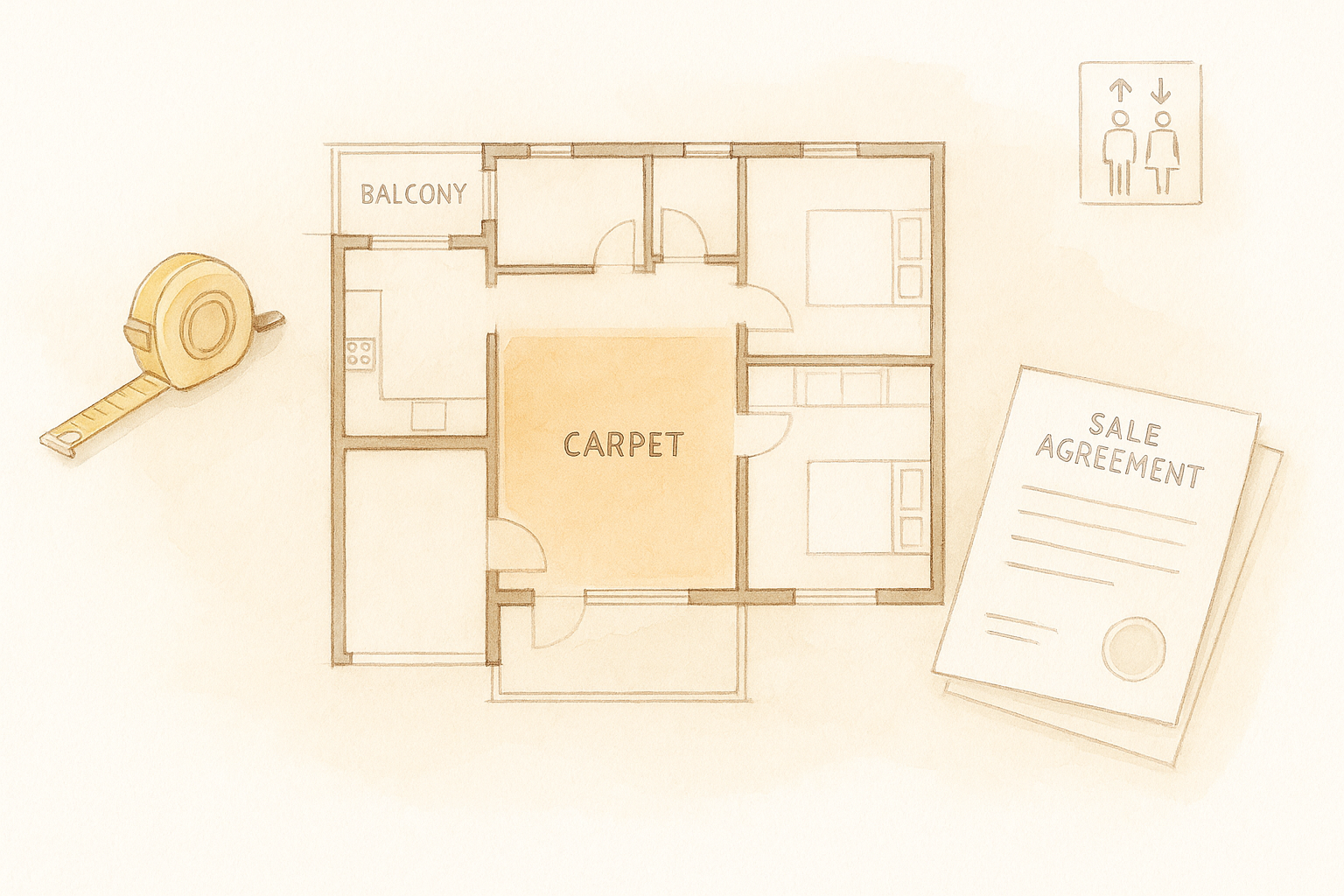
Buying a flat in India becomes confusing when the same 2 BHK is described with different area numbers. A builder may talk about 1,200 sq ft, the agreement may mention carpet area, and the brochure may highlight saleable or super built-up area. All three numbers can be correct, but they do not mean the same thing.
The most important rule is simple: carpet area is the space you can actually use inside your home, while built-up and super built-up area include additional portions. Understanding this difference helps you compare projects in Mumbai, Pune, Bengaluru, Noida, Gurugram, Hyderabad, Chennai, Ahmedabad, or any other Indian city without getting misled by a bigger-looking number.
Why Area Definitions Matter When Buying a Flat
Area definitions directly affect price comparison. If one project quotes ₹9,000 per sq ft on carpet area and another quotes ₹7,000 per sq ft on super built-up area, the cheaper-looking option may not actually be cheaper. You must first convert both into the same basis before deciding.
They also affect expectations. A buyer who hears “1,200 sq ft flat” may imagine a large living room, spacious bedrooms, and wide kitchen. But if that 1,200 sq ft is super built-up area, the actual usable carpet area may be much lower after adding lobby, lift, staircase, clubhouse, and other common area loading.
In India, this became especially important after RERA. In registered real estate projects, developers are expected to disclose carpet area clearly. However, brochures, sales conversations, resale listings, and informal advertisements may still use built-up or super built-up area. That is why every buyer should ask: “Is this carpet area, built-up area, or super built-up area?”
Carpet Area Meaning: The Actual Usable Space
Carpet area is the area within the walls of your flat that you can actually use for living. It includes spaces such as bedrooms, living room, dining area, kitchen, bathrooms, study room, store room, dressing area, and similar internal usable spaces.
Under the commonly used RERA understanding, carpet area excludes external wall thickness, service shafts, exclusive balcony or verandah area, and open terrace area. However, it includes the area covered by internal partition walls inside the apartment. This point is important because many buyers assume internal wall thickness is excluded, but current RERA-style disclosure includes it.
In simple terms, if you are comparing the livability of two flats, carpet area is the best starting point. A 760 sq ft carpet area flat is usually more useful to a family than a 760 sq ft super built-up area flat, because the latter includes a share of common spaces outside the apartment.
- Carpet area includes rooms and internal usable spaces.
- It includes internal partition walls.
- It excludes external walls, service shafts, open terraces, and usually exclusive balconies.
- It is the most practical number for judging usable home size.
Some independent houses, duplexes, or bungalows may have internal staircases or internal balcony-like spaces that function as part of the home layout. In such cases, the way area is measured can vary depending on approval drawings, local practice, and sale documents. For apartments, always rely on the RERA carpet area mentioned in official documents.
Built-up Area: Carpet Area Plus Walls and Balconies
Built-up area is larger than carpet area. It generally includes the carpet area plus external wall thickness, balcony area, and service shaft portions attached to the unit. In older sale documents and many resale transactions, built-up area is still used frequently.
For example, if a flat has 800 sq ft carpet area, its built-up area may be around 900 to 1,000 sq ft depending on wall thickness, balcony size, ducts, and design. This is only an indicative range; the exact number depends on the approved plan and measurement method.
Built-up area is useful for technical understanding, but it is not the best number for judging how spacious the home will feel. Two flats with the same built-up area may have different carpet areas because one may have thicker walls, larger balconies, or more non-usable service zones.
- Built-up area = carpet area + external walls + balcony + service shafts, depending on the project definition.
- It is usually higher than carpet area.
- It may appear in older property papers, resale listings, and municipal documents.
- It should not be compared directly with carpet area pricing.
In cities like Delhi NCR or Bengaluru, many resale sellers still say “1,500 sq ft flat” without clarifying the area type. Before negotiating, ask whether that number is built-up, super built-up, or carpet. If the seller does not know, request the sanctioned plan, builder allotment letter, or society records.
Super Built-up Area: The Saleable Area with Common Spaces
Super built-up area is usually the largest of the three. It includes the built-up area of your flat plus a proportionate share of common areas in the building or project. These common areas may include lobby, staircase, lift area, corridors, clubhouse, gym, swimming pool, indoor games room, security cabin, and other shared facilities.
This proportionate share is often called “loading.” If a project has high-end amenities, wide corridors, multiple lifts, large clubhouses, and landscaped common facilities, the loading may be higher. That means the difference between carpet area and super built-up area becomes bigger.
For example, a flat advertised as 1,400 sq ft super built-up area may have only 900 to 1,050 sq ft carpet area, depending on the loading. This does not automatically mean the project is bad. It simply means you are paying for shared facilities too, so the price must be evaluated carefully.
- Super built-up area = built-up area + proportionate common areas.
- It is also called saleable area in many old brochures.
- It can make a flat look larger than its actual usable size.
- It is not the same as the area inside your main door.
Super built-up area became popular because it allowed builders to distribute the cost of common infrastructure among all buyers. But for buyers, it can create confusion if the loading is not disclosed transparently. In RERA-registered projects, the carpet area is the key figure to check.
Carpet, Built-up and Super Built-up: Simple Example
Let us take a practical example of an apartment in Pune or Hyderabad. Suppose the carpet area of a 2 BHK is 800 sq ft. This includes the living room, two bedrooms, kitchen, bathrooms, passage, and internal partition walls.
Now add external wall thickness, balcony, and service shaft areas. The built-up area may become around 950 sq ft. Then add the flat’s proportionate share of lift lobby, staircase, corridor, clubhouse, gym, and other common amenities. The super built-up area may become around 1,200 sq ft.
The same home can therefore be described in three ways: 800 sq ft carpet area, 950 sq ft built-up area, or 1,200 sq ft super built-up area. If you hear only “1,200 sq ft flat,” you may assume the entire 1,200 sq ft is inside your home, but that is not correct.
- Carpet area: actual usable area inside the flat.
- Built-up area: carpet area plus walls, balcony, and service areas.
- Super built-up area: built-up area plus share of common facilities.
This is why price per sq ft can be misleading. If the total flat price is ₹96 lakh, the price is ₹12,000 per sq ft on 800 sq ft carpet area, but ₹8,000 per sq ft on 1,200 sq ft super built-up area. The property is the same; only the area base has changed.
How to Check Area Before Booking or Buying
Before paying a token amount, ask for written area details. Verbal explanations from a sales executive or broker are not enough. The area mentioned in brochures should match the RERA registration, draft agreement, allotment letter, and approved plan.
Use this checklist when reviewing a new flat, under-construction project, or resale apartment:
- Ask for the exact RERA carpet area of the unit.
- Check whether balcony, terrace, and utility areas are shown separately.
- Ask for built-up and super built-up area only after confirming carpet area.
- Compare price per sq ft on carpet area, not only on saleable area.
- Verify the floor plan dimensions room by room.
- Check the loading percentage if super built-up area is being discussed.
- Ensure the area in the agreement matches the official project disclosure.
For under-construction projects in Maharashtra, Karnataka, Telangana, Uttar Pradesh, Gujarat, Tamil Nadu, and other states, check the state RERA website. Search by project name, promoter name, or registration number. The RERA page usually provides carpet area, sanctioned plans, approvals, project status, and other disclosures.
In resale deals, RERA data may not always be enough, especially for older buildings. In that case, check the original builder agreement, occupancy certificate, share certificate, property tax record, society records, and approved floor plan. If the deal value is high, hire an architect or legal professional to verify measurements.
Common Mistakes Buyers Should Avoid
The most common mistake is assuming that the largest number is the actual home size. Builders, brokers, and resale sellers may use the area type that sounds most attractive. As a buyer, your job is not to argue over terminology but to get the exact breakup in writing.
Another mistake is ignoring layout efficiency. Two flats with the same carpet area can feel very different. A 750 sq ft carpet flat with a compact passage and well-sized rooms may feel larger than an 800 sq ft carpet flat with long corridors, odd corners, and poorly placed columns.
Also remember that balcony and terrace value depends on your lifestyle. In Mumbai, a small balcony may be premium because space is limited. In Noida or Bengaluru, larger balconies may be common in many projects. But if your main need is indoor usable space, do not pay only for a bigger super built-up number.
- Do not compare carpet area with super built-up area.
- Do not rely only on brochure claims.
- Do not ignore loading percentage.
- Do not assume every balcony is included in carpet area.
- Do not finalize without checking the agreement area clause.
For home loans, banks usually focus on legal title, approved plans, valuation, and agreement value. But for your personal decision, carpet area remains the most useful metric. It tells you how much space your family will actually live in every day.