Building a House
Finding Right FlatEssential
1/2/3 BHK – what should you choose?
A practical India-focused guide to choosing the right home size before site visits.
7 minutes read· Last updated 28 Apr 2026
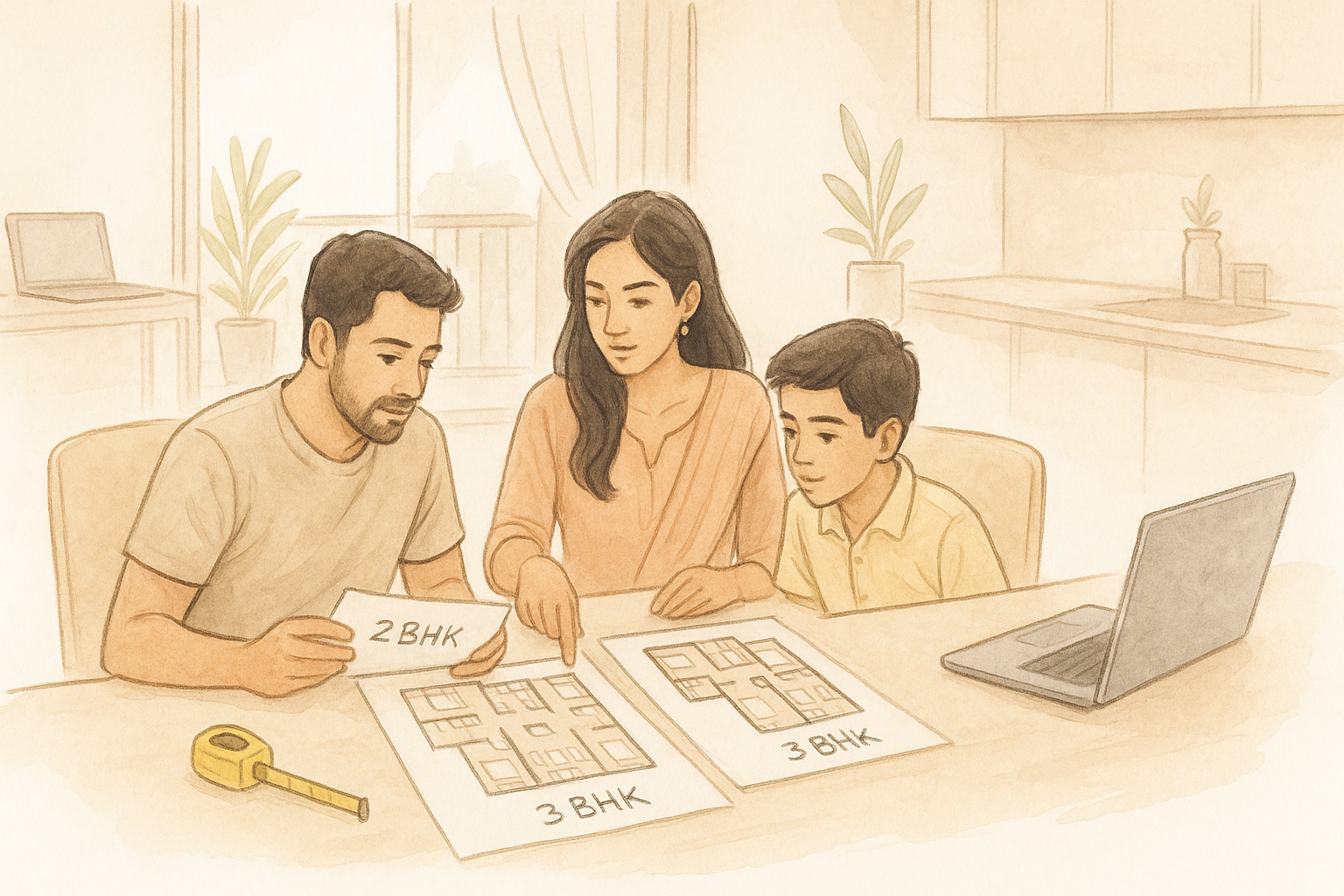
Buying a home is not just about budget, location, and whether the flat is called a 1 BHK, 2 BHK, or 3 BHK. Two homes with the same configuration and similar square feet can feel completely different once you start living in them.
This happens often with first-time home buyers in cities like Mumbai, Pune, Bengaluru, Gurugram, Noida, Hyderabad, and Chennai. A buyer compares the price and carpet area, books the flat, moves in, and then realises the new 3 BHK feels smaller than the old 3 BHK because the layout, room sizes, corridors, storage, balcony, and usable space are different.
The right BHK choice is not the biggest home you can stretch for. It is the home size that supports your family, work, lifestyle, storage, guests, and financial goals for the next 5–10 years without feeling either congested or wasteful.
Why the Right BHK Size Matters
Your home affects your daily routine more than any other asset you buy. Offices may change, children grow, parents may move in, and work-from-home needs can change, but most Indian families do not change homes every two years. A home is usually a 5-year, 10-year, or even 15-year decision.
If you buy a smaller home than you need, daily life becomes uncomfortable. There may be no quiet work corner, no space for children to study, no guest room for parents, no storage for winter clothes, and no breathing space in the living room. Over time, this affects family comfort, work productivity, and your ability to enjoy the home.
If you buy a much bigger home than required, it is not just a one-time extra cost. Larger homes usually mean higher interior costs, higher monthly maintenance, more electricity usage, higher property tax in many cities, and higher cleaning or house-help charges. In premium societies in Mumbai, Bengaluru, and Gurugram, maintenance is often charged per square foot, so extra space keeps costing you every month.
Look Beyond BHK: Understand Usable Space
A 3 BHK does not automatically mean a spacious home. The real question is how the space is distributed. A flat with long passages, awkward bedroom entries, narrow kitchens, small living rooms, or unusable corners may feel smaller than its advertised size.
In India, always check the RERA carpet area, not only the saleable area or super built-up area. Carpet area is closer to the actual usable floor area inside the home, excluding external walls and common areas. In many older projects, buyers compare square feet without understanding whether they are looking at carpet, built-up, or super built-up area.
Space utilisation also matters. A compact 850 sq ft carpet 2 BHK with a square living room, efficient kitchen, proper wardrobes, and minimal corridor space may work better than a 1,050 sq ft flat with poor planning. During site visits, observe where your sofa, dining table, beds, wardrobes, study desk, puja unit, washing machine, and storage will actually go.
Decide Who Will Live in the Home
The first step in choosing between 1 BHK, 2 BHK, and 3 BHK is to list who will live in the house today and who may live with you in the future. This includes spouse, children, parents, in-laws, siblings, live-in help, and frequent guests.
For example, a couple in Pune or Bengaluru may feel that a 2 BHK is enough today. But if they plan to have a child, expect parents to visit for long periods, or may need elderly parents to shift after retirement or medical needs, a 3 BHK may become more practical. Similarly, a single buyer in Mumbai may choose a 1 BHK for budget reasons, but if marriage or work-from-home is likely, a compact 2 BHK may offer more flexibility.
Think in phases, not just today’s need. A toddler today may become a teenager needing a separate study and sleeping space. Parents living in the hometown today may need to move in after 5–10 years. A guest room may not be used daily, but in many Indian families, it becomes important during festivals, medical visits, weddings, or extended family stays.
Match the Home to Work, Hobbies, and Lifestyle
Work style is now a major factor in home size. If one or two people work from home, you need more than a dining-table setup. A proper workstation should have a chair, desk, charging points, ventilation, lighting, and privacy for calls. In a 1 BHK, this may mean a corner in the bedroom or living room. In a 2 BHK, the second room can double as a study. In a 3 BHK, one room can become a flexible office or guest room.
Hobbies also need space. If cooking is a serious hobby, the kitchen should allow two people to move comfortably and should have counter space for appliances like mixer, air fryer, microwave, OTG, coffee machine, and storage jars. If gardening matters, check whether the balcony is wide enough for planters, not just long and narrow. If you practise music, painting, yoga, or dance, check whether the living room or bedroom can support that activity without moving furniture every day.
Your social lifestyle is equally important. If you host friends regularly, celebrate festivals at home, or have relatives visiting from another city, the living room and guest sleeping arrangement matter. A family that hosts often may prefer a larger living-dining area over oversized bedrooms. A family that values privacy may prefer three smaller bedrooms instead of two large rooms.
Plan Storage Before You Finalise the Flat
Storage is one of the most underestimated factors in Indian homes. Many buyers focus on bedrooms and living rooms but forget wardrobes, lofts, utility storage, luggage, cleaning supplies, seasonal items, pooja items, sports equipment, children’s toys, and documents.
Storage needs also change by region. In North India, families in Delhi NCR, Chandigarh, Jaipur, and Lucknow need space for quilts, blankets, heaters, winter clothes, and extra bedding. In Mumbai and coastal cities, storage must also handle humidity, so well-ventilated wardrobes and utility areas are important. In cities with hard water or frequent appliance use, utility space for washing machine, drying, water purifier, and service access becomes valuable.
Before finalising the BHK size, walk through your current home and identify what is missing and what is wasted. This exercise gives more clarity than only looking at brochures. If your current home feels comfortable, note which spaces you actually use. If it feels congested, write down the exact reasons.
- Is there enough wardrobe space for all family members?
- Is there a place for luggage and seasonal bedding?
- Can the kitchen store appliances and groceries comfortably?
- Is there a utility area for washing machine and drying clothes?
- Is there space for a study desk or work-from-home setup?
- Can guests sleep without disturbing everyone’s routine?
- Is any room, balcony, or passage becoming wasted space?
Connect BHK Choice With Financial Goals
The ideal home is also a financial decision. Your dream home may be a large 3 BHK in a prime location, but your current budget may only support a 2 BHK comfortably. In that case, the right decision depends on your time horizon.
If you plan to live in the home for only 4–6 years and upgrade later, buying a smaller but easily saleable property can make sense. In many Indian markets, well-located 1 BHK and 2 BHK flats are more liquid than very large apartments because the buyer pool is bigger. A good 2 BHK near metro access, IT hubs, schools, or business districts may be easier to rent or sell than a large flat in a remote location.
If you are buying for long-term family use, compromising too much on space may create problems later. You may save money today but spend more on shifting, stamp duty, brokerage, interiors, and loan processing when you upgrade. Compare both options: a smaller flat in a prime area versus a larger flat in a developing location.
A practical approach is to decide your non-negotiables and flexible points. For example, your non-negotiables may be two bathrooms, a work corner, a proper kitchen, and a balcony. Your flexible points may be bedroom size, floor level, or whether the guest room is permanent or multipurpose.
When and How to Do This Exercise
Do this exercise before starting serious site visits. If you begin visiting projects without clarity, every sample flat will look attractive in a different way. Builders design sample flats to feel spacious, but the actual unit may have different dimensions, lower furniture size, or less storage.
Start with your current home. Ask whether you are comfortable there. If not, identify what is missing: an extra bedroom, larger kitchen, better storage, more privacy, bigger balcony, or better living room. If you are comfortable, identify what you never use. Maybe the balcony is too narrow, the passage is wasted, or the second bedroom is rarely used.
Then visit 5–10 properties across different configurations and sizes. See a compact 1 BHK, a larger 1 BHK, a small 2 BHK, an efficient 2 BHK, a compact 3 BHK, and a spacious 3 BHK if your budget allows. After these visits, come back to your checklist and refine your ideal size. This will help you avoid confusion between 600 sq ft, 800 sq ft, 1,000 sq ft, and 1,200 sq ft options.
A good final decision often comes down to one trade-off: a smaller home in a prime location or a larger home in a non-prime location. For example, in Mumbai, this may mean choosing between a 1 BHK closer to the station and a 2 BHK farther away. In Bengaluru, it may mean a compact flat near an IT corridor versus a larger flat with a longer commute. Your right answer depends on lifestyle, family needs, and financial comfort.