Building a House
Finishing & InteriorEssential
Curtains & Soft Furnishing Guide
A practical guide to selecting curtain length, fabric, color, and layering so every room feels more finished and functional.
10 min read· Last updated 12 Apr 2026
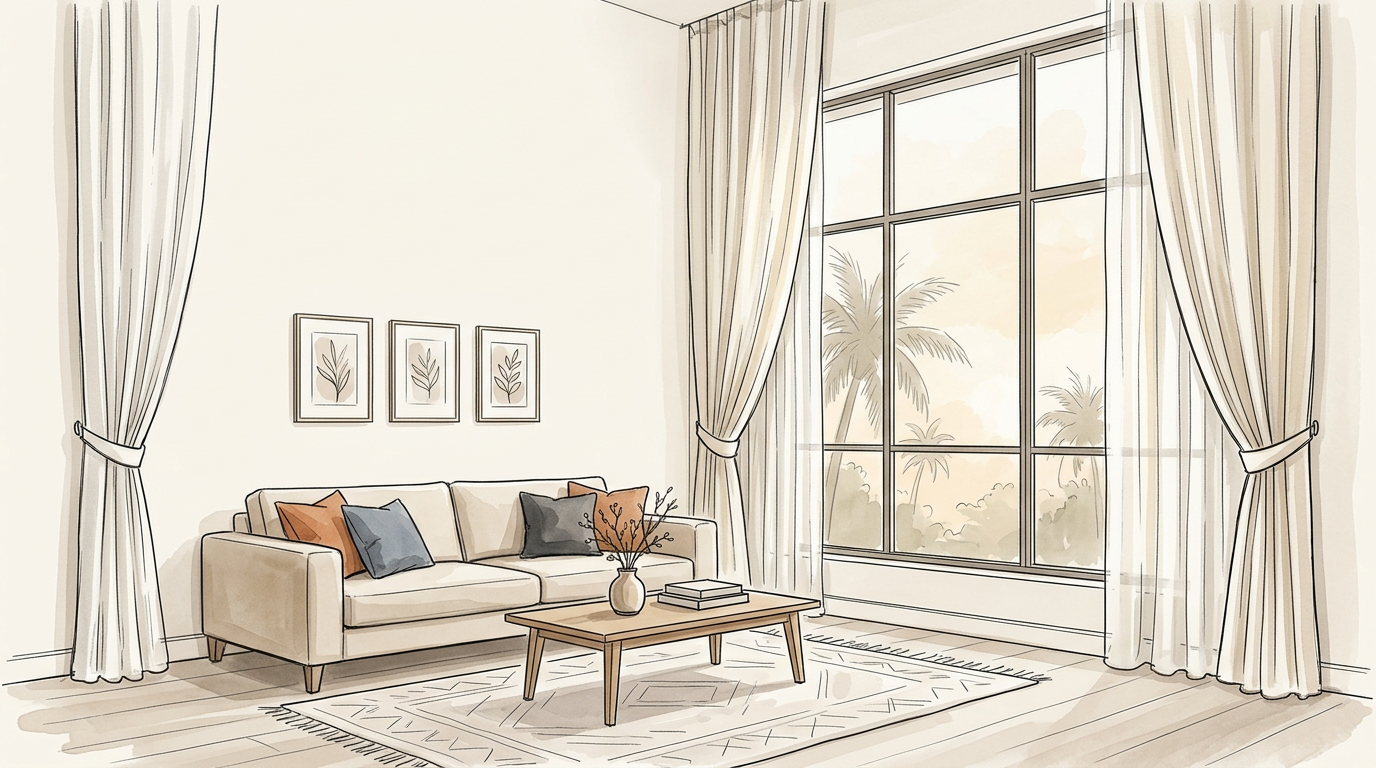
Curtains and soft furnishings shape how a room feels more than most homeowners expect. A living room in Pune, a bedroom in Bengaluru, or a builder flat in Noida can look either calm and polished or visually confused depending on the curtain length, fabric weight, pattern, and color balance. Even when the furniture is good, the room often feels incomplete if the window treatment is badly chosen.
This matters even more in Indian homes because light, heat, privacy, dust, and room size vary sharply from one city and one orientation to another. A west-facing room in Ahmedabad needs a different curtain solution from a north-facing bedroom in Bengaluru or a compact apartment in Mumbai. The right approach is to treat curtains as both a design decision and a performance decision, then coordinate them with the rest of the soft furnishings in the room.
Start with measurements before you look at designs
Most curtain mistakes begin in the shop, not in the room. People often choose a fabric because it looks attractive on the hanger or in the display catalogue, then discover after installation that it looks too narrow, too short, or too weak for the window. The first decision should always be size, because curtain fullness and drop length decide whether the room looks complete.
As a practical rule, the curtain width should usually be around twice the clear width of the window if you want a properly gathered look when the fabric is closed. If the window opening is 4 feet wide, the total curtain width generally needs to be closer to 8 feet. Anything much tighter starts looking flat and underdressed, especially in living rooms and master bedrooms.
Length matters just as much. Curtains should usually end at floor level or very slightly above it, not at the bottom of the window frame. A curtain that stops exactly at the sill or just below the window often makes the room look shorter and less refined. If you want a more premium, softer look, a puddle of about 3 to 4 inches can work well, but going much beyond that becomes impractical in Indian homes where dust and daily cleaning are real concerns.
Fix the rod height and width to improve the room visually
Curtains do not start from the fabric. They start from the rod placement. In lower-height apartments, the rod should usually be mounted closer to the ceiling rather than just above the window frame. This creates a taller visual line and makes the room feel less compressed. In taller rooms with generous slab height, the rod can still sit above the window, but it should be positioned with design intent rather than copied blindly from another home.
Rod width should also extend beyond the window opening. A useful rule is to take the rod around 6 inches beyond the window on both the left and right sides. This extra width allows the curtain stack to sit partly outside the opening when drawn back, which means more glass remains visible and more daylight enters the room. If the rod ends exactly at the window width, the curtain blocks part of the opening even when it is fully open.
Use these placement rules before ordering fabric or tracks:
- Mount the rod near the ceiling in low-height rooms to visually lift the space.
- Extend the rod at least 6 inches beyond the window on each side.
- Measure the final curtain length from the rod or track position, not from the window frame.
- Decide early whether the curtain should just touch the floor or puddle slightly.
Choose fabric according to light, privacy, and window direction
The fabric should respond to what the window is actually doing. If the room receives harsh heat and glare, especially from west-facing or strongly exposed openings, a blackout curtain is often the better choice. Blackout fabric usually includes a backing or coating that cuts light sharply, improves privacy, and helps the room feel cooler and more restful. This works especially well in bedrooms, media rooms, and living rooms that get difficult afternoon sun.
If the opening receives softer daylight, such as many north-facing windows or rooms where privacy concerns are lower, sheer curtains can work beautifully. Sheers allow light to filter through while softening the view and giving the space a lighter, airier look. They suit living rooms, sitting areas, balconies, and rooms where daylight is an asset rather than a problem. The decision should be based on actual orientation and usage, not only on what looks fashionable online.
Many Indian homes need both conditions at different times of day. That is where layering becomes useful. A sheer curtain can stay closed during the day for privacy and softness, while a heavier blackout or lined drape can be drawn at night or during harsh sunlight hours. In bedrooms in Gurugram, Hyderabad, or Chennai, this layered approach is often more practical than choosing only one curtain type and expecting it to solve every need.
Match pattern, color, and texture with the room, not the catalogue
Curtains should balance the room, not compete with it. If the room already has strong patterns in wallpaper, cushions, upholstery, bed linen, or rugs, the curtain usually needs to be quieter and more plain. A heavily patterned curtain in a room that already has printed chairs, decorative wallpaper, and textured furniture will often make the space feel busy and visually tiring.
The reverse is also true. If the room is simple, minimal, and built around plain walls, neutral furniture, and clean lines, a patterned curtain can add depth and personality. In a calm bedroom in Bengaluru or a modern living room in Pune, this may be the easiest place to introduce movement without overdesigning the room. The rule is simple: when the room is visually active, keep the curtains calmer; when the room is visually plain, curtains can carry more character.
Color temperature should also support the room mood. If the room already feels cool because of grey flooring, blue upholstery, white walls, or limited sunlight, warmer curtain tones such as beige, greige, muted sand, soft olive, or warmer neutrals often make the space feel more comfortable. If the room already feels warm because of yellow light, wooden furniture, or cream-heavy finishes, cooler curtain tones such as muted blue-grey, sage, or soft stone can create better balance.
Coordinate curtains with the rest of the soft furnishings
Soft furnishing does not stop at the window. Curtains should be chosen along with cushions, throws, upholstery, rugs, bedding, and accent fabric if you want the room to feel designed instead of assembled item by item. This does not mean every fabric must match exactly. It means the materials should belong to the same visual family in tone, scale, and mood.
In a living room, for example, the curtain can take one role while the sofa cushions take another. If the curtain has pattern, the cushions can stay simpler. If the sofa is already textured or boldly colored, the curtain can become more restrained. In a bedroom, the curtain should also respond to the bed back, bedsheet palette, and rug tone. A room where every soft element is trying to stand out at once usually ends up feeling more chaotic than luxurious.
One of the smartest ways to shop is to carry room photographs or short videos when comparing fabrics. This helps you judge whether the curtain tone will sit well with the flooring, wall paint, wardrobe laminate, and furniture finish. In Indian projects where homeowners often buy curtains after flooring and painting are already complete, this one habit makes selection much more accurate than trusting memory inside the store.
Use layering and finishing details to improve daily use
Layering is not only a luxury move. It is often the most practical solution in Indian homes where daylight requirements change through the day. A sheer plus drape combination lets you manage privacy, glare, and mood more precisely. Another option is to combine Roman blinds or roller blinds with side curtains, especially in compact rooms where window treatment must look clean without becoming bulky.
Finishing details also affect the final result. Header style, pleat depth, lining, and fabric fall all influence how rich or flat the curtain looks. Even a good fabric can look weak if it is stitched with poor fullness or hung on an undersized rod. In living rooms and formal bedrooms, better finishing usually shows immediately. In children’s rooms or utility zones, practicality may matter more than decorative fall, but the curtain should still look deliberate.
Use this checklist before placing the final order:
- Final rod or track position is fixed before curtain length is measured.
- Curtain width is adequate for fullness, not just enough to cover the glass.
- Fabric matches the window's sunlight and privacy needs.
- Pattern level is balanced against the room's walls, furniture, and upholstery.
- Curtain color supports the room's warm or cool tone.
- Layering is considered where both daylight and blackout control are needed.
- Room photos are reviewed before final fabric selection.
- Length is set to floor-touch or a controlled 3 to 4 inch puddle, not an accidental mid-level drop.
Avoid common mistakes that make curtains look wrong
Most bad curtain decisions are avoidable. The first is choosing on beauty alone and ignoring width, drop, and light control. The second is fixing the rod too low, which makes the room feel shorter. The third is using too many patterns at once between the curtain, sofa, cushions, and wallpaper. The fourth is forgetting that every room has a different need. A living room curtain, a bedroom curtain, and a balcony sheer should not all follow the same logic.
Another common mistake is treating curtains as the last leftover purchase in the project budget. In reality, they finish the room at eye level. A carefully designed home in Delhi, Hyderabad, or Kochi can still feel incomplete if the curtains are skimpy, wrongly colored, or badly hung. Good curtains do not need to be expensive, but they do need correct proportion, correct fabric, and coordination with the rest of the room.
If you want the safest approach, decide in this order: first the rod position, then the curtain size, then the light-control fabric, then the room coordination, and finally the decorative style. That sequence keeps the decision practical. It also stops you from buying a curtain that looks good in isolation but feels wrong once it enters the room.