Building a House
Buying LandEssential
Plot Checklist: Road Access, Water, Electricity & Drainage
A practical due-diligence guide to check whether a plot is truly buildable before you pay.
8 min read· Last updated 12 Apr 2026
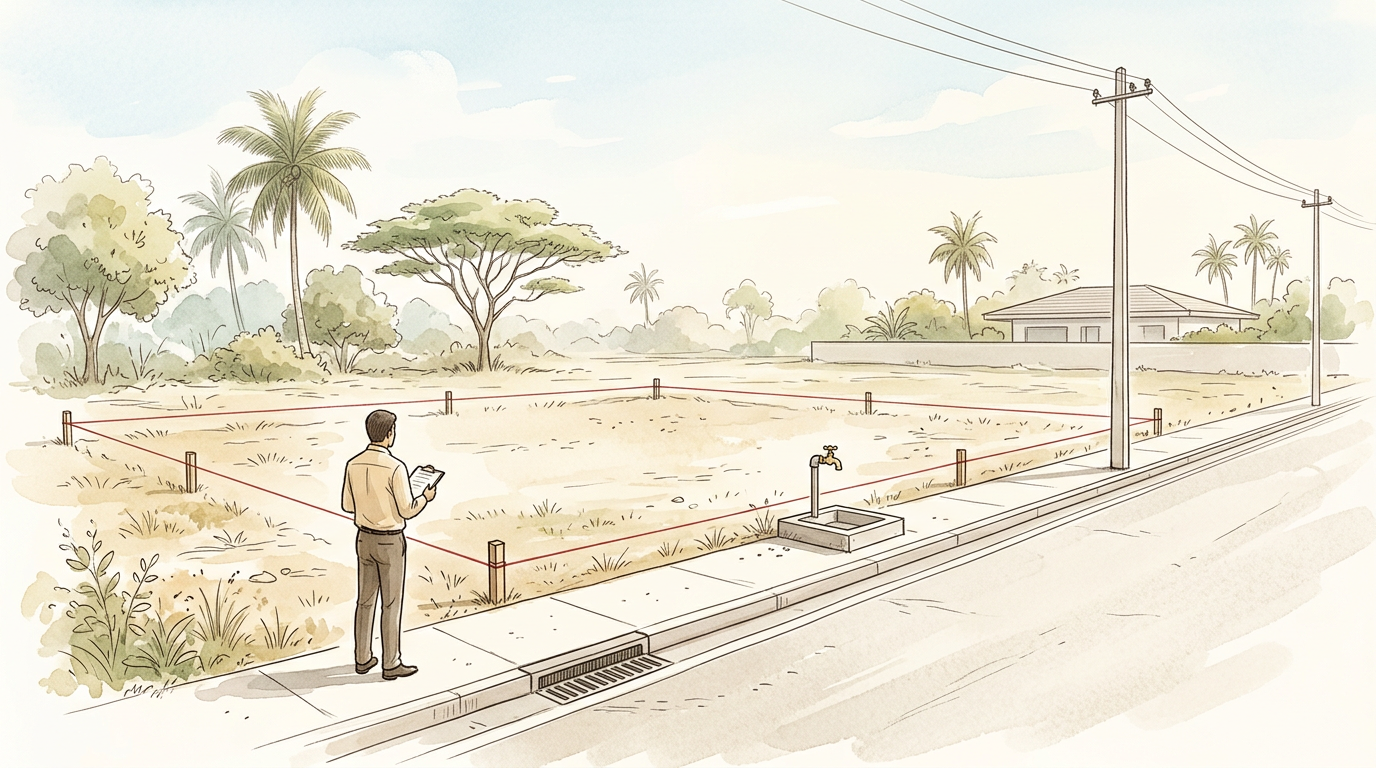
Why this checklist matters before you buy
Many first-time buyers judge a plot by price, location pin, and future appreciation. That is not enough. A plot can look attractive on paper and still become difficult to build on if the access road is weak, the water source is disputed, the power connection is impractical, or the drainage path is missing.
This risk is higher in peripheral growth areas around Indian cities such as Pune, Hyderabad, Bengaluru, Ahmedabad, Jaipur, and Lucknow, where plotted developments often sell ahead of full utility maturity. In these areas, buyers are sometimes shown future ring roads, proposed metro links, or planned infrastructure as if it already exists. Your decision should depend on present ground reality, not only on layout promises.
The safest approach is simple: verify whether the plot is legally buildable, physically usable, and serviceable with road access, water, electricity, and drainage. If even one of these is weak, construction cost rises, approval timelines stretch, and resale becomes harder.
Check road access beyond the brochure
Start with the approach road because every other utility depends on access. A plot may sit inside a sanctioned layout, but if the last stretch is a narrow kutcha road, a disputed internal lane, or a passage passing through another owner’s land, your future construction can stall. Cement trucks, excavation machines, water tankers, and material vehicles all need reliable entry from a public road to the plot.
Do not rely only on what is “proposed” in a development plan. A future 18-metre or 30-metre road shown on a map is not the same as a usable road today. Measure the actual width on site, inspect whether the road is paved, check turning radius for vehicles, and confirm whether the frontage is genuinely open and accessible. Also check if encroachments, compound walls, shops, or informal structures can block future widening.
Connectivity should be judged in current terms: distance to the nearest wide road, highway, town centre, bus route, metro station, school, and daily-use market. For a self-use plot, present access matters more than speculative upside. For an investment plot, poor present access usually means slower appreciation and fewer serious buyers at resale.
Verify water source, rights, and reliability
Water is not just about availability; it is also about legal control. On many plots, especially older converted lands, there may be an existing well, borewell, pipeline chamber, irrigation line, or shared source that is tied to older ownership arrangements. If the water structure lies within or across the plot, you must confirm who can use it, who maintains it, and whether it restricts construction. A covered chamber or old well can silently eat into your usable building area.
Ask three questions clearly. First, what is the primary source: municipal line, borewell, tanker, private supply, or a combination? Second, is there a written right to use that source? Third, is that source reliable across summer months? In many Indian layouts, the advertised water line exists only in the master plan, while actual supply depends on tankers for years. That changes both monthly cost and livability.
If there is an existing well or borewell, inspect it physically and ask for any agreement linked to it. A source that serves another society, farmhouse, or retained land parcel can create a permanent easement issue. Also ask whether groundwater extraction is practically viable in that belt and whether rainwater harvesting or storage will be required under local building rules.
Assess electricity readiness before construction starts
Electricity problems usually surface after purchase, when the owner is ready to build. A seller may say “line is available nearby,” but that can still mean transformer augmentation, a new pole line, right-of-way approvals, or high connection cost. What you need to know is not whether electricity exists somewhere in the area, but whether a standard domestic connection can be taken to your specific plot without abnormal delay or cost.
Check the nearest distribution pole, transformer, and existing occupied houses using regular domestic supply. If the plot is in a new layout, ask whether internal electrification has been completed and handed over to the local distribution company. In Maharashtra this may involve MSEDCL; in other states it could be BESCOM, TANGEDCO, TPDDL, UPPCL, or the relevant discom. If there are overhead lines crossing the plot, note them carefully because setback, safety, and relocation issues can affect your design.
Also think one stage ahead. During construction, you may need temporary power, water pumps, dewatering, welding equipment, and site lighting. If the nearest usable power point is too far away, construction becomes dependent on diesel generators, which increases cost. For a corner plot or a plot on a slope, ask the engineer or electrician whether service entry, earthing, and drainage around the electrical room can be planned properly from day one.
Study drainage, slope, and flood behaviour on site
Drainage is one of the most ignored plot checks, yet it directly affects foundation health, dampness, mosquito issues, and long-term maintenance. A plot can appear level and clean after summer clearing, but once monsoon arrives, the same land may receive runoff from higher neighbouring parcels or roadside stormwater. This is especially common in low-lying outskirts, cut-and-fill layouts, and sites near lakes, nalas, village ponds, or old agricultural channels.
Stand on the plot and observe natural slope, adjoining road level, and the direction in which rainwater will flow. If the plot is lower than the approach road, you may spend heavily later on filling, retaining, and stormwater management. If the site is lower than neighbouring plots on two or three sides, runoff pressure can become a recurring problem. Check whether there is a defined stormwater drain, roadside gutter, municipal outfall, or at least a safe discharge route.
Sewage drainage matters too. Confirm whether the plot connects to an underground sewer network or whether a septic tank and soak pit will be necessary. In many peri-urban areas, buyers assume drainage will be “managed later,” but space for septic systems, soak pits, and inspection chambers must be planned early. Also inspect any visible chamber on site. It may be stormwater, sewage, irrigation, or part of an old underground structure. Never assume without opening and verifying.
Match physical reality with documents and approvals
A legally saleable plot is not automatically ready for construction. You need title clarity, land-use clarity, and build-permission clarity. Start with the chain of title, mutation entries, and current ownership record. In Maharashtra this may include 7/12 and property card records; in other states, ask for the equivalent Record of Rights, jamabandi, khasra-khatauni, khata, or patta documents. Then verify whether the land has been lawfully converted from agricultural use to residential or non-agricultural use where required.
If the plot is part of a layout, ask for approved layout sanction, internal road status, and common-area transfer details. In older schemes, unresolved conveyance or incomplete transfer of common infrastructure can create practical disputes later. If the site is part of a society or plotted project, confirm whether access roads, water infrastructure, and utility corridors are common assets or still tied to the developer or original landowner. This is where hidden restrictions often sit.
Finally, remember that even an NA or residential plot usually still needs building plan approval before you start construction. You may need sanctioned plans from the local municipal corporation, municipal council, development authority, or gram panchayat, depending on jurisdiction. Setbacks, FSI/FAR, height, septic norms, and rainwater harvesting requirements must all align. If you skip this stage and build casually, resale and bank finance can become difficult later.
Practical first-visit checklist for buyers
Use your first site visit to collect evidence, not impressions. Carry the layout copy, survey sketch if available, measuring tape or distance app, phone camera, and location pin. Match the drawing with the ground. The goal is to identify mismatches before token payment, not after registration.
- Confirm the plot boundaries and compare them with the site sketch or survey plan.
- Check the actual width and condition of the approach road from the nearest public road to the plot.
- Verify whether any part of the access passes through private land, a farm track, or an encroached strip.
- Inspect for wells, borewells, chambers, drains, poles, transformers, overhead lines, or underground utility markers.
- Ask nearby residents about summer water supply, monsoon flooding, and power reliability.
- Check whether neighbouring houses are occupied year-round or only shown as future development.
- Ask for land-use conversion proof, title documents, layout approval, and latest ownership records.
- Confirm from an architect or local authority what approvals are still needed before construction.
If the plot passes the first-visit test, move to legal due diligence with a property lawyer and technical review with an architect or civil engineer. That small upfront effort can save you from buying land that looks clear in photos but performs poorly in real life.