Building a House
Legal & FinanceEssential
Loan Rejection Risks
Understand why banks reject home loans and how to improve approval chances before applying.
7 minutes read· Last updated 28 Apr 2026
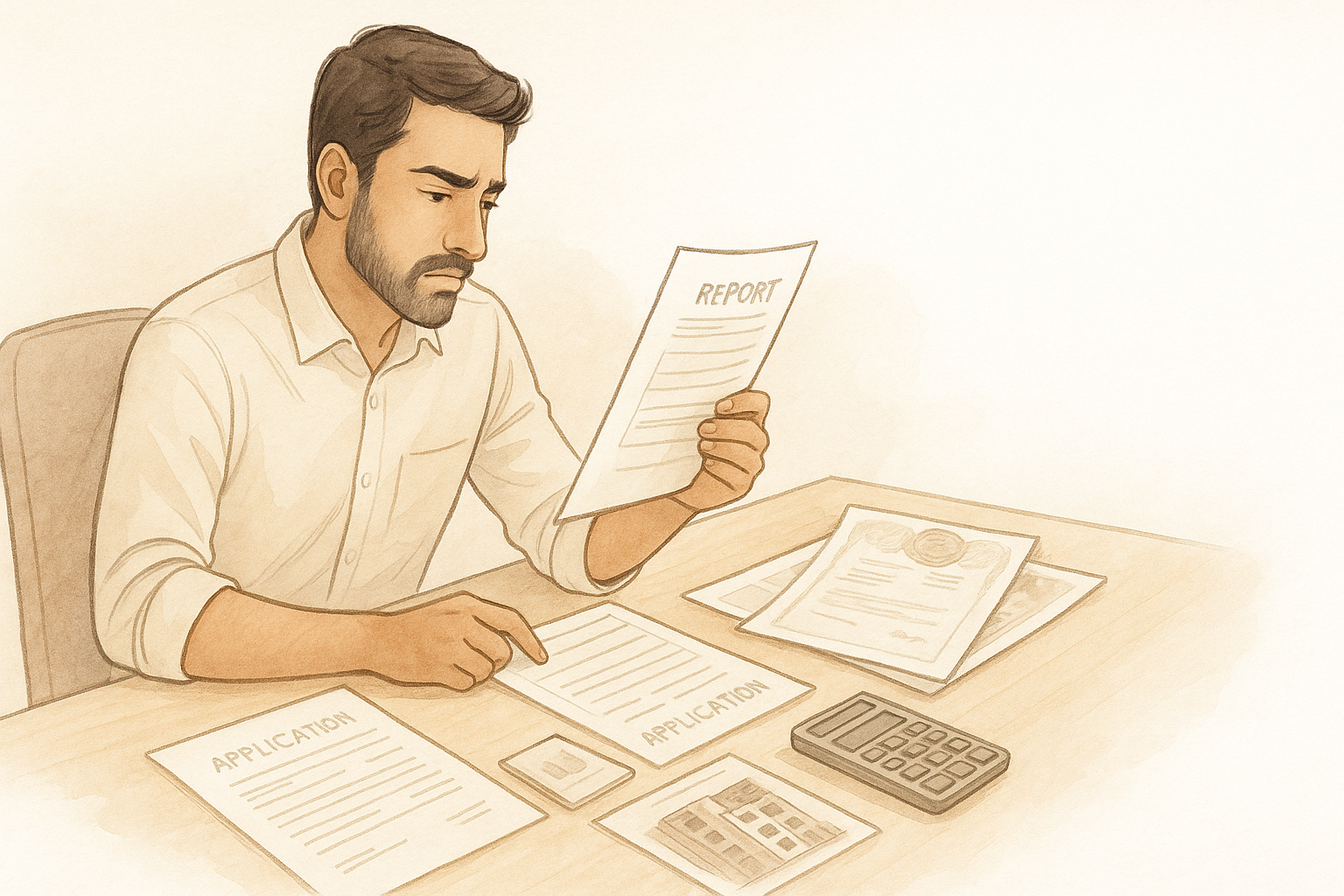
A home loan rejection can feel confusing, especially when you expected approval based only on your salary or CIBIL score. In India, banks and NBFCs check many factors before approving a home loan: repayment capacity, credit history, property condition, legal title, age, employment stability, existing liabilities, and even the builder or project profile.
The important point is simple: a low credit score is a major reason, but it is not the only reason. Your loan application may be rejected even when your credit score is acceptable, if the property papers are weak, your EMI burden is high, or the bank is not comfortable with the risk.
This guide explains the most common loan rejection risks in India and what you can do before applying for a home loan, balance transfer, loan against property, or any major secured loan.
Credit Score and Repayment History
Your credit score, usually called CIBIL score in India, is one of the first things lenders check. It is a three-digit number that generally ranges from 300 to 900. A higher score shows stronger repayment behaviour, while a lower score signals higher risk for the bank.
Most lenders prefer a score of 750 or above for smoother home loan approval. If your score is low, the bank may reject the loan, offer a lower loan amount, ask for a guarantor, demand additional collateral, or charge a higher interest rate. Even small missed payments on credit cards, personal loans, two-wheeler loans, or buy-now-pay-later accounts can affect your profile.
Sometimes, the problem may not be your fault. Credit reports can contain errors such as wrongly reported overdue amounts, closed loans still showing active, or another person’s loan appearing due to data mismatch. Before applying, download your credit report from CIBIL, Experian, Equifax, or CRIF High Mark and verify every loan entry.
Property Condition and Legal Acceptability
For home loans, the property is not just the asset you want to buy; it is also the bank’s security. This is why lenders conduct both technical and legal checks before disbursing the loan. If the property fails these checks, the borrower’s application can be rejected even if income and credit score are strong.
There is a common myth that banks do not finance old buildings. That is not fully correct. Banks can finance resale flats and old houses in cities like Mumbai, Pune, Delhi NCR, Bengaluru, Chennai, Hyderabad, and Kolkata, but they examine the remaining life and physical condition of the structure. If the valuer reports weak construction, major seepage, structural risk, illegal extensions, or very limited remaining life, the loan may be declined or the sanctioned amount may be reduced.
Legal issues are equally important. Missing title chain, unregistered sale agreements, unclear ownership, family disputes, pending litigation, unapproved layouts, and properties built without required permissions can all create loan rejection risks. In apartments, banks may also check occupancy certificate, completion certificate, approved building plan, RERA registration where applicable, society NOC, and builder approvals.
Incomplete or Mismatched Documentation
Incomplete documentation is one of the most preventable home loan rejection reasons in India. Every lender has a document list, and applications often get delayed or rejected because the submitted papers do not match the borrower’s income, identity, property details, or bank statement trail.
For salaried applicants, banks commonly ask for PAN, Aadhaar, address proof, salary slips, Form 16, ITR, bank statements, employment proof, and existing loan statements. For self-employed applicants, lenders may ask for ITRs, GST returns, balance sheet, profit and loss statement, current account statements, business registration proof, and professional certificates where relevant.
Property documents need equal attention. In a resale flat, you may need previous sale deeds, share certificate, society NOC, property tax receipts, electricity bills, sanctioned plan, occupancy certificate, and an encumbrance check. In under-construction projects, the bank may ask for builder-buyer agreement, demand letter, allotment letter, RERA details, approved plan, and land title documents.
Use this basic checklist before submitting your file:
- PAN, Aadhaar, and address details match across records
- Salary credits or business income are visible in bank statements
- Existing EMIs and credit card dues are disclosed
- Property chain documents are complete and readable
- Seller name matches the title documents
- Approved plan, OC/CC, or RERA details are available where applicable
- No unexplained large cash deposits appear in recent bank statements
Banks do not like uncertainty. If your documents create doubt, the lender may ask for clarification. If the issue remains unresolved, the application may be rejected.
Age, Loan Tenure, and Repayment Capacity
Age plays a direct role in home loan eligibility. Most lenders offer home loans to applicants above 18 or 21 years, and the maximum repayment age is usually around 60 to 65 years for salaried borrowers and up to 65 or 70 years for some self-employed borrowers, depending on the lender’s policy.
The closer you are to retirement, the shorter your available loan tenure becomes. A 30-year-old salaried person may get a tenure of 25 to 30 years, but a 56-year-old applicant may be eligible for only a few years of repayment period. Shorter tenure means higher EMI, and a higher EMI may reduce eligibility or lead to rejection.
For example, if two applicants want a ₹50 lakh home loan, the younger applicant may manage the EMI over 25 years, while the older applicant may need to repay within 5 to 8 years. The bank will check whether that EMI is practical after considering salary, pension prospects, existing loans, household expenses, and dependents.
There are ways to improve chances. You can add a younger earning co-applicant, increase the down payment, choose a lower loan amount, close smaller existing loans, or show stable post-retirement income if acceptable to the lender. However, avoid stretching the EMI beyond your actual comfort only to obtain approval.
Employment Stability, Income Quality, and Employer Profile
Lenders prefer predictable income. A borrower who changes jobs very frequently, has unexplained career gaps, or recently moved to a new company may be treated as higher risk. This does not mean job changes are always negative, but too many changes in a short period can raise questions.
For salaried borrowers, banks examine company profile, salary mode, probation status, employment continuity, and monthly salary credits. Working with a well-known private company, government department, PSU, bank, listed company, or reputed MNC can improve comfort. On the other hand, cash salary, delayed salary credits, unstable start-ups, or unverified employers can create loan rejection risks.
For self-employed borrowers, the focus shifts to business stability and documented income. Banks typically prefer at least two to three years of ITRs and consistent bank transactions. If your business income is good but mostly in cash or not reflected in tax returns, your actual repayment capacity may not be recognised by the lender.
- Keep salary or business income routed through bank accounts.
- File ITRs regularly and avoid under-reporting income.
- Maintain clean current account and savings account statements.
- Avoid frequent job changes immediately before applying.
- If you are on probation, wait for confirmation if possible.
- Keep appointment letters, increment letters, and relieving letters ready.
Income is not judged only by amount. It is judged by stability, proof, continuity, and lender confidence.
Existing Liabilities, Profession Risk, and Loan Amount
Your existing debt burden is another major reason for loan rejection. Banks calculate how much of your monthly income is already going toward EMIs and other fixed obligations. This is often referred to as FOIR, or Fixed Obligation to Income Ratio.
If your total EMIs are too high compared with your income, the lender may refuse a fresh loan. Many banks become cautious when obligations cross around 50% of net monthly income, though the acceptable level varies by income slab, lender policy, and borrower profile. Credit card outstanding, personal loans, car loans, education loans, and business loans can all affect eligibility.
The requested loan amount also matters. In home loans, lenders usually finance a percentage of the property value, not the full price. For many properties, the loan-to-value ratio may be up to 75% to 90%, depending on loan size and policy. You must arrange the margin money, stamp duty, registration charges, brokerage, GST where applicable, interiors, and shifting costs separately.
Some professions may face additional scrutiny depending on the lender’s internal risk policy. This does not mean that lawyers, police personnel, journalists, small contractors, commission agents, or freelancers cannot get loans. It means some banks may ask for stronger documentation, a co-applicant, guarantor, additional security, or clearer income proof.
How to Reduce Loan Rejection Risks Before Applying
The best way to avoid rejection is to prepare before submitting your application. Every loan enquiry may appear in your credit report, and multiple rejected applications within a short time can make future lenders more cautious. Instead of applying randomly to many banks, first check your eligibility and property acceptability.
Start with your own profile. Estimate your EMI capacity, review your credit score, collect income documents, and list all existing liabilities. Then review the property. For a resale flat, verify title chain, society records, property tax, utility bills, and approved plans. For a builder project, check RERA registration, lender approvals, construction stage, payment schedule, and possession timeline.
If one bank rejects your file, do not immediately apply to five more lenders without understanding the likely issue. Ask the bank representative for broad feedback, even if they do not give a formal written reason. A rejection due to credit score needs a different solution from a rejection due to property title or income mismatch.
- Check your credit report and correct errors early.
- Avoid missed EMIs and credit card delays for at least six months.
- Keep bank statements clean and explain large deposits.
- Choose a property with clear legal and technical approvals.
- Keep all KYC, income, and property documents ready.
- Add a strong co-applicant if your income or age is a concern.
- Reduce existing liabilities before requesting a high loan amount.
- Apply through a lender that is comfortable with your employer, profession, property type, and city.
Also compare bank and NBFC policies. A nationalised bank may be strict on documentation but offer lower rates. A private bank may process faster but apply sharper eligibility filters. An NBFC may be flexible in some cases but may charge a higher interest rate. Choose based on your actual profile, not only the advertised rate.