Building a House
Legal & FinanceEssential
Legal Mistakes Home Buyers Make
A practical India-focused guide to avoid costly errors before booking a flat, villa, plot, or second home
7 minutes read· Last updated 28 Apr 2026
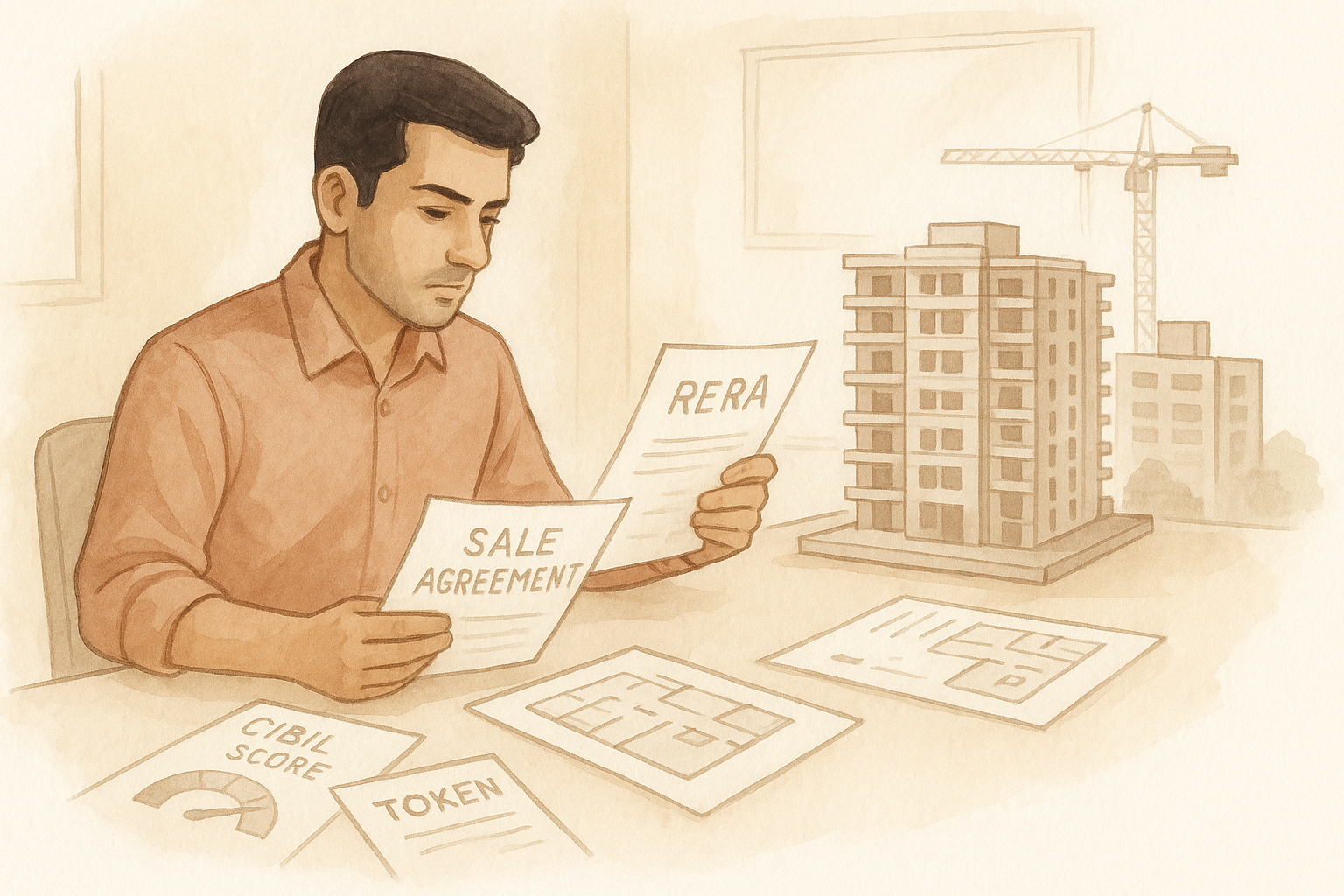
Buying a home is usually the biggest financial decision for an Indian family. A wrong step can block lakhs of rupees in token money, delay possession, increase loan pressure, or even create legal disputes that take years to resolve.
Most mistakes happen before the buyer signs the agreement. The problem is not always fraud; it is often poor preparation. Buyers visit sites without research, trust verbal promises, ignore loan eligibility, and forget to verify documents such as RERA registration, title, approvals, commencement certificate, occupancy certificate, and possession terms.
Why Legal Preparation Matters Before a Site Visit
A site visit is not just a tour of a sample flat. It is the first stage of legal and financial due diligence. If you reach a project with zero information, the sales team controls the conversation, and you may accept claims about possession date, carpet area, amenities, pricing, or approvals without cross-checking them.
Before visiting a project in Mumbai, Pune, Bengaluru, Hyderabad, Noida, Gurugram, Chennai, Ahmedabad, or any Tier-2 city, study the location, builder background, RERA details, nearby infrastructure, and recent market rates. This helps you ask sharper questions and identify exaggeration.
For example, if a builder says a metro station is “coming soon”, check whether it is an approved project, proposed route, or just a marketing line. If the brochure says “20 minutes from airport”, verify actual travel time during peak traffic. Small checks before the visit can save you from a wrong booking decision.
Mistake 1: Trusting Verbal Promises Instead of Written Records
One of the most common legal mistakes home buyers make is relying on spoken commitments. Sales executives may mention flexible payment plans, free parking, assured rent, clubhouse access, road widening, or early possession. Unless these points are written in the allotment letter, agreement for sale, cost sheet, or registered document, they are difficult to enforce later.
In India, a brochure or WhatsApp message may help as supporting evidence, but the main protection comes from signed documents. Always ask for a written cost sheet and confirm whether the amount includes GST, stamp duty, registration, floor rise, PLC, club membership, maintenance deposit, corpus fund, legal charges, parking charges, and electricity or water connection charges.
This is especially important in under-construction projects. The agreement must clearly mention carpet area, possession date, delay compensation, cancellation clause, payment schedule, defect liability, and specifications. Under RERA, many of these disclosures are required, but buyers still need to read the document carefully before paying a large amount.
Mistake 2: Ignoring CIBIL Score and Home Loan Eligibility
Many buyers shortlist a ₹70 lakh or ₹1 crore property without checking whether they can actually get the required loan. This creates a serious risk. If you pay token money and later the bank approves a smaller loan, you may be forced to arrange a large shortfall quickly or cancel the booking.
Before finalising a property, check your CIBIL score, monthly income, existing EMIs, credit card dues, and loan eligibility. Most lenders prefer a strong repayment record and stable income. A low CIBIL score, high debt burden, irregular bank statements, or weak business documentation can reduce your home loan approval amount.
Also remember that banks usually do not fund the entire property cost. In many cases, buyers must arrange margin money, stamp duty, registration, GST, brokerage, interiors, moving expenses, and initial maintenance separately. A buyer who only calculates EMI on the base price often faces a cash crunch at the agreement stage.
- Check your CIBIL score before property search.
- Get a rough loan eligibility estimate from two or three banks or housing finance companies.
- Calculate down payment and extra charges separately.
- Keep emergency funds for at least six months of EMI.
- Avoid taking new personal loans or large credit card debt before home loan sanction.
Mistake 3: Looking for Homes Before Getting Loan Pre-Approval
Loan pre-approval gives you a realistic purchase budget. Without it, you may fall in love with a flat that is beyond your borrowing capacity. This is emotionally frustrating and financially risky, especially when the family has already approved the property and the builder is pushing for quick payment.
A pre-approved home loan is not a final sanction, but it gives a useful estimate based on your income, age, credit history, employer or business profile, and existing liabilities. It also helps you negotiate better because you know your upper limit. If your pre-approved limit is ₹45 lakh, searching only within the ₹55 lakh to ₹60 lakh all-inclusive range is safer than visiting ₹80 lakh projects.
For salaried buyers, banks generally review salary slips, Form 16, bank statements, and existing EMIs. For self-employed buyers, they may review ITRs, GST returns, profit and loss statements, balance sheets, and business bank accounts. If documents are weak, fix the issue before booking a home.
Mistake 4: Overstretching Budget and Buying Too Many Properties
Some buyers treat real estate as a status decision. They want a bigger flat, better tower, higher floor, second home, farmhouse, or investment property without checking long-term affordability. Overborrowing can turn a good asset into a source of stress.
A practical rule is to keep total EMIs at a comfortable level compared to monthly income. The exact limit depends on family expenses, children’s education, medical needs, business stability, and job security. A household in Bengaluru paying school fees and rent may have a different comfort level from a family in Indore with lower fixed expenses.
The same caution applies to second homes and investment properties. A holiday home near Lonavala, Alibaug, Goa, Coorg, or a plot near a future highway may look attractive, but maintenance, travel, property tax, security, association charges, and resale liquidity must be considered. Buy only when the holding cost is manageable even if rental income does not come as expected.
Mistake 5: Not Verifying RERA, Title, and Approvals
Legal due diligence is the backbone of safe property buying. For under-construction projects, check whether the project is registered on the relevant state RERA portal, such as MahaRERA, UP RERA, Karnataka RERA, Telangana RERA, Gujarat RERA, or HRERA. The RERA page can show promoter details, approved plans, completion timeline, complaints, and uploaded documents.
For resale homes, verify title chain, sale deed, encumbrance certificate, property tax receipts, society NOC if applicable, electricity and water dues, and whether the seller has an outstanding home loan. In apartments, confirm whether the building has occupancy certificate or completion certificate. In plotted developments, check land conversion, layout approval, access road, zoning, and mutation records.
Do not assume that bank approval alone means the property is fully safe. Banks perform checks mainly to protect their loan, not to replace your legal due diligence. Hire an independent property lawyer, especially for resale flats, old buildings, joint development projects, inherited properties, plots, gram panchayat layouts, and builder-buyer agreements.
- RERA registration number verified on official portal
- Builder name and project name match the documents
- Title documents reviewed by an independent lawyer
- Approved building plan checked
- Commencement certificate checked for under-construction project
- Occupancy certificate or completion certificate checked for ready property
- Encumbrance certificate reviewed for loans or claims
- Property tax, utility dues, and society dues checked
- Agreement for sale reviewed before signing
- Possession date and delay compensation confirmed in writing
Mistake 6: Skipping Proper Site Inspection and Document Questions
A proper site visit should answer both physical and legal questions. Do not only look at the sample flat, lobby, view, or clubhouse model. Inspect approach road, drainage, nearby high-tension lines, railway tracks, dumping grounds, noise sources, water supply, parking access, lift quality, fire safety provisions, and actual construction progress.
Ask specific questions and note the answers. When will possession be given? What happens if it is delayed? Is parking open, covered, mechanical, or separately allotted? What is the carpet area as per RERA? Which amenities are phase-wise and which are part of your tower? Are there separate charges for clubhouse, corpus, advance maintenance, gas pipeline, power backup, or legal documentation?
For resale flats, visit at different times of the day. Check seepage, ventilation, sunlight, water pressure, lift maintenance, society disputes, parking allocation, and pending repair work. Speak to neighbours or the society office if possible. A flat that looks good during a 20-minute visit may reveal problems during monsoon or peak-hour usage.
Home Buyer Action Plan Before Paying Booking Amount
The safest approach is to move step by step. First decide your purpose: self-use, rental income, capital appreciation, second home, or retirement home. Then define your location, budget, size, possession preference, loan eligibility, and legal comfort level. This prevents random site visits and emotional decisions.
After shortlisting, compare at least three to five properties in the same micro-market. For example, compare projects in Hinjewadi before booking in Pune, compare sectors in Noida Extension, compare Whitefield and Sarjapur Road in Bengaluru, or compare New Town and Rajarhat in Kolkata. This gives you a realistic view of price, connectivity, builder quality, and resale potential.
- Fix your all-inclusive budget.
- Check CIBIL score and home loan eligibility.
- Get loan pre-approval or written eligibility estimate.
- Shortlist locations based on work, school, transport, and resale demand.
- Verify RERA, title, approvals, and possession status.
- Ask for a written cost sheet and draft agreement.
- Get documents reviewed by a lawyer.
- Inspect the actual site, not only the sample flat.
- Read cancellation and refund clauses before paying token money.
- Pay through traceable banking channels and keep receipts.
This action plan is useful for first-time buyers as well as experienced investors. Even if you have bought property before, each state, builder, society, and land parcel can have different legal risks. A cautious process protects your money and gives you better negotiating power.